Solve for T: T*cos(30) + (T-2*0,591*9,81)*cos(30)=0,591*6,1^2 / (1*cos(30))
Solve for T:
T*cos(30) + (T-2*0,591*9,81)*cos(30)=0,591*6,1^2 / (1*cos(30))
Homework Answers

Add Answer to:
Solve for T:
T*cos(30) + (T-2*0,591*9,81)*cos(30)=0,591*6,1^2 /
(1*cos(30))
QUESTION 11 Solve 27sin(t)*cos(t) = -12sin(t) for the smallest non-negative solution QUESTION 12 Solve cos(x) =...
 QUESTION 11 Solve 27sin(t)*cos(t) = -12sin(t) for the smallest non-negative solution QUESTION 12 Solve cos(x) = -2sin(x) for the smallest non-negative solution QUESTION 13 Solve 14sin(t)*cos(t) = -6cos(t), for the smallest non-negative solution, where t is between 0 and 2pi QUESTION 14 Solve sec(4x) - 2 = 0 for the smallest non-negative solution QUESTION 15 Solve cos(x) = 6sin(x) for the smallest non-negative solution
r(t) = 10 sin(300t + 60°) cos(x - 90) sin(x) v(t) 10 cos(300t- 30°) ω =...
 r(t) = 10 sin(300t + 60°) cos(x - 90) sin(x) v(t) 10 cos(300t- 30°) ω = 300, Mag = 10, θ =-30° v 102-30 MLP Mcos(P) +jMsin(P) v = 10 cos(-30) +j10 sin(-30) Step 1: Convert to Cosine Step 2: Identify Frequency, Magnitude, and Phase Step 3: Convert to real/imag form = 8.66-J5 Step 4: Solve Step 5: Convert Back
(1 point) Solve y" + 2y + 2y = 4te-t cos(t). 1) Solve the homogeneous part:...
 (1 point) Solve y" + 2y + 2y = 4te-t cos(t). 1) Solve the homogeneous part: y' + 2y + 2y = 0 for Yh, using a real basis. Note the coded answer is ordered. If your basis is correct and your answer is not accepted, try again with the other ordering. Yn = C1 e^(-t)sin(t) +C2 e^(-t)cos(t) . 2) Compute the particular solution yp via complexifying the differential equation: Note that the forcing e * cos(t) = Re(el 1+i)t)....
Solve for t, 0 < t <2pi 20sin(t)cos(t)=-8sin(t) t= ? Solve Csc(2x)-2=0 for the four smallest...
Solve for t, 0 < t <2pi 20sin(t)cos(t)=-8sin(t) t= ? Solve Csc(2x)-2=0 for the four smallest positive solutions x= Solve 2Cos^2(x)+2cos(x)+1=0 for all solutions 0<x <2pi x= Solve 2sin^2(x)-5sin(x)+2=0 for all solutions 0 <x <2pi x=? Solve sin^2(w)=-5cos(w) for all solutions 0 < w < 2pi w= ? if you could go over the steps of at lease one that would really help me understand and pull apart what I am supposed to do to solve more of these.
Solve for t, 0 <t < 27 16 sin(t)cos(t) = 6 sin(t) t = Solve sec(4x)...
 Solve for t, 0 <t < 27 16 sin(t)cos(t) = 6 sin(t) t = Solve sec(4x) – 2 = 0 for the four smallest positive solutions X=
Solve 2 cos 0 – 1 = 0 for 0° SO < 360° 1 Solve for...
 Solve 2 cos 0 – 1 = 0 for 0° SO < 360° 1 Solve for all degree solutions: sin? 0 + 4sin 0 + 3 = 0 Solve for all degree solutions: sin 30 = 1
(1 point) A. Solve the following initial value problem: dy dt cos (t)-1 with y(6) tan(6). (Find y as a function of t.) (1 point) A. Solve the following initial value problem: dy dt cos (t)-1 wit...
 (1 point) A. Solve the following initial value problem: dy dt cos (t)-1 with y(6) tan(6). (Find y as a function of t.)
(1 point) A. Solve the following initial value problem: dy dt cos (t)-1 with y(6) tan(6). (Find y as a function of t.)
(1 point) A. Solve the following initial value problem: dy dt cos (t)-1 with y(6) tan(6). (Find y as a function of t.)
(1 point) Solve y" + 2y' + 2y = 4te* cos(t). 1) Solve the homogeneous part:...
 (1 point) Solve y" + 2y' + 2y = 4te* cos(t). 1) Solve the homogeneous part: y" + 2y' + 2y = 0 for Yh, using a real basis. Note the coded answer is ordered. If your basis is correct and your answer is not accepted, try again with the other ordering. Yn = C1 te^(-+)*cost +C2 te^(-t)*cost 2) Compute the particular solution y, via complexifying the differential equation: Note that the forcing et cos(t) = Re(el-1+i)t). You will solve...
Solve the equation on the intervalo cos What are the solutions to cos t in the...
 Solve the equation on the intervalo cos What are the solutions to cos t in the intervalose<2x? Select the correct choice and in any anwwer boxes in your choice below. OA The solution is (Simplify your answer. Type an exact answer, using as needed. Use integers or tractions for any numbers in the expression. Use a comma to separate answers as needed.) There is no solution
solve using Taylor series Prove that if COS Z t /2, when z z2 (T/2)2 f(2)...
 solve using Taylor series
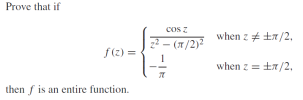
Prove that if COS Z t /2, when z z2 (T/2)2 f(2) when z /2, then f is an entire function
solve using Taylor series
Prove that if COS Z t /2, when z z2 (T/2)2 f(2) when z /2, then f is an entire function
 QUESTION 11 Solve 27sin(t)*cos(t) = -12sin(t) for the smallest non-negative solution QUESTION 12 Solve cos(x) = -2sin(x) for the smallest non-negative solution QUESTION 13 Solve 14sin(t)*cos(t) = -6cos(t), for the smallest non-negative solution, where t is between 0 and 2pi QUESTION 14 Solve sec(4x) - 2 = 0 for the smallest non-negative solution QUESTION 15 Solve cos(x) = 6sin(x) for the smallest non-negative solution
 r(t) = 10 sin(300t + 60°) cos(x - 90) sin(x) v(t) 10 cos(300t- 30°) ω = 300, Mag = 10, θ =-30° v 102-30 MLP Mcos(P) +jMsin(P) v = 10 cos(-30) +j10 sin(-30) Step 1: Convert to Cosine Step 2: Identify Frequency, Magnitude, and Phase Step 3: Convert to real/imag form = 8.66-J5 Step 4: Solve Step 5: Convert Back
 (1 point) Solve y" + 2y + 2y = 4te-t cos(t). 1) Solve the homogeneous part: y' + 2y + 2y = 0 for Yh, using a real basis. Note the coded answer is ordered. If your basis is correct and your answer is not accepted, try again with the other ordering. Yn = C1 e^(-t)sin(t) +C2 e^(-t)cos(t) . 2) Compute the particular solution yp via complexifying the differential equation: Note that the forcing e * cos(t) = Re(el 1+i)t)....
 Solve for t, 0 <t < 27 16 sin(t)cos(t) = 6 sin(t) t = Solve sec(4x) – 2 = 0 for the four smallest positive solutions X=
 Solve 2 cos 0 – 1 = 0 for 0° SO < 360° 1 Solve for all degree solutions: sin? 0 + 4sin 0 + 3 = 0 Solve for all degree solutions: sin 30 = 1
 (1 point) A. Solve the following initial value problem: dy dt cos (t)-1 with y(6) tan(6). (Find y as a function of t.)
(1 point) A. Solve the following initial value problem: dy dt cos (t)-1 with y(6) tan(6). (Find y as a function of t.)
(1 point) A. Solve the following initial value problem: dy dt cos (t)-1 with y(6) tan(6). (Find y as a function of t.)
 (1 point) Solve y" + 2y' + 2y = 4te* cos(t). 1) Solve the homogeneous part: y" + 2y' + 2y = 0 for Yh, using a real basis. Note the coded answer is ordered. If your basis is correct and your answer is not accepted, try again with the other ordering. Yn = C1 te^(-+)*cost +C2 te^(-t)*cost 2) Compute the particular solution y, via complexifying the differential equation: Note that the forcing et cos(t) = Re(el-1+i)t). You will solve...
 Solve the equation on the intervalo cos What are the solutions to cos t in the intervalose<2x? Select the correct choice and in any anwwer boxes in your choice below. OA The solution is (Simplify your answer. Type an exact answer, using as needed. Use integers or tractions for any numbers in the expression. Use a comma to separate answers as needed.) There is no solution
 solve using Taylor series
Prove that if COS Z t /2, when z z2 (T/2)2 f(2) when z /2, then f is an entire function
solve using Taylor series
Prove that if COS Z t /2, when z z2 (T/2)2 f(2) when z /2, then f is an entire function
Most questions answered within 3 hours.
-
Where is the error in this code sequence?
String s1 = "Hello";
String s2 = "ello";...
asked 11 months ago -
Financial data for Joel de Paris, Inc., for last year
follow:
Joel de Paris, Inc.
Balance...
asked 11 months ago -
Consider this reaction:
Al2(SO4)3 (aq)+ BaCl3
(aq) Al2Cl6 (aq)- +
3BaSO4(s) . What is the...
asked 11 months ago -
Suppose that Savneet is considering increasing her
recent random sample from 20 car rentals to 40...
asked 11 months ago -
Trucks arrive at an unloading terminal at an average rate of 120
per hour.
Trucks arrive...
asked 11 months ago -
Why are methanol and ethanol completely soluble in water while
octanol is not very little soluble....
asked 11 months ago -
A facilities manager at a university reads in a research report
that the mean amount of...
asked 11 months ago -
When the CuSO4 is rehydrated by adding water to the anhydrous
compound, is this an endothermic...
asked 11 months ago -
A ray of sunlight is passing from diamond into crown glass; the
angle of incidence is...
asked 11 months ago -
A block of mass 0.249 kg is placed on top of a light, vertical
spring of...
asked 11 months ago -
how do the kidneys compensate in the presences of acidosis
a) trigger hyperventilate
b) reserve acid...
asked 11 months ago -
Question 501 pts
The rental rate of capital to the firm increases. Which of the
following...
asked 11 months ago