Assume that the reaction represented by the equation A → products is second order in A...
Assume that the reaction represented by the equation A → products is second order in A with a rate constant of 8.5×10⁻² M-1·s-1. What is the concentration of A after a reaction time of 5s if the initial concentration of A was 7.0 M? Enter your result in M, without the unit, to a precision of 0.1M.
Homework Answers
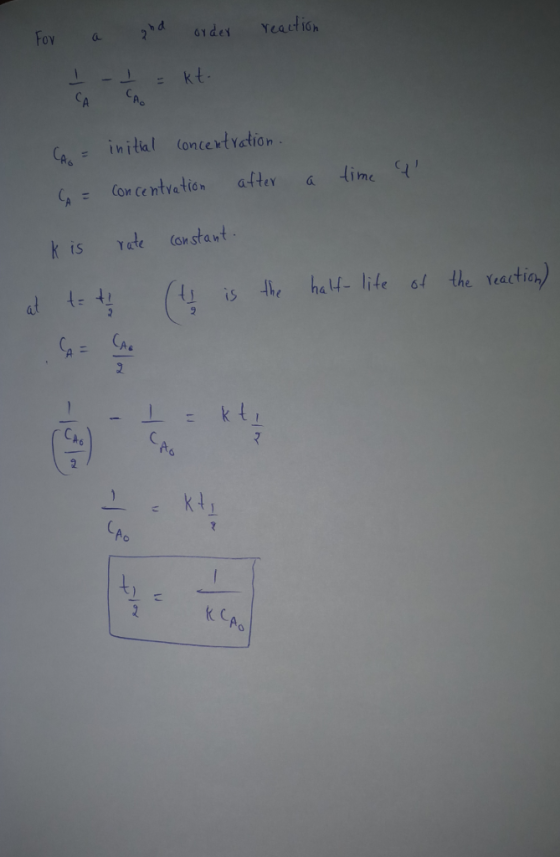
(1/CA)-(1/7M)=8.5*10-2M-1s-1*5s
(1/CA)=(8.5*10-2M-1*5)+(1/7)M-1
(1/CA)=0.56785714286M-1
CA=1.761
Add Answer to:
Assume that the reaction represented by the equation A →
products is second order in A...
Assume that the reaction represented by the equation A → products is first order in A,...
Assume that the reaction represented by the equation A → products is first order in A, with a rate constant of k = 1.246×10⁻³ s-1. If the initial concentration of A is {y} M, how much time does it take for the concentration to drop to 30% of the initial value? Enter your result in seconds, without the unit, to a precision of 0.1 seconds.
3. The thermal decomposition of A, 2A + products is a second-order reaction. Given that the...
 3. The thermal decomposition of A, 2A + products is a second-order reaction. Given that the initial concentration of A is = 2.45 x 10⁻³ M and the intial rate of reaction is 2.05x10⁻⁶ M s-1, calculate the rate constant. Also calculate the rate of reaction after 90% of A has reacted.
1. The second-order rate constant for self-reaction of hydroxyl radicals 2 OH → H2O + O...
1. The second-order rate constant for self-reaction of hydroxyl radicals 2 OH → H2O + O has the value 1.0786E9 M-1·s-1 at 360.0 K. Compute the half-life of OH radicals at this temperature if the initial concentration is 6.74E-6 M. 3. Calculate the initial rate of a first-order reaction if the concentration of reactant is 0.37 M and the half-life is 4.48 s. Enter the correct numerical value to 2.0% precision. Express scientific notation like 4.29E-15 M·s-1 4. Cyano...
(b) A reaction follows second-order kinetics with a rate constant 7.0 10M'sat 25°C, If the initial...
 (b) A reaction follows second-order kinetics with a rate constant 7.0 10M'sat 25°C, If the initial concentration is 0.86 M, calculate the concentration after 120 s
[time] [Z] 4. Suppose the data shown are for the second order reaction: → products. What...
 [time] [Z] 4. Suppose the data shown are for the second order reaction: → products. What is the value of the rate constant k? O min 50.000 atm 6.250 3.333 2.273. 5. For a first order reaction (G - products) with k = 0.173 min', suppose a chemist runs the reaction starting with an initial concentration [G]. = 12.0 M. a. How many minutes will it take for [G] to decrease to 4.70 M? b. What [G] will remain after...
2. The reaction A → products was found to be second order order and have a...
 2. The reaction A → products was found to be second order order and have a rate constant, k, of 0.681 M-1 5-1. If the initial concentration of the reaction was 0.885 M, what is the half life for the reaction? 10.2 Submit Answer Incorrect. Tries 5/45 Previous Tries
I need help with both questions!!!! 3. Consider the second order reaction A → products. The...
 I
need help with both questions!!!!
3. Consider the second order reaction A → products. The rate constant for the reaction at 25 deg C is 0.350 M's? If the initial concentration of A is 0.800 M, what is the concentration after 4 seconds? a) .165 M b) .197 M c) .377 M d) .400 M e) .454 M 4. A student records the concentration of 12 as a function of time and prepares the graphs shown below. What can...
I
need help with both questions!!!!
3. Consider the second order reaction A → products. The rate constant for the reaction at 25 deg C is 0.350 M's? If the initial concentration of A is 0.800 M, what is the concentration after 4 seconds? a) .165 M b) .197 M c) .377 M d) .400 M e) .454 M 4. A student records the concentration of 12 as a function of time and prepares the graphs shown below. What can...
The reaction A --> Products is second order with a rate constant of 0.2500 L mol-1...
The reaction A --> Products is second order with a rate constant of 0.2500 L mol-1 s-1. If we start with a 1.000 M concentration of A, what is the rate of the reaction (in mol L-1 s-1) after 20 s? Your answer should be rounded up to four decimal places.
1. A reaction is second order in[A] and second-order in [B]: Rate,=K[A]^2[B]^2. what are the units...
1. A reaction is second order in[A] and second-order in [B]: Rate,=K[A]^2[B]^2. what are the units of k for this reaction? If the concentration of air decreases by a factor of 2 and the concentration of b increases by a factor of 5 what happens to the rate? 2. for the forward reaction 2NO+Cl2=>2NOCl. determine the rate(m/s)for experiment #4 given [NO]°(M)=0.40M and [Cl2]°z(M)=0?20M. Rate? 3.The following data were collected over time for the forward reaction 2NO2=>2NO+O2 ( 1/[NO2]=100 at 0...
A certain second-order reaction (B→products) has a rate constant of 1.20×10⁻³ M−1⋅s−1 at 27 ∘C and...
A certain second-order reaction (B→products) has a rate constant of 1.20×10⁻³ M−1⋅s−1 at 27 ∘C and an initial half-life of 260 s . What is the concentration of the reactant B after one half-life?
 3. The thermal decomposition of A, 2A + products is a second-order reaction. Given that the initial concentration of A is = 2.45 x 10⁻³ M and the intial rate of reaction is 2.05x10⁻⁶ M s-1, calculate the rate constant. Also calculate the rate of reaction after 90% of A has reacted.
 (b) A reaction follows second-order kinetics with a rate constant 7.0 10M'sat 25°C, If the initial concentration is 0.86 M, calculate the concentration after 120 s
 [time] [Z] 4. Suppose the data shown are for the second order reaction: → products. What is the value of the rate constant k? O min 50.000 atm 6.250 3.333 2.273. 5. For a first order reaction (G - products) with k = 0.173 min', suppose a chemist runs the reaction starting with an initial concentration [G]. = 12.0 M. a. How many minutes will it take for [G] to decrease to 4.70 M? b. What [G] will remain after...
 2. The reaction A → products was found to be second order order and have a rate constant, k, of 0.681 M-1 5-1. If the initial concentration of the reaction was 0.885 M, what is the half life for the reaction? 10.2 Submit Answer Incorrect. Tries 5/45 Previous Tries
 I
need help with both questions!!!!
3. Consider the second order reaction A → products. The rate constant for the reaction at 25 deg C is 0.350 M's? If the initial concentration of A is 0.800 M, what is the concentration after 4 seconds? a) .165 M b) .197 M c) .377 M d) .400 M e) .454 M 4. A student records the concentration of 12 as a function of time and prepares the graphs shown below. What can...
I
need help with both questions!!!!
3. Consider the second order reaction A → products. The rate constant for the reaction at 25 deg C is 0.350 M's? If the initial concentration of A is 0.800 M, what is the concentration after 4 seconds? a) .165 M b) .197 M c) .377 M d) .400 M e) .454 M 4. A student records the concentration of 12 as a function of time and prepares the graphs shown below. What can...
Most questions answered within 3 hours.
-
Where is the error in this code sequence?
String s1 = "Hello";
String s2 = "ello";...
asked 10 months ago -
Financial data for Joel de Paris, Inc., for last year
follow:
Joel de Paris, Inc.
Balance...
asked 10 months ago -
Consider this reaction:
Al2(SO4)3 (aq)+ BaCl3
(aq) Al2Cl6 (aq)- +
3BaSO4(s) . What is the...
asked 10 months ago -
Suppose that Savneet is considering increasing her
recent random sample from 20 car rentals to 40...
asked 10 months ago -
Trucks arrive at an unloading terminal at an average rate of 120
per hour.
Trucks arrive...
asked 10 months ago -
Why are methanol and ethanol completely soluble in water while
octanol is not very little soluble....
asked 10 months ago -
A facilities manager at a university reads in a research report
that the mean amount of...
asked 10 months ago -
When the CuSO4 is rehydrated by adding water to the anhydrous
compound, is this an endothermic...
asked 10 months ago -
A ray of sunlight is passing from diamond into crown glass; the
angle of incidence is...
asked 10 months ago -
A block of mass 0.249 kg is placed on top of a light, vertical
spring of...
asked 10 months ago -
how do the kidneys compensate in the presences of acidosis
a) trigger hyperventilate
b) reserve acid...
asked 10 months ago -
Question 501 pts
The rental rate of capital to the firm increases. Which of the
following...
asked 10 months ago