In a CO2 transcritical compression refrigeration cycle the evaporating temperature is -10ºC and the outlet gas...
In a CO2 transcritical compression refrigeration cycle the evaporating temperature is -10ºC and the outlet gas cooler temperature is 31oC at a pressure of 78 bar. If the isentropic efficiency of the compressor is 80% and the temperature of the vapour at the entrance of the compressor is 0oC, calculate the refrigerating effect and the COP of the cycle. If the expansion device is replaced by a turbine with an isentropic efficiency of 80%, calculate the new values of the refrigerating effect and the COP for the net power input.
Homework Answers
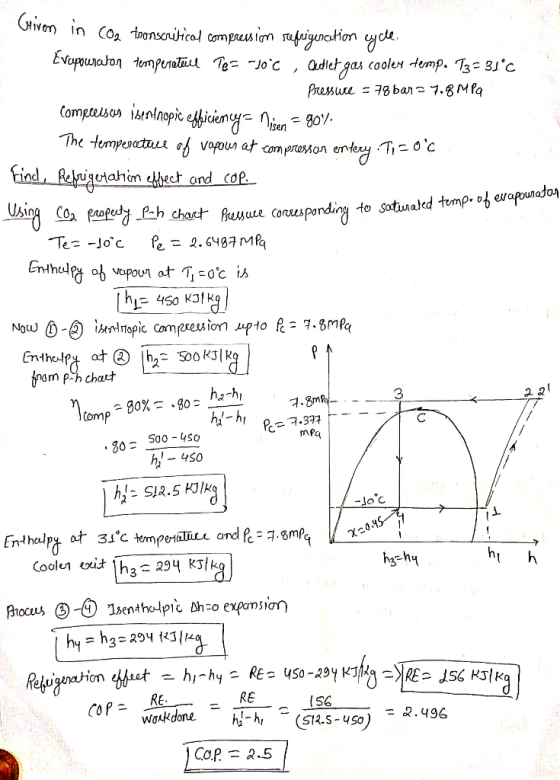
In Co2 transcritical compression refrigeration cycle Co2 is used as refrigerant when it is compressed above it's critical point it does not condensed in to gas cooler that is why this cycle is known as transcritical cycle.
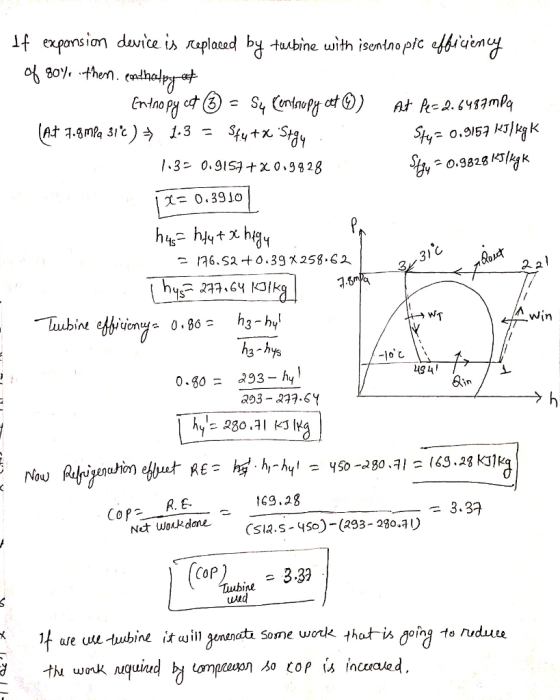
in this question we have to find the refrigeration effect and COP of cycle when expansion takes place in expansion device and when expansion occurs in turbine.
I have taken data directly from Co2 properties P-h chart so values is approximated using interpolation.
Add Answer to:
In a CO2 transcritical compression refrigeration cycle the
evaporating temperature is -10ºC and the outlet gas...
A standard vapour compression refrigeration cycle operates between pressures of 220 kPa and 1000 ...
 A standard vapour compression refrigeration cycle operates
between pressures of 220 kPa and 1000 kPa, with a compressor having
an isentropic efficiency of 92.0%. It has a mass flow rate of
0.71kg/s. Evaluate the enthalpy for each of the states in the
cycle: Property State 1 2a 3 4 h kJ/kg Calculate the actual power
consumed by the compressor: W˙compressor= kW Calculate the CoP of
the cycle: CoP=
A standard vapour compression refrigeration cycle operates between pressures of 220 kPa...
A standard vapour compression refrigeration cycle operates
between pressures of 220 kPa and 1000 kPa, with a compressor having
an isentropic efficiency of 92.0%. It has a mass flow rate of
0.71kg/s. Evaluate the enthalpy for each of the states in the
cycle: Property State 1 2a 3 4 h kJ/kg Calculate the actual power
consumed by the compressor: W˙compressor= kW Calculate the CoP of
the cycle: CoP=
A standard vapour compression refrigeration cycle operates between pressures of 220 kPa...
Please help with HW 37 Qoutl condenser Condenser A standard 4-component vapor-compression cycle using R-134a is...
 Please help with HW 37
Qoutl condenser Condenser A standard 4-component vapor-compression cycle using R-134a is shown in the figure to the right. The cycle is used as a refrigeration cycle to cool a refrigerator at 5 °C with a cooling capacity of 200 W, with a heat transfer to a kitchen at 20 °C. Assume that the pressure drops in the evaporator and condenser are negligible, and that the compressor and expansion valve are adiabatic. Take the boundary temperature...
Please help with HW 37
Qoutl condenser Condenser A standard 4-component vapor-compression cycle using R-134a is shown in the figure to the right. The cycle is used as a refrigeration cycle to cool a refrigerator at 5 °C with a cooling capacity of 200 W, with a heat transfer to a kitchen at 20 °C. Assume that the pressure drops in the evaporator and condenser are negligible, and that the compressor and expansion valve are adiabatic. Take the boundary temperature...
The refrigerant gas which is air, enters the compressor of a Brayton refrigeration cycle at 101...
The refrigerant gas which is air, enters the compressor of a Brayton refrigeration cycle at 101 kPa, 280 K. If the compressor pressure ratio is 5 and the turbine inlet temperature is 330 K. The compressor has an isentropic efficiency of 70% and the turbine has an isentropic efficiency of 80%. Using air table rather than constant-specific-heat theory, determine (a) the net work input per unit mass of air flow, (b) the refrigeration capacity, in kJ/kg, (c) the coefficient of...
In a vapor-compression refrigeration cycle, ammonia exits the evaporator as saturated vapor at -22 °C. There...
 In a vapor-compression refrigeration cycle, ammonia exits the
evaporator as saturated vapor at -22 °C. There are
irreversibilities in the compressor. The refrigerant enters the
condenser at 16 bar and 160 °C, and saturated liquid exits at 16
bar. There is no significant heat transfer between the compressor
and its surroundings, and the refrigerant passes through the
evaporator with a negligible change in pressure.
Calculate the coefficient of performance, b, and the isentropic
compressor efficiency, defined as:
2s Condenser Expansion...
In a vapor-compression refrigeration cycle, ammonia exits the
evaporator as saturated vapor at -22 °C. There are
irreversibilities in the compressor. The refrigerant enters the
condenser at 16 bar and 160 °C, and saturated liquid exits at 16
bar. There is no significant heat transfer between the compressor
and its surroundings, and the refrigerant passes through the
evaporator with a negligible change in pressure.
Calculate the coefficient of performance, b, and the isentropic
compressor efficiency, defined as:
2s Condenser Expansion...
ycles 1. A refrigeration system operates with a superheated cycle using R134a. The required refrigerating capacity...
 ycles 1. A refrigeration system operates with a superheated cycle using R134a. The required refrigerating capacity is 30 TR. The evaporator works at -10 Cand the condenser pressure is 1 MPa. The refrigerant is superheated by 10°C before entering to the compressor. Assume isentropic compression in the compressor and isenthalpic expansion in the expansion valve. Answering the following questions using the ph diagram. and the c Sion in the ring to a) Sketch the process in the p-h diagram and...
Thermodynamics A two-stage vapour-compression refrigeration plant shown in Figure Q2 diagrammatically below is discharged with Refrigerant...
 Thermodynamics
A two-stage vapour-compression refrigeration plant shown in Figure Q2 diagrammatically below is discharged with Refrigerant 12. Both compressors are single-acting, single-stage reciprocating machines with four cylinders and as isentropic efficiency of 80%. They each have a stroke/bore ratio of 1.2 and run at 600 rev/min with a volumetric efficiency of 90%. The condenser, flash chamber and evaporator pressures are 10 bar, 3 bar and 1 bar respectively. Saturation states exist at points 5 and 3 and the vapour at...
Thermodynamics
A two-stage vapour-compression refrigeration plant shown in Figure Q2 diagrammatically below is discharged with Refrigerant 12. Both compressors are single-acting, single-stage reciprocating machines with four cylinders and as isentropic efficiency of 80%. They each have a stroke/bore ratio of 1.2 and run at 600 rev/min with a volumetric efficiency of 90%. The condenser, flash chamber and evaporator pressures are 10 bar, 3 bar and 1 bar respectively. Saturation states exist at points 5 and 3 and the vapour at...
Click Submit to complete this assessment. Question 25 In a vapor compression cycle if the refrigeration...
 Click Submit to complete this assessment. Question 25 In a vapor compression cycle if the refrigeration effect is 482 KJ/kg, while energy supplied to the compressor is 119 Kj/kg, the COP of the system is A Click Submit to complete this assessment. MacBook Pro esc & @ % 5 0 6 7 V 8 3 ۳ 2 4 E 1 Moving to another question will save this response. Question 12 15 points A deep freezer uses R134a as refrigerant and...
1. A combined gas-steam power cycle uses a single gas turbine cycle for the air cycle...
 1. A combined gas-steam power cycle uses a single gas turbine
cycle for the air cycle and a simple Rankine cycle for the water
vapor cycle. Atmospheric air enters the compressor at a rate of
88.2 lbm / s, at 14.7 psia and 59 ° F, and the maximum gas cycle
temperature is 1,742 ° F. The pressure ratio in the compressor is
7. The isentropic efficiency of both the compressor and the turbine
is 80%. Gas exits the heat...
1. A combined gas-steam power cycle uses a single gas turbine
cycle for the air cycle and a simple Rankine cycle for the water
vapor cycle. Atmospheric air enters the compressor at a rate of
88.2 lbm / s, at 14.7 psia and 59 ° F, and the maximum gas cycle
temperature is 1,742 ° F. The pressure ratio in the compressor is
7. The isentropic efficiency of both the compressor and the turbine
is 80%. Gas exits the heat...
Problem #1 [30 Points] Vapor Compression Refrigeration Cycle An ideal vapor compression refrigeration system cycle, with...
 Problem #1 [30 Points] Vapor Compression Refrigeration Cycle An ideal vapor compression refrigeration system cycle, with ammonia as the working fluid, has an evaporator temperature of -20°C and a condenser pressure of 12 bar. Saturated vapor enters the compressor, and saturated liquid exits the condenser. The mass flow rate of refrigerant is 3 kg/minute. Determine the coefficient of performance and the refrigerating capacity in tons. Given: Find: T-s Process Diagram: Schematic Assume:
In a simple vapor compression refrigeration cycle: - Ammonia exits the evaporator as saturated· vapor at...
In a simple vapor compression refrigeration cycle: - Ammonia exits the evaporator as saturated· vapor at -22°C (State 1 ) .. - Ammonia enters the condenser at 16 Bar and 160°C (State 2; h2 = 1798.45 kJ/kg) - Ammonia exits the condenser as saturated l1quid at 16 Bar (State 3; h3 = 376.46 kJ/kg) - The refrigeration capacity is 150 kW. Draw the system schematic and the T-s diagram and determine: i) the mass flow rate· of refrigerant, ii) the...
 A standard vapour compression refrigeration cycle operates
between pressures of 220 kPa and 1000 kPa, with a compressor having
an isentropic efficiency of 92.0%. It has a mass flow rate of
0.71kg/s. Evaluate the enthalpy for each of the states in the
cycle: Property State 1 2a 3 4 h kJ/kg Calculate the actual power
consumed by the compressor: W˙compressor= kW Calculate the CoP of
the cycle: CoP=
A standard vapour compression refrigeration cycle operates between pressures of 220 kPa...
A standard vapour compression refrigeration cycle operates
between pressures of 220 kPa and 1000 kPa, with a compressor having
an isentropic efficiency of 92.0%. It has a mass flow rate of
0.71kg/s. Evaluate the enthalpy for each of the states in the
cycle: Property State 1 2a 3 4 h kJ/kg Calculate the actual power
consumed by the compressor: W˙compressor= kW Calculate the CoP of
the cycle: CoP=
A standard vapour compression refrigeration cycle operates between pressures of 220 kPa...
 Please help with HW 37
Qoutl condenser Condenser A standard 4-component vapor-compression cycle using R-134a is shown in the figure to the right. The cycle is used as a refrigeration cycle to cool a refrigerator at 5 °C with a cooling capacity of 200 W, with a heat transfer to a kitchen at 20 °C. Assume that the pressure drops in the evaporator and condenser are negligible, and that the compressor and expansion valve are adiabatic. Take the boundary temperature...
Please help with HW 37
Qoutl condenser Condenser A standard 4-component vapor-compression cycle using R-134a is shown in the figure to the right. The cycle is used as a refrigeration cycle to cool a refrigerator at 5 °C with a cooling capacity of 200 W, with a heat transfer to a kitchen at 20 °C. Assume that the pressure drops in the evaporator and condenser are negligible, and that the compressor and expansion valve are adiabatic. Take the boundary temperature...
 In a vapor-compression refrigeration cycle, ammonia exits the
evaporator as saturated vapor at -22 °C. There are
irreversibilities in the compressor. The refrigerant enters the
condenser at 16 bar and 160 °C, and saturated liquid exits at 16
bar. There is no significant heat transfer between the compressor
and its surroundings, and the refrigerant passes through the
evaporator with a negligible change in pressure.
Calculate the coefficient of performance, b, and the isentropic
compressor efficiency, defined as:
2s Condenser Expansion...
In a vapor-compression refrigeration cycle, ammonia exits the
evaporator as saturated vapor at -22 °C. There are
irreversibilities in the compressor. The refrigerant enters the
condenser at 16 bar and 160 °C, and saturated liquid exits at 16
bar. There is no significant heat transfer between the compressor
and its surroundings, and the refrigerant passes through the
evaporator with a negligible change in pressure.
Calculate the coefficient of performance, b, and the isentropic
compressor efficiency, defined as:
2s Condenser Expansion...
 ycles 1. A refrigeration system operates with a superheated cycle using R134a. The required refrigerating capacity is 30 TR. The evaporator works at -10 Cand the condenser pressure is 1 MPa. The refrigerant is superheated by 10°C before entering to the compressor. Assume isentropic compression in the compressor and isenthalpic expansion in the expansion valve. Answering the following questions using the ph diagram. and the c Sion in the ring to a) Sketch the process in the p-h diagram and...
 Thermodynamics
A two-stage vapour-compression refrigeration plant shown in Figure Q2 diagrammatically below is discharged with Refrigerant 12. Both compressors are single-acting, single-stage reciprocating machines with four cylinders and as isentropic efficiency of 80%. They each have a stroke/bore ratio of 1.2 and run at 600 rev/min with a volumetric efficiency of 90%. The condenser, flash chamber and evaporator pressures are 10 bar, 3 bar and 1 bar respectively. Saturation states exist at points 5 and 3 and the vapour at...
Thermodynamics
A two-stage vapour-compression refrigeration plant shown in Figure Q2 diagrammatically below is discharged with Refrigerant 12. Both compressors are single-acting, single-stage reciprocating machines with four cylinders and as isentropic efficiency of 80%. They each have a stroke/bore ratio of 1.2 and run at 600 rev/min with a volumetric efficiency of 90%. The condenser, flash chamber and evaporator pressures are 10 bar, 3 bar and 1 bar respectively. Saturation states exist at points 5 and 3 and the vapour at...
 Click Submit to complete this assessment. Question 25 In a vapor compression cycle if the refrigeration effect is 482 KJ/kg, while energy supplied to the compressor is 119 Kj/kg, the COP of the system is A Click Submit to complete this assessment. MacBook Pro esc & @ % 5 0 6 7 V 8 3 ۳ 2 4 E 1 Moving to another question will save this response. Question 12 15 points A deep freezer uses R134a as refrigerant and...
 1. A combined gas-steam power cycle uses a single gas turbine
cycle for the air cycle and a simple Rankine cycle for the water
vapor cycle. Atmospheric air enters the compressor at a rate of
88.2 lbm / s, at 14.7 psia and 59 ° F, and the maximum gas cycle
temperature is 1,742 ° F. The pressure ratio in the compressor is
7. The isentropic efficiency of both the compressor and the turbine
is 80%. Gas exits the heat...
1. A combined gas-steam power cycle uses a single gas turbine
cycle for the air cycle and a simple Rankine cycle for the water
vapor cycle. Atmospheric air enters the compressor at a rate of
88.2 lbm / s, at 14.7 psia and 59 ° F, and the maximum gas cycle
temperature is 1,742 ° F. The pressure ratio in the compressor is
7. The isentropic efficiency of both the compressor and the turbine
is 80%. Gas exits the heat...
 Problem #1 [30 Points] Vapor Compression Refrigeration Cycle An ideal vapor compression refrigeration system cycle, with ammonia as the working fluid, has an evaporator temperature of -20°C and a condenser pressure of 12 bar. Saturated vapor enters the compressor, and saturated liquid exits the condenser. The mass flow rate of refrigerant is 3 kg/minute. Determine the coefficient of performance and the refrigerating capacity in tons. Given: Find: T-s Process Diagram: Schematic Assume:
Most questions answered within 3 hours.
-
Where is the error in this code sequence?
String s1 = "Hello";
String s2 = "ello";...
asked 11 months ago -
Financial data for Joel de Paris, Inc., for last year
follow:
Joel de Paris, Inc.
Balance...
asked 11 months ago -
Consider this reaction:
Al2(SO4)3 (aq)+ BaCl3
(aq) Al2Cl6 (aq)- +
3BaSO4(s) . What is the...
asked 11 months ago -
Suppose that Savneet is considering increasing her
recent random sample from 20 car rentals to 40...
asked 11 months ago -
Trucks arrive at an unloading terminal at an average rate of 120
per hour.
Trucks arrive...
asked 11 months ago -
Why are methanol and ethanol completely soluble in water while
octanol is not very little soluble....
asked 11 months ago -
A facilities manager at a university reads in a research report
that the mean amount of...
asked 11 months ago -
When the CuSO4 is rehydrated by adding water to the anhydrous
compound, is this an endothermic...
asked 11 months ago -
A ray of sunlight is passing from diamond into crown glass; the
angle of incidence is...
asked 11 months ago -
A block of mass 0.249 kg is placed on top of a light, vertical
spring of...
asked 11 months ago -
how do the kidneys compensate in the presences of acidosis
a) trigger hyperventilate
b) reserve acid...
asked 11 months ago -
Question 501 pts
The rental rate of capital to the firm increases. Which of the
following...
asked 11 months ago