Consider a 0.30 kg puck tied to a stake in the ice (i.e. ignore friction) with...
Consider a 0.30 kg puck tied to a stake in the ice (i.e. ignore friction) with a string 0.25 m in length. The puck is moving in uniform circular motion and completes a revolution with a period of 0.23 s. What is the tension in the string in Newtons?
Homework Answers
The tension in the string is equal to the centrifugal force
associated with the circular motion. So, if the length of the
string is L, the mass attached at the end of it is m, and the
angular frequency of the circular motion is  , then the
tension in the string is
, then the
tension in the string is

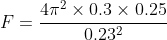
Now re-expressing in terms of the time period T of the circular motion, we get

Where we have used

So, putting the given values,

We get the tension in the string as

Add Answer to:
Consider a 0.30 kg puck tied to a stake in the ice (i.e. ignore
friction) with...
An air puck of mass 0.23 kg is tied to a string and allowed to revolve in a circle of radius 1.2 m on a frictionl...
 An air puck of mass 0.23 kg is tied to a string and allowed to revolve in a circle of radius 1.2 m on a frictionless horizontal table. The other end of the string passes through a hole in the center of the table, and a mass of 0.9 kg is tied to it. The suspended mass remains in equilibrium while the puck on the tabletop revolves. a) What is the tension in the string? (b) What is the force...
A small rock with mass 0.50 kg is tied to the free end of a light...
A small rock with mass 0.50 kg is tied to the free end of a light string that is 8.0 m long. The rock is moving in a horizontal circle and the string makes an angle of 37° with respect to the vertical. a. What is the radius r of the circular path of the rock? b. What is the tension in the string? c. What is the period of the rock’s motion, the time it takes to complete one...
An air puck of mass 0.18 kg is tied to a string and allowed to revolve...
 An air puck of mass 0.18 kg is tied to a string and allowed to revolve in a circle of radius 1.1 m on a frictionless horizontal table. The other end of the string passes through a hole in the center of the table, and a mass of 1.3 kg is tied to it. The suspended mass remains in equilibrium while the puck on the tabletop revolves (a) What is the tension in the string? (6) What is the force...
The coefficient of friction between a 0.17 kg puck and and the ice is μk =...
The coefficient of friction between a 0.17 kg puck and and the ice is μk = 0.15. If the puck leaves a hockey stick traveling at 20 m/s, what is its speed when it reaches the goalie 15 m away? How much time does the goalie have to react? Assume the puck travels on the ice the whole time.
an ice puck of mass m revolves on an icy surface in a circle at speed...
 an
ice puck of mass m revolves on an icy surface in a circle at speed
v at the end of a horizontal string of length L. the tension in the
string is T.
write the equation for centripetal force, and substitute the
values T and L appropriately. then with a bit of elementary
algebra, rearrange the equation so that it solves for mass.
find the mass of the puck when the length of the string is 2.0
m, string...
an
ice puck of mass m revolves on an icy surface in a circle at speed
v at the end of a horizontal string of length L. the tension in the
string is T.
write the equation for centripetal force, and substitute the
values T and L appropriately. then with a bit of elementary
algebra, rearrange the equation so that it solves for mass.
find the mass of the puck when the length of the string is 2.0
m, string...
A puck of mass 0.70 kg approaches a second, identical puck that is stationary on frictionless ice. The initial speed of...
 A puck of mass 0.70 kg approaches a second, identical puck that is stationary on frictionless ice. The initial speed of the moving puck is 5.0 m/s. After the collision, one puck leaves with a speed vi at 30° to the original line of motion. The second puck leaves with speed v2 at 60°. (a) Calculate V1 and v2. Vi = 866025 x Vy = 250011 x m/s m/s (b) Was the collision elastic? Yes No eBook
4. A 0.090 kg puck initially moving at 2.0 m/s stops on ice after sliding 30m....
 4. A 0.090 kg puck initially moving at 2.0 m/s stops on ice after sliding 30m. Find a) the net force on the puck while sliding b) the force due to friction on the puck c) the coefficient of friction between the puck and the ice 5. A force of 6.0 N is applied to a 4.0kg object which results in a constant velocity of 5.5 m/s. a) What is the force of friction? b) Calculate
An object of mass m1 = 4.00 kg is tied to an object of mass m2...
An object of mass m1 = 4.00 kg is tied to an object of mass m2 = 3.40 kg with String 1 of length ℓ = 0.500 m. The combination is swung in a vertical circular path on a second string, String 2, of length ℓ = 0.500 m. During the motion, the two strings are collinear at all times as shown in the figure. At the top of its motion, m2 is traveling at v = 5.30 m/s. Two...
A 0.300 kg potato is tied to a string with length 2.30 m , and the...
A 0.300 kg potato is tied to a string with length 2.30 m , and the other end of the string is tied to a rigid support. The potato is held straight out horizontally from the point of support, with the string pulled taut, and is then released. Part A) What is the speed of the potato at the lowest point of its motion? let g be = 9.80 m/s^2 Part B) What is the tension on the string at...
N3.L2.4-01 A mass of 3.0 kg is tied via a light string to the center of...
 N3.L2.4-01 A mass of 3.0 kg is tied via a light string to the center of a table. A sccond mass of 5.0 kg is tied, also via a light string, to the first mass. Both masses are made to undergo uniform circular motion in the horizontal plane at a rate of 10 revolutions per second. The first mass is 1.2 m from the center of the table and the sccond mass is 2.0 m from the center of the...
 An air puck of mass 0.23 kg is tied to a string and allowed to revolve in a circle of radius 1.2 m on a frictionless horizontal table. The other end of the string passes through a hole in the center of the table, and a mass of 0.9 kg is tied to it. The suspended mass remains in equilibrium while the puck on the tabletop revolves. a) What is the tension in the string? (b) What is the force...
 An air puck of mass 0.18 kg is tied to a string and allowed to revolve in a circle of radius 1.1 m on a frictionless horizontal table. The other end of the string passes through a hole in the center of the table, and a mass of 1.3 kg is tied to it. The suspended mass remains in equilibrium while the puck on the tabletop revolves (a) What is the tension in the string? (6) What is the force...
 an
ice puck of mass m revolves on an icy surface in a circle at speed
v at the end of a horizontal string of length L. the tension in the
string is T.
write the equation for centripetal force, and substitute the
values T and L appropriately. then with a bit of elementary
algebra, rearrange the equation so that it solves for mass.
find the mass of the puck when the length of the string is 2.0
m, string...
an
ice puck of mass m revolves on an icy surface in a circle at speed
v at the end of a horizontal string of length L. the tension in the
string is T.
write the equation for centripetal force, and substitute the
values T and L appropriately. then with a bit of elementary
algebra, rearrange the equation so that it solves for mass.
find the mass of the puck when the length of the string is 2.0
m, string...
 A puck of mass 0.70 kg approaches a second, identical puck that is stationary on frictionless ice. The initial speed of the moving puck is 5.0 m/s. After the collision, one puck leaves with a speed vi at 30° to the original line of motion. The second puck leaves with speed v2 at 60°. (a) Calculate V1 and v2. Vi = 866025 x Vy = 250011 x m/s m/s (b) Was the collision elastic? Yes No eBook
 4. A 0.090 kg puck initially moving at 2.0 m/s stops on ice after sliding 30m. Find a) the net force on the puck while sliding b) the force due to friction on the puck c) the coefficient of friction between the puck and the ice 5. A force of 6.0 N is applied to a 4.0kg object which results in a constant velocity of 5.5 m/s. a) What is the force of friction? b) Calculate
 N3.L2.4-01 A mass of 3.0 kg is tied via a light string to the center of a table. A sccond mass of 5.0 kg is tied, also via a light string, to the first mass. Both masses are made to undergo uniform circular motion in the horizontal plane at a rate of 10 revolutions per second. The first mass is 1.2 m from the center of the table and the sccond mass is 2.0 m from the center of the...
Most questions answered within 3 hours.
-
Where is the error in this code sequence?
String s1 = "Hello";
String s2 = "ello";...
asked 11 months ago -
Financial data for Joel de Paris, Inc., for last year
follow:
Joel de Paris, Inc.
Balance...
asked 11 months ago -
Consider this reaction:
Al2(SO4)3 (aq)+ BaCl3
(aq) Al2Cl6 (aq)- +
3BaSO4(s) . What is the...
asked 11 months ago -
Suppose that Savneet is considering increasing her
recent random sample from 20 car rentals to 40...
asked 11 months ago -
Trucks arrive at an unloading terminal at an average rate of 120
per hour.
Trucks arrive...
asked 11 months ago -
Why are methanol and ethanol completely soluble in water while
octanol is not very little soluble....
asked 11 months ago -
A facilities manager at a university reads in a research report
that the mean amount of...
asked 11 months ago -
When the CuSO4 is rehydrated by adding water to the anhydrous
compound, is this an endothermic...
asked 11 months ago -
A ray of sunlight is passing from diamond into crown glass; the
angle of incidence is...
asked 11 months ago -
A block of mass 0.249 kg is placed on top of a light, vertical
spring of...
asked 11 months ago -
how do the kidneys compensate in the presences of acidosis
a) trigger hyperventilate
b) reserve acid...
asked 11 months ago -
Question 501 pts
The rental rate of capital to the firm increases. Which of the
following...
asked 11 months ago