Write a class encapsulating the concept of a vendor, if a vendor has the following attributes:...
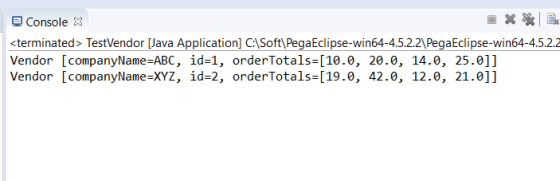
Write a class encapsulating the concept of a vendor, if a vendor has the following attributes: company name, id, array of quarterly purchase order totals (4 double elements). Include a constructor, accessor, mutator, and toString methods. Also code the following methods: one returning the total purchase orders (total all array elements) and a method to modify an array element (change the value of an array element). Write a client class to create 2 vendor objects and test all your methods.
Homework Answers
import java.util.Arrays;
class Vendor {
private String companyName;
private int id;
private double orderTotals[] = new double[4];
public Vendor() {
}
// constructor initialize the values
public Vendor(String aCompanyName, int aId, double[]
aOrderTotals) {
companyName = aCompanyName;
id = aId;
orderTotals = aOrderTotals;
}
// setters and getters
public String getCompanyName() {
return companyName;
}
public void setCompanyName(String aCompanyName)
{
companyName = aCompanyName;
}
public int getId() {
return id;
}
public void setId(int aId) {
id = aId;
}
public double[] getOrderTotals() {
return orderTotals;
}
public void setOrderTotals(double[] aOrderTotals)
{
orderTotals = aOrderTotals;
}
// toString will return the string representaion of
object
public String toString() {
return "Vendor [companyName=" +
companyName + ", id=" + id + ", orderTotals=" +
Arrays.toString(orderTotals)
+ "]";
}
}
public class TestVendor {
public static void main(String[] args) {
double t1[] = { 10, 20, 14, 25
};
// creating vendor object with
constructor
Vendor v1 = new Vendor("ABC", 1,
t1);
// printing v1 so it will call
toString and print object details
System.out.println(v1);
double t2[] = { 19, 42, 12, 21
};
// creating vendor object with
default constructor
Vendor v2 = new Vendor();
// setting values using
setters
v2.setCompanyName("XYZ");
v2.setId(2);
v2.setOrderTotals(t2);
System.out.println(v2);
}
}
Add Answer to:
Write a class encapsulating the concept of a vendor, if a vendor
has the following attributes:...
Write a class encapsulating the concept of daily temperatures for a week with a single dimensiona...
Write a class encapsulating the concept of daily temperatures for a week with a single dimensional array of temperatures. Write the following methods: • A constructor accepting an array of seven temperatures as a parameter. • Accessor, mutator, toString() and equals() methods • A method returning how many temperatures were below freezing. • A method returning an array of temperatures above 100 degrees. • A method returning the largest change in temperature between any two consecutive days. • A method...
Using Java Write a class encapsulating the concept of student grades (50 elements) on a test,...
Using Java Write a class encapsulating the concept of student grades (50 elements) on a test, assuming student grades are composed of a list of integers between 0 and 100. Write the following methods: A constructor with just one parameter, the number of students; all grades can be randomly generated Accessor, mutator, toString, and equals methods A method returning the highest grade A method returning the average grade A method returning the lowest grade Write a client class to test...
You will need to first create an object class encapsulating a Trivia Game which INHERITS from...
You will need to first create an object class encapsulating a Trivia Game which INHERITS from Game. Game is the parent class with the following attributes: description - which is a string write the constructor, accessor, mutator and toString methods. Trivia is the subclass of Game with the additional attributes: 1. trivia game id - integer 2. ultimate prize money - double 3. number of questions that must be answered to win - integer. 4. write the accessor, mutator, constructor,...
write a class encapsulating the concept of a student assuming that the student has the following...
 write a class encapsulating the concept of a student assuming
that the student has the following attributes the name of student
the average of the student the
rite a class encapsulating the concept of a Student, assuming that the Student has the following attributes: the name of the student, the average of the student, and the student's GPA. Include a default constructor, an overloaded constructor, the accessors and mutators, and methods, toString() and equals(). Also include a method returning the...
write a class encapsulating the concept of a student assuming
that the student has the following attributes the name of student
the average of the student the
rite a class encapsulating the concept of a Student, assuming that the Student has the following attributes: the name of the student, the average of the student, and the student's GPA. Include a default constructor, an overloaded constructor, the accessors and mutators, and methods, toString() and equals(). Also include a method returning the...
In JAVA, please In this module, you will combine your knowledge of class objects, inheritance and...
In JAVA, please In this module, you will combine your knowledge of class objects, inheritance and linked lists. You will need to first create an object class encapsulating a Trivia Game which INHERITS from Game. Game is the parent class with the following attributes: 1. description - which is a string 2. write the constructor, accessor, mutator and toString methods. Trivia is the subclass of Game with the additional attributes: 1. trivia game id - integer 2. ultimate prize money...
In 6A, you created an object class encapsulating a Trivia Game which INHERITS from Game. Now...
In 6A, you created an object class encapsulating a Trivia Game which INHERITS from Game. Now that you have successfully created Trivia objects, you will continue 6B by creating a linked list of trivia objects. Add the linked list code to the Trivia class. Your linked list code should include the following: a TriviaNode class with the attributes: 1. trivia game - Trivia object 2. next- TriviaNode 3. write the constructor, accessor, mutator and toString methods. A TriviaLinkedList Class which...
Write a class encapsulating the concept of a television set, assuming a television set has the...
 Write a class encapsulating the concept of a television set, assuming a television set has the following attributes: a brand and a price. include a constructor, the accessors and mutators, and methods to string and equals. Write a client class to test all the methods in your class.
Write a class Store which includes the attributes: store name, city. Write another class encapsulating an...
Write a class Store which includes the attributes: store name, city. Write another class encapsulating an Art Gallery, which inherits from Store. An Art Gallery has the following additional attributes: how many paintings are sold every year and the number of artists submitting artwork. Code the constructor, accessors, mutators, toString and equals method of the super class Store. Code the constructor, accessors and mutators for the subclass Art Gallery. In the Art Gallery class, also code a method returning the...
IN JAVA Write a class Store which includes the attributes: store name, city. Write another class...
IN JAVA Write a class Store which includes the attributes: store name, city. Write another class encapsulating an Art Gallery, which inherits from Store. An Art Gallery has the following additional attributes: how many paintings are sold every year and the number of artists submitting artwork. Code the constructor, accessors, mutators, toString and equals method of the super class Store. Code the constructor, accessors and mutators for the subclass Art Gallery. In the Art Gallery class, also code a method...
Write a Java class that implements the concept of Coins, assuming the following attributes (variables): number...
Write a Java class that implements the concept of Coins, assuming the following attributes (variables): number of quarters, number of dimes, number of nickels, and number of pennies. Include two constructors (non-argument constructor that assigns 1 to each coin, and another constructor that takes necessary arguments to create an object), needed getter and setter methods, method toString (to print coins objects in a meaningful way), and method equals (to compare two coins objects based on number of coins). Also include...
 write a class encapsulating the concept of a student assuming
that the student has the following attributes the name of student
the average of the student the
rite a class encapsulating the concept of a Student, assuming that the Student has the following attributes: the name of the student, the average of the student, and the student's GPA. Include a default constructor, an overloaded constructor, the accessors and mutators, and methods, toString() and equals(). Also include a method returning the...
write a class encapsulating the concept of a student assuming
that the student has the following attributes the name of student
the average of the student the
rite a class encapsulating the concept of a Student, assuming that the Student has the following attributes: the name of the student, the average of the student, and the student's GPA. Include a default constructor, an overloaded constructor, the accessors and mutators, and methods, toString() and equals(). Also include a method returning the...
 Write a class encapsulating the concept of a television set, assuming a television set has the following attributes: a brand and a price. include a constructor, the accessors and mutators, and methods to string and equals. Write a client class to test all the methods in your class.
Most questions answered within 3 hours.
-
Where is the error in this code sequence?
String s1 = "Hello";
String s2 = "ello";...
asked 10 months ago -
Financial data for Joel de Paris, Inc., for last year
follow:
Joel de Paris, Inc.
Balance...
asked 10 months ago -
Consider this reaction:
Al2(SO4)3 (aq)+ BaCl3
(aq) Al2Cl6 (aq)- +
3BaSO4(s) . What is the...
asked 10 months ago -
Suppose that Savneet is considering increasing her
recent random sample from 20 car rentals to 40...
asked 10 months ago -
Trucks arrive at an unloading terminal at an average rate of 120
per hour.
Trucks arrive...
asked 10 months ago -
Why are methanol and ethanol completely soluble in water while
octanol is not very little soluble....
asked 10 months ago -
A facilities manager at a university reads in a research report
that the mean amount of...
asked 10 months ago -
When the CuSO4 is rehydrated by adding water to the anhydrous
compound, is this an endothermic...
asked 10 months ago -
A ray of sunlight is passing from diamond into crown glass; the
angle of incidence is...
asked 10 months ago -
A block of mass 0.249 kg is placed on top of a light, vertical
spring of...
asked 10 months ago -
how do the kidneys compensate in the presences of acidosis
a) trigger hyperventilate
b) reserve acid...
asked 10 months ago -
Question 501 pts
The rental rate of capital to the firm increases. Which of the
following...
asked 10 months ago