The following algorithm can be used to carry out multiplication of M and N by repeated...
The following algorithm can be used to carry out multiplication of M and N by repeated addition:
initialize product to 0
REPEAT
add M to product
decrement N
UNTIL N == 0
Use this algorithm to multiply the contents of %ax by the contents
of %bx and store the product in %dx.
Homework Answers
.model small
.code
mov dx, 00h
mov ax, 02h
mov bx, 04h
lp:
cmp bx, 00h ; compare bx with 0
jbe final ; jump if bx is below or equal to 0
add dx, ax ; else dx <- dx+ax
sub bx, 01h ; bx<-bx-1
final:
mov ah,4ch
int 21H
end ; end of program
Add Answer to:
The following algorithm can be used to carry out multiplication
of M and N by repeated...
8. The following algorithm can be used to carry out division of two non- negative numbers by repeated subtraction. initialize quotient to o WHILE dividend >- divisor DO increment quotient subtr...
 8. The following algorithm can be used to carry out division of two non- negative numbers by repeated subtraction. initialize quotient to o WHILE dividend >- divisor DO increment quotient subtract divisor from dividend END WHILE Use this algorithm to write (assembly) code to divide the contents of %eax by the contents of %ebx and store the product in %edx.
8. The following algorithm can be used to carry out division of two non- negative numbers by repeated subtraction. initialize...
8. The following algorithm can be used to carry out division of two non- negative numbers by repeated subtraction. initialize quotient to o WHILE dividend >- divisor DO increment quotient subtract divisor from dividend END WHILE Use this algorithm to write (assembly) code to divide the contents of %eax by the contents of %ebx and store the product in %edx.
8. The following algorithm can be used to carry out division of two non- negative numbers by repeated subtraction. initialize...
) Identify the hexadecimal value moved to the destination by each of the following instruction below...
 ) Identify the hexadecimal value moved to the destination by each of the following instruction below based on the given data declaration. Assume that the offset of byteVal is 00000000H data byteVal wordVal dwordVal aString BYTE 1,2,3,4 WORD 1000H,2000H,3000H,4000H DWORD 12345678H,34567890H BYTE "ABCDEFG",0 ax,offset byteVal i. mov dx,wordVal i. mov al,aString+2 i11. mov dx,wordVal+4 iv. mov mov eax,offset byteVal+2 V. CO2 (10 marks) d) The incomplete program below used to find the multiplication product of the given numbers by 4...
Can someone carefully explain and answer questions 1, 2, 3, 4 and 5 in detail, please!!! Multiplication can be thought...
 Can someone carefully explain and answer questions 1, 2, 3, 4
and 5 in detail, please!!!
Multiplication can be thought of as repeated addition. Three times four is 4 added to itself 3 times. 1) Create an assembly program that multiplies two 8 bit integers (2's complement) together in your PIC, using the repeated summation technique 2) Add a feature to your program that detects if the answer is too big to hold in 8 bit 2's complement notation 3)...
Can someone carefully explain and answer questions 1, 2, 3, 4
and 5 in detail, please!!!
Multiplication can be thought of as repeated addition. Three times four is 4 added to itself 3 times. 1) Create an assembly program that multiplies two 8 bit integers (2's complement) together in your PIC, using the repeated summation technique 2) Add a feature to your program that detects if the answer is too big to hold in 8 bit 2's complement notation 3)...
Consider the following algorithm that operates on a list of n integers: • Divide the n...
Consider the following algorithm that operates on a list of n integers: • Divide the n values into n 2 pairs • Find the max of each pair. • Repeat until you have the max value of the list (a) Show the steps of the above algorithm for the list (25,19,9,8,2,26,21,26,31,26,3,14). (b) Derive and prove a tight bound on the asymptotic runtime of this algorithm (c) Assuming you just ran the above algorithm, show that you can use the result...
Can someone carefully explain and answer questions 1, 2, 3, 4 and 5 in detail, please!!!...
 Can someone carefully explain and answer questions 1, 2, 3, 4
and 5 in detail, please!!!
Multiplication can be thought of as repeated addition. Three times four is 4 added to itself 3 times. 1) Create an assembly program that multiplies two 8 bit integers (2's complement) together in your PIC, using the repeated summation technique 2) Add a feature to your program that detects if the answer is too big to hold in 8 bit 2's complement notation 3)...
Can someone carefully explain and answer questions 1, 2, 3, 4
and 5 in detail, please!!!
Multiplication can be thought of as repeated addition. Three times four is 4 added to itself 3 times. 1) Create an assembly program that multiplies two 8 bit integers (2's complement) together in your PIC, using the repeated summation technique 2) Add a feature to your program that detects if the answer is too big to hold in 8 bit 2's complement notation 3)...
What is the missing reagent that can be used to carry out the following transformation? MgBr...
 What is the missing reagent that can be used to carry out the following transformation? MgBr ? COOH A. H20 B. CO2 C. PCC D.K2Cr2O7, H2S04
2. a) Booth's algorithm to find the product of a multiplier, M, and a 12 multiplicand, B, can be summarized by the following table Ca | Multiplier | LSL# ALU | Cout A+0 0 x002 x01 2N x10 (2N+1) A...
 2. a) Booth's algorithm to find the product of a multiplier, M, and a 12 multiplicand, B, can be summarized by the following table Ca | Multiplier | LSL# ALU | Cout A+0 0 x002 x01 2N x10 (2N+1) A+B0 A-B1 x11 2N x002 2N x01 (2N+1) A+B0 x102 2N A-B1 x112 A+01 Demonstrate how Booth's algorithm performs multiplication by finding the product of 000111102 (M) and 110111002 (B). Each step in the calculation should be given. Give the result...
Use Prim's algorithm (Algorithm 4.1) to find a minimum spanning tree for he following graph. Show...
 Please solve the problem in a clear word document not
hand writing
Use Prim's algorithm (Algorithm 4.1) to find a minimum spanning tree for he following graph. Show the actions step by step. 32 17 45 18 10 28 4 25 07 59 V10 4 12 4.1 MINIMUM SPANNING TREES 161 void prim (int n const number Wll set of.edges& F) index i, vnear; number min edge e; index nearest [2.. n]; number distance [2.. n]; for (i= 2; i...
Please solve the problem in a clear word document not
hand writing
Use Prim's algorithm (Algorithm 4.1) to find a minimum spanning tree for he following graph. Show the actions step by step. 32 17 45 18 10 28 4 25 07 59 V10 4 12 4.1 MINIMUM SPANNING TREES 161 void prim (int n const number Wll set of.edges& F) index i, vnear; number min edge e; index nearest [2.. n]; number distance [2.. n]; for (i= 2; i...
Cel. 2. Carry at the a i m of the following How does this action change if the c repeathering can 3. Carry out the f...
 Cel. 2. Carry at the a i m of the following How does this action change if the c repeathering can 3. Carry out the following
8. Ackermann's Function Ackermann's Function is a recursive mathematical algorithm that can be used to test...
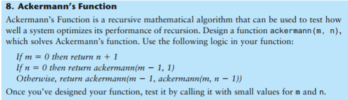 8. Ackermann's Function Ackermann's Function is a recursive mathematical algorithm that can be used to test how well a system optimizes its performance of recursion. Design a function ackermann (m, n), which solves Ackermann's function. Use the following logic in your function: If m 0 then return n + 1 If n = 0 then return ackermann(m – 1, 1) Otherwise, return ackermann(m – 1, ackermann(m, n - 1)) Once you've designed your function, test it by calling it with...
 8. The following algorithm can be used to carry out division of two non- negative numbers by repeated subtraction. initialize quotient to o WHILE dividend >- divisor DO increment quotient subtract divisor from dividend END WHILE Use this algorithm to write (assembly) code to divide the contents of %eax by the contents of %ebx and store the product in %edx.
8. The following algorithm can be used to carry out division of two non- negative numbers by repeated subtraction. initialize...
8. The following algorithm can be used to carry out division of two non- negative numbers by repeated subtraction. initialize quotient to o WHILE dividend >- divisor DO increment quotient subtract divisor from dividend END WHILE Use this algorithm to write (assembly) code to divide the contents of %eax by the contents of %ebx and store the product in %edx.
8. The following algorithm can be used to carry out division of two non- negative numbers by repeated subtraction. initialize...
 ) Identify the hexadecimal value moved to the destination by each of the following instruction below based on the given data declaration. Assume that the offset of byteVal is 00000000H data byteVal wordVal dwordVal aString BYTE 1,2,3,4 WORD 1000H,2000H,3000H,4000H DWORD 12345678H,34567890H BYTE "ABCDEFG",0 ax,offset byteVal i. mov dx,wordVal i. mov al,aString+2 i11. mov dx,wordVal+4 iv. mov mov eax,offset byteVal+2 V. CO2 (10 marks) d) The incomplete program below used to find the multiplication product of the given numbers by 4...
 Can someone carefully explain and answer questions 1, 2, 3, 4
and 5 in detail, please!!!
Multiplication can be thought of as repeated addition. Three times four is 4 added to itself 3 times. 1) Create an assembly program that multiplies two 8 bit integers (2's complement) together in your PIC, using the repeated summation technique 2) Add a feature to your program that detects if the answer is too big to hold in 8 bit 2's complement notation 3)...
Can someone carefully explain and answer questions 1, 2, 3, 4
and 5 in detail, please!!!
Multiplication can be thought of as repeated addition. Three times four is 4 added to itself 3 times. 1) Create an assembly program that multiplies two 8 bit integers (2's complement) together in your PIC, using the repeated summation technique 2) Add a feature to your program that detects if the answer is too big to hold in 8 bit 2's complement notation 3)...
 Can someone carefully explain and answer questions 1, 2, 3, 4
and 5 in detail, please!!!
Multiplication can be thought of as repeated addition. Three times four is 4 added to itself 3 times. 1) Create an assembly program that multiplies two 8 bit integers (2's complement) together in your PIC, using the repeated summation technique 2) Add a feature to your program that detects if the answer is too big to hold in 8 bit 2's complement notation 3)...
Can someone carefully explain and answer questions 1, 2, 3, 4
and 5 in detail, please!!!
Multiplication can be thought of as repeated addition. Three times four is 4 added to itself 3 times. 1) Create an assembly program that multiplies two 8 bit integers (2's complement) together in your PIC, using the repeated summation technique 2) Add a feature to your program that detects if the answer is too big to hold in 8 bit 2's complement notation 3)...
 What is the missing reagent that can be used to carry out the following transformation? MgBr ? COOH A. H20 B. CO2 C. PCC D.K2Cr2O7, H2S04
 2. a) Booth's algorithm to find the product of a multiplier, M, and a 12 multiplicand, B, can be summarized by the following table Ca | Multiplier | LSL# ALU | Cout A+0 0 x002 x01 2N x10 (2N+1) A+B0 A-B1 x11 2N x002 2N x01 (2N+1) A+B0 x102 2N A-B1 x112 A+01 Demonstrate how Booth's algorithm performs multiplication by finding the product of 000111102 (M) and 110111002 (B). Each step in the calculation should be given. Give the result...
 Please solve the problem in a clear word document not
hand writing
Use Prim's algorithm (Algorithm 4.1) to find a minimum spanning tree for he following graph. Show the actions step by step. 32 17 45 18 10 28 4 25 07 59 V10 4 12 4.1 MINIMUM SPANNING TREES 161 void prim (int n const number Wll set of.edges& F) index i, vnear; number min edge e; index nearest [2.. n]; number distance [2.. n]; for (i= 2; i...
Please solve the problem in a clear word document not
hand writing
Use Prim's algorithm (Algorithm 4.1) to find a minimum spanning tree for he following graph. Show the actions step by step. 32 17 45 18 10 28 4 25 07 59 V10 4 12 4.1 MINIMUM SPANNING TREES 161 void prim (int n const number Wll set of.edges& F) index i, vnear; number min edge e; index nearest [2.. n]; number distance [2.. n]; for (i= 2; i...
 Cel. 2. Carry at the a i m of the following How does this action change if the c repeathering can 3. Carry out the following
 8. Ackermann's Function Ackermann's Function is a recursive mathematical algorithm that can be used to test how well a system optimizes its performance of recursion. Design a function ackermann (m, n), which solves Ackermann's function. Use the following logic in your function: If m 0 then return n + 1 If n = 0 then return ackermann(m – 1, 1) Otherwise, return ackermann(m – 1, ackermann(m, n - 1)) Once you've designed your function, test it by calling it with...
Most questions answered within 3 hours.
-
Where is the error in this code sequence?
String s1 = "Hello";
String s2 = "ello";...
asked 10 months ago -
Financial data for Joel de Paris, Inc., for last year
follow:
Joel de Paris, Inc.
Balance...
asked 10 months ago -
Consider this reaction:
Al2(SO4)3 (aq)+ BaCl3
(aq) Al2Cl6 (aq)- +
3BaSO4(s) . What is the...
asked 10 months ago -
Suppose that Savneet is considering increasing her
recent random sample from 20 car rentals to 40...
asked 10 months ago -
Trucks arrive at an unloading terminal at an average rate of 120
per hour.
Trucks arrive...
asked 10 months ago -
Why are methanol and ethanol completely soluble in water while
octanol is not very little soluble....
asked 10 months ago -
A facilities manager at a university reads in a research report
that the mean amount of...
asked 10 months ago -
When the CuSO4 is rehydrated by adding water to the anhydrous
compound, is this an endothermic...
asked 10 months ago -
A ray of sunlight is passing from diamond into crown glass; the
angle of incidence is...
asked 10 months ago -
A block of mass 0.249 kg is placed on top of a light, vertical
spring of...
asked 10 months ago -
how do the kidneys compensate in the presences of acidosis
a) trigger hyperventilate
b) reserve acid...
asked 10 months ago -
Question 501 pts
The rental rate of capital to the firm increases. Which of the
following...
asked 10 months ago