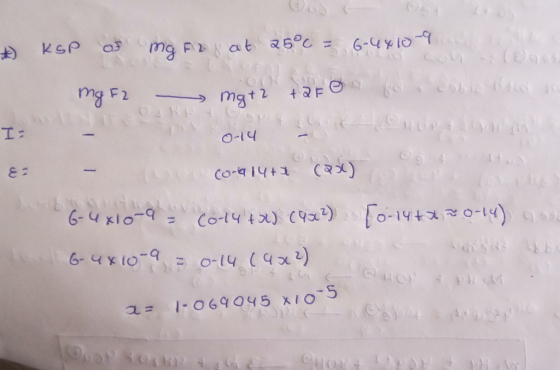
A-Calculate the molar solubility of MgF2 in 0.14 M MgCl2 at 25 ∘C. B-In an excess...
A-Calculate the molar solubility of MgF2 in 0.14 M MgCl2 at 25 ∘C.
B-In an excess of NH3(aq), Cu2+ ion forms a deep blue complex ion, Cu(NH3)42+, which has a formation constant Kf=5.6×10¹¹. Calculate the concentration of Cu2+ in a solution prepared by adding 4.7×10⁻³mol of CuSO4 to 0.460 L of 0.37 M NH3.
Express your answer using two significant figures.
Homework Answers
 if
you have any doubts about the answer please mention in the comments
please do rate the answer .
if
you have any doubts about the answer please mention in the comments
please do rate the answer .
Add Answer to:
A-Calculate the molar solubility of MgF2 in 0.14 M MgCl2 at 25
∘C.
B-In an excess...
Part A 2+ which has a In an excess of NH3 (aq), Cu24 ion forms a...
 Part A 2+ which has a In an excess of NH3 (aq), Cu24 ion forms a deep blue complex ion, Cu(NH3)4 formation constant Kf = 5.6 x 101" Calculate the concentration of Cu2+ in a solution prepared by adding 4.6 x 10⁻³mol of CuSO4 to 0.470 L of 0.39 M NH3 Express your answer using two significant figures. ν ΑΣΦ ? [Cu2]= M Request Answer Submit
7.Calculate the molar solubility for the binary salt MX3 with Ksp=0.0000071. Enter your answer as a...
7.Calculate the molar solubility for the binary salt MX3 with Ksp=0.0000071. Enter your answer as a decimal number with two significant figures. 8.Calculate the molar solubility of the binary salt MX2 with Ksp=0.000016. Enter your answer as a decimal with two significant figures. 9. Calculate the molar solubility of MX2 (Ksp=0.0000011) in 0.085 M NaX. Enter your answer as a decimal with two significant figures. 10.Determine the molar solubility of MX (Ksp=4.2x10⁻⁸) in 0.083 M NaCN. The metal ion M+...
Determine the molar solubility of AgBr (Ksp = 5.40e-13) in 2.983 M NH3 if the complex...
Determine the molar solubility of AgBr (Ksp = 5.40e-13) in 2.983 M NH3 if the complex ion [Ag(NH3)2]+ forms with a Kf = 1.70e7. 3.012e-3 0.01136 8.984e-3 7.104e-3
4. Calculate the molar solubility of AlCl3 (Ksp = 1.9 x 10⁻³³) in 1.20 M OH-(aq)...
4. Calculate the molar solubility of AlCl3 (Ksp = 1.9 x 10⁻³³) in 1.20 M OH-(aq) (a solubility that yields Al(OH)¬4- complex ions with a complex ion constant formation Kf = 3.0 x 1033)
Indicate whether the following would increase or decrease the solubility of copper(II) hydroxide. It may help...
Indicate whether the following would increase or decrease the solubility of copper(II) hydroxide. It may help to know that copper(II) ion forms a complex ion with ammonia: Cu2+ (aq) + 4 NH3 (aq) ⇌ Cu(NH3)42+ (aq). adding 50.0 mL of a solution of 0.25 M sulfuric acid adding 50.0 mL of a solution of 6.0 M ammonia
Find the molar solubility of PbCO3 solid in a 1.50 M sodium oxalate solution (which provides...
 Find the molar solubility of PbCO3 solid in a 1.50 M
sodium oxalate solution (which provides the bidentate ox^2-
ligand). The Ksp for PbCO3 is 7.4x10^-14 and the Kf for the [Pb
(ox)2]^2- complex ion is 3.5x10^6.
What is the new K value for the combined solubility equilibrium and
formation equilibrium?
What is the molar solubility of the PbCO3 in the oxalate
solution?
1. Which compound increaves in increase in solubility 2. & Find the mo solubility of Pbcov said...
Find the molar solubility of PbCO3 solid in a 1.50 M
sodium oxalate solution (which provides the bidentate ox^2-
ligand). The Ksp for PbCO3 is 7.4x10^-14 and the Kf for the [Pb
(ox)2]^2- complex ion is 3.5x10^6.
What is the new K value for the combined solubility equilibrium and
formation equilibrium?
What is the molar solubility of the PbCO3 in the oxalate
solution?
1. Which compound increaves in increase in solubility 2. & Find the mo solubility of Pbcov said...
ANSWER ALL PARTS 1. Determine the molar solubility of AgBr in a 0.50 M NH3 solution....
ANSWER ALL PARTS 1. Determine the molar solubility of AgBr in a 0.50 M NH3 solution. The Ksp for AgBr is 5.0 x 10⁻¹³ and the Kf for Ag(NH3)2+is 1.7 x 10⁷. 2. How many unpaired electrons are there in the Zn2+ ion in the Zn(NH3)62+ complex ion? 3. Which of the following complex ions will absorb the shortest wavelength of visible light? Ni(CN)64- Ni(NH3)62+ Ni(H2O)62+ NiCl64-
5. The molar solubility for calcium fluoride, CaF2, is 2.0 x 10' M at 25°C. Calculate...
 5. The molar solubility for calcium fluoride, CaF2, is 2.0 x 10' M at 25°C. Calculate the solubility product constant for calcium fluoride a. 1.4 x 10² b. 8.0 x 10⁻⁸ c. 1.6 x 10⁻¹¹ d. 3.2 x 10" e. 4.2 x 10⁻²⁴ e. None of these statements is liue. 15. Which of the following statements regarding complex ions is true? a. Complex ions are formed of a metal ion and a ligand. b. The metal ion is a Lewis...
H. Complex Ions 1. Silver chloride has very low solubility in water (Ks of 1.6 x...
 H. Complex Ions 1. Silver chloride has very low solubility in water (Ks of 1.6 x 10⁻¹⁹), however, it is highly soluble in an ammonia solution due to the formation of the complex ion [Ag(NH3)21 (Kr" 1.7 X 10) Given this information, calculate the molar solubility of AgCl in 2.25 M ammonia. 2. Calculate the molar solubility of Cul in 0.92 M KCN. (Ksp of Cul is 1.1 x 10⁻¹², Kp of [Cu(CN)2] is 1.0 x 10¹⁶).
Smallers 23) (15 pts.) A saturated solution of zinc hydrokide is prepared at 25°C. Calculate, then...
 Smallers 23) (15 pts.) A saturated solution of zinc hydrokide is prepared at 25°C. Calculate, then compare the S molar solubility (least soluble to most soluble) of Zn(OH)2 in each of the following systems: a) in ost east b) in 7.5 x 10³ M NaOH solution c) in 3.0 M NH3 (colorless complex ion Zn(NH3)42 forms) pure water wmmonion Lomwan on
 Part A 2+ which has a In an excess of NH3 (aq), Cu24 ion forms a deep blue complex ion, Cu(NH3)4 formation constant Kf = 5.6 x 101" Calculate the concentration of Cu2+ in a solution prepared by adding 4.6 x 10⁻³mol of CuSO4 to 0.470 L of 0.39 M NH3 Express your answer using two significant figures. ν ΑΣΦ ? [Cu2]= M Request Answer Submit
 Find the molar solubility of PbCO3 solid in a 1.50 M
sodium oxalate solution (which provides the bidentate ox^2-
ligand). The Ksp for PbCO3 is 7.4x10^-14 and the Kf for the [Pb
(ox)2]^2- complex ion is 3.5x10^6.
What is the new K value for the combined solubility equilibrium and
formation equilibrium?
What is the molar solubility of the PbCO3 in the oxalate
solution?
1. Which compound increaves in increase in solubility 2. & Find the mo solubility of Pbcov said...
Find the molar solubility of PbCO3 solid in a 1.50 M
sodium oxalate solution (which provides the bidentate ox^2-
ligand). The Ksp for PbCO3 is 7.4x10^-14 and the Kf for the [Pb
(ox)2]^2- complex ion is 3.5x10^6.
What is the new K value for the combined solubility equilibrium and
formation equilibrium?
What is the molar solubility of the PbCO3 in the oxalate
solution?
1. Which compound increaves in increase in solubility 2. & Find the mo solubility of Pbcov said...
 5. The molar solubility for calcium fluoride, CaF2, is 2.0 x 10' M at 25°C. Calculate the solubility product constant for calcium fluoride a. 1.4 x 10² b. 8.0 x 10⁻⁸ c. 1.6 x 10⁻¹¹ d. 3.2 x 10" e. 4.2 x 10⁻²⁴ e. None of these statements is liue. 15. Which of the following statements regarding complex ions is true? a. Complex ions are formed of a metal ion and a ligand. b. The metal ion is a Lewis...
 H. Complex Ions 1. Silver chloride has very low solubility in water (Ks of 1.6 x 10⁻¹⁹), however, it is highly soluble in an ammonia solution due to the formation of the complex ion [Ag(NH3)21 (Kr" 1.7 X 10) Given this information, calculate the molar solubility of AgCl in 2.25 M ammonia. 2. Calculate the molar solubility of Cul in 0.92 M KCN. (Ksp of Cul is 1.1 x 10⁻¹², Kp of [Cu(CN)2] is 1.0 x 10¹⁶).
 Smallers 23) (15 pts.) A saturated solution of zinc hydrokide is prepared at 25°C. Calculate, then compare the S molar solubility (least soluble to most soluble) of Zn(OH)2 in each of the following systems: a) in ost east b) in 7.5 x 10³ M NaOH solution c) in 3.0 M NH3 (colorless complex ion Zn(NH3)42 forms) pure water wmmonion Lomwan on
Most questions answered within 3 hours.
-
Where is the error in this code sequence?
String s1 = "Hello";
String s2 = "ello";...
asked 11 months ago -
Financial data for Joel de Paris, Inc., for last year
follow:
Joel de Paris, Inc.
Balance...
asked 11 months ago -
Consider this reaction:
Al2(SO4)3 (aq)+ BaCl3
(aq) Al2Cl6 (aq)- +
3BaSO4(s) . What is the...
asked 11 months ago -
Suppose that Savneet is considering increasing her
recent random sample from 20 car rentals to 40...
asked 11 months ago -
Trucks arrive at an unloading terminal at an average rate of 120
per hour.
Trucks arrive...
asked 11 months ago -
Why are methanol and ethanol completely soluble in water while
octanol is not very little soluble....
asked 11 months ago -
A facilities manager at a university reads in a research report
that the mean amount of...
asked 11 months ago -
When the CuSO4 is rehydrated by adding water to the anhydrous
compound, is this an endothermic...
asked 11 months ago -
A ray of sunlight is passing from diamond into crown glass; the
angle of incidence is...
asked 11 months ago -
A block of mass 0.249 kg is placed on top of a light, vertical
spring of...
asked 11 months ago -
how do the kidneys compensate in the presences of acidosis
a) trigger hyperventilate
b) reserve acid...
asked 11 months ago -
Question 501 pts
The rental rate of capital to the firm increases. Which of the
following...
asked 11 months ago