If the economy is experiencing a 10% inflation rate and a 1% unemployment rate: a. Illustrate...
If the economy is experiencing a 10% inflation rate and a 1% unemployment rate:
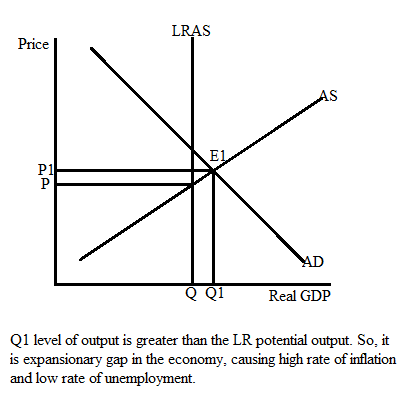
a. Illustrate the initial condition. That means to show the gap on an ag/as graph.
Homework Answers
A high rate of inflation such as 10% and very low rate of unemployment ( less than natural rate of unemployment) of 1%, show that economy is facing expansionary gap as follows:
Add Answer to:
If the economy is experiencing a 10% inflation rate and a 1%
unemployment rate:
a. Illustrate...
Suppose that the economy is experiencing a high level of inflation rate and unemployment is below...
Suppose that the economy is experiencing a high level of inflation rate and unemployment is below the natural rate. How does the economy return to the natural rate of unemployment if this higher inflation rate persists?
If an economy is operating at the natural rate of unemployment, it is OA) experiencing inflation....
 If an economy is operating at the natural rate of unemployment, it is OA) experiencing inflation. B) in a recession. OC) producing at its full employment real GDP. D) in an expansion.
8. The Phillips curve is based on the observed negative relation between the rate of inflation and the unemployment rate. That is, decreases in the unemployment rate tend to be associated with in...
 8. The Phillips curve is based on the observed negative relation between the rate of inflation and the unemployment rate. That is, decreases in the unemployment rate tend to be associated with increases in the rate of inflation a) Given what you know about the relation between the unemployment rate and the GDP gap, restate the Phillips curve in terms of inflation and the GDP gap. b) Based on the AD-IE model, and given your answer in (a), explain why...
1. Suppose an economy is experiencing higher inflation rate as well as a recessionary gap. Using...
1. Suppose an economy is experiencing higher inflation rate as well as a recessionary gap. Using the policy reaction function, explain whether the Reserve bank will increase or decrease the interest rate? 2. Explain the effect of an increase in imports on the equilibrium output and inflation in the AD-AS model. Carefully distinguish between the short run and the long run. Would this affect the potential output? Why/Why not? 3. Suppose capital in Country A increases from 100 in 2017...
1. Suppose an economy is experiencing higher inflation rate as well as a recessionary gap. Using...
 1. Suppose an economy is experiencing higher inflation rate as well as a recessionary gap. Using the policy reaction function, explain whether the Reserve bank will increase or decrease the interest rate? 2. Explain thee effect of an increase in imports on the equilibrium output and inflation in the AD-AS model. Carefully distinguish between the short run and the long run Would this affect the potential output? Why/Why not? 3. Suppose capital in Country A increases from 100 in 2017...
An economy has the natural rate of unemployment equal to 8.3%. The inflation rate in the...
An economy has the natural rate of unemployment equal to 8.3%. The inflation rate in the previous period was 8.3%. If there is no cyclical unemployment and the country has adaptive expectations, what is the difference (in percentage points) between the inflation rate and the expected inflation rate?
Consider an economy in which the unemployment rate is at the natural level and the inflation...
Consider an economy in which the unemployment rate is at the natural level and the inflation rate is 10%. Suppose that the domestic central bank wants to reduce inflation to 5%. Starting from year t the central bank reduces the money supply in such a way that unemployment remains above the natural level by one percent each year. After 5 years the inflation reaches the new target of 5%. Compute the sacrifice ratio of this policy. What is the slope...
The United States is currently experiencing a 2% unemployment rate, a 11% inflation rate and real...
The United States is currently experiencing a 2% unemployment rate, a 11% inflation rate and real GDP is rising rapidly. Answer the following questions in detail and use complete sentences: Who is in charge of monetary policy in the United States? What type of monetary policy does this economy need and why? What are the tools of the prescribed monetary policy and how would they change in response to this economic situation? How would this policy affect interest rates and...
Suppose that the economy is in long-run macroeconomic equilibrium, experiencing full employment, when the Aggregate Demand...
Suppose that the economy is in long-run macroeconomic equilibrium, experiencing full employment, when the Aggregate Demand Curve shifts to the right. In the short run, the economy experiences a(n) ___________ gap with _______________. inflationary; low unemployment recessionary; low inflation recessionary; high inflation inflationary; high unemployment
Suppose an economy were experiencing a high rate of unemployment, an appropriate corrective measure by the...
Suppose an economy were experiencing a high rate of unemployment, an appropriate corrective measure by the government would be to: reduce personal income tax. reduce government spending. reduce unemployment compensation reduce the rate of interest for borrowing reduce transfer payments.
 If an economy is operating at the natural rate of unemployment, it is OA) experiencing inflation. B) in a recession. OC) producing at its full employment real GDP. D) in an expansion.
 8. The Phillips curve is based on the observed negative relation between the rate of inflation and the unemployment rate. That is, decreases in the unemployment rate tend to be associated with increases in the rate of inflation a) Given what you know about the relation between the unemployment rate and the GDP gap, restate the Phillips curve in terms of inflation and the GDP gap. b) Based on the AD-IE model, and given your answer in (a), explain why...
 1. Suppose an economy is experiencing higher inflation rate as well as a recessionary gap. Using the policy reaction function, explain whether the Reserve bank will increase or decrease the interest rate? 2. Explain thee effect of an increase in imports on the equilibrium output and inflation in the AD-AS model. Carefully distinguish between the short run and the long run Would this affect the potential output? Why/Why not? 3. Suppose capital in Country A increases from 100 in 2017...
Most questions answered within 3 hours.
-
Where is the error in this code sequence?
String s1 = "Hello";
String s2 = "ello";...
asked 11 months ago -
Financial data for Joel de Paris, Inc., for last year
follow:
Joel de Paris, Inc.
Balance...
asked 11 months ago -
Consider this reaction:
Al2(SO4)3 (aq)+ BaCl3
(aq) Al2Cl6 (aq)- +
3BaSO4(s) . What is the...
asked 11 months ago -
Suppose that Savneet is considering increasing her
recent random sample from 20 car rentals to 40...
asked 11 months ago -
Trucks arrive at an unloading terminal at an average rate of 120
per hour.
Trucks arrive...
asked 11 months ago -
Why are methanol and ethanol completely soluble in water while
octanol is not very little soluble....
asked 11 months ago -
A facilities manager at a university reads in a research report
that the mean amount of...
asked 11 months ago -
When the CuSO4 is rehydrated by adding water to the anhydrous
compound, is this an endothermic...
asked 11 months ago -
A ray of sunlight is passing from diamond into crown glass; the
angle of incidence is...
asked 11 months ago -
A block of mass 0.249 kg is placed on top of a light, vertical
spring of...
asked 11 months ago -
how do the kidneys compensate in the presences of acidosis
a) trigger hyperventilate
b) reserve acid...
asked 11 months ago -
Question 501 pts
The rental rate of capital to the firm increases. Which of the
following...
asked 11 months ago