Which of the following statements describes a correct step in the formation of an ionic bond...
Which of the following statements describes a correct step in the formation of an ionic bond between sodium and chlorine?
1. Removing an electron from sodium (ionization energy) will provide energy for ionic bond formation
2. Adding an electron to chlorine (electron affinity) will require energy
3. The Coulombic potential between the ions (lattice energy) will release energy
4. The Coulombic potential between the ions (lattice energy) will require energy
Homework Answers
1) false, removing electron from sodium requires energy.
2) false, adding an electron to chlorine releases energy.
3) true, the attraction between two oppositely charged ions releases energy.
4) false, it releases energy not requires.
So, the correct step is the third statement.
Comment if any doubts.
Add Answer to:
Which of the following statements describes a correct step in
the formation of an ionic bond...
The C1-C1 bond energy is 243 kJ/mol. Therefore the breaking of the bond between chlorine atoms...
 The C1-C1 bond energy is 243 kJ/mol. Therefore the breaking of the bond between chlorine atoms should require the absorption of 243 kJ per mote of Cl_2 formed. should require the absorption of486 kJ per mole of Cl_2 formed should result in the release of 243 kJ per mole of Cl_2 formed. should result in the release of 486 Id per mole of Cl_2 form A reactive element with a relatively high electronegativity would be expected to have a relatively...
please solve D 3. The "driving force" that makes the formation of an ionic compound energetically favorable is: the...
 please solve
D 3. The "driving force" that makes the formation of an ionic compound energetically favorable is: the ionization energy of the metal. the electron affinity of the nonmetal. the formation of the crystal lattice. the exchange of core electrons between the atoms. the change of the atoms from solid into gas state.
please solve
D 3. The "driving force" that makes the formation of an ionic compound energetically favorable is: the ionization energy of the metal. the electron affinity of the nonmetal. the formation of the crystal lattice. the exchange of core electrons between the atoms. the change of the atoms from solid into gas state.
Sodium fluoride (NaF) is a molecule formed by an ionic bond. a. The electron affinity of...
 Sodium fluoride (NaF) is a molecule formed by an ionic bond. a. The electron affinity of F is 3.40 eV and the ionization energy of Na is 5.14 eV. What is the transfer energy associated with this bond? b. The equilibrium separation of the Na and F atoms in the molecule is r_0 = 0.193 nm. What is the electrostatic potential energy of the atoms? c. The measured dissociation energy of NaF is 4.99 eV. Using the results above, what...
Select which process describes the following energy changes. (Ionization energy, electron affinity, bond enthalpy, or standard...
Select which process describes the following energy changes. (Ionization energy, electron affinity, bond enthalpy, or standard enthalpy of formation A. F(g) + e- => F-(g) B. F2(g) => 2F(g) C. Na(g) => Na+(g) + e- D. Na(s) + 1/2F2(g) => NaF(g)
2. Use the following data to calculate the lattice energy (U) of NaCl(s) from sodium me...
 2. Use the following data to calculate the lattice energy (U) of NaCl(s) from sodium me chlorine: Enthalpy of formation (4H) for NaCl(s) - -411 kJ/mol Enthalpy of sublimation (4Hub) of Na 107.3 kJ/mol The first ionization energy of Na (E,)-495.8 kJ/mol The bond dissociation energy (D) of Clh- 243 kJ/mol The electron affinity of Cl (Eea)- 348.6 kJ/mol.
19. Which of the following statements regarding ionic compounds is correct? A) Ions are held together...
 19. Which of the following statements regarding ionic compounds is correct? A) Ions are held together in an ionic lattice by covalent bonds. B) The crystal structure of a given compound does not depend on the sizes and number of ions in a formula unit of the compound. C) Ionic compounds tend to have low melting points. D) Ionic compounds are formed when two metals react. E) In forming an ionic compound from its elements, one element transfers one or...
1 2. for molecules CS2 and CH3F a.describe its lewis structure b.the kind of orbitals used...
 1
2. for molecules CS2 and CH3F
a.describe its lewis structure
b.the kind of orbitals used by the central atoms to bond
c.polarity
d.approximate geometry
3.explain the formation of sigma and phi bonds in the
XeO3.molecule illustrate its structure and explain its
polarity
4.explain why
a. melting point NaF> NaCl but CF4 <CCl4
b. Boiling point HF> HCl but CF4 <CCl4
a. One of the properties of ionic compounds is hard but brittle. Briefly explain why? b. The data is...
1
2. for molecules CS2 and CH3F
a.describe its lewis structure
b.the kind of orbitals used by the central atoms to bond
c.polarity
d.approximate geometry
3.explain the formation of sigma and phi bonds in the
XeO3.molecule illustrate its structure and explain its
polarity
4.explain why
a. melting point NaF> NaCl but CF4 <CCl4
b. Boiling point HF> HCl but CF4 <CCl4
a. One of the properties of ionic compounds is hard but brittle. Briefly explain why? b. The data is...
The total potential energy describing the NaCl lattice is given by: Utot = [ ( -(αe^2)...
The total potential energy describing the NaCl lattice is given by: Utot = [ ( -(αe^2) / (4πε 0r) ) + ( A / r^8 ) ], where a is the Madelung constant (a=1.75 for NaCl) and A is a positive constant. 1. What is the physical meaning of the two terms of Utot? Let r0 be the value of the ionic separation r for which Utot is minimum. 2. Deduce an expression of A as a function of r0....
Which of the following best describes an ionic bond? It is a transfer of an electron...
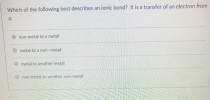 Which of the following best describes an ionic bond? It is a transfer of an electron from a: O non-metal to a metal O metal to a non- metal O metal to another metal O non-metal to another non-metal
Which of the following statements concerning lattice energy is false? It is often defined as the...
 Which of the following statements concerning lattice energy is false? It is often defined as the energy released when an ionic compound forms from its ions. MgO has a higher lattice energy than NaF. In the Lewis structure for elemental nitrogen, there is (are) a single bond between the nitrogen atoms a double bond between the nitrogen atoms a triple bond between the nitrogen atoms three unpaired electrons two unpaired electrons, one on each nitrogen What is the geometry of...
 The C1-C1 bond energy is 243 kJ/mol. Therefore the breaking of the bond between chlorine atoms should require the absorption of 243 kJ per mote of Cl_2 formed. should require the absorption of486 kJ per mole of Cl_2 formed should result in the release of 243 kJ per mole of Cl_2 formed. should result in the release of 486 Id per mole of Cl_2 form A reactive element with a relatively high electronegativity would be expected to have a relatively...
 please solve
D 3. The "driving force" that makes the formation of an ionic compound energetically favorable is: the ionization energy of the metal. the electron affinity of the nonmetal. the formation of the crystal lattice. the exchange of core electrons between the atoms. the change of the atoms from solid into gas state.
please solve
D 3. The "driving force" that makes the formation of an ionic compound energetically favorable is: the ionization energy of the metal. the electron affinity of the nonmetal. the formation of the crystal lattice. the exchange of core electrons between the atoms. the change of the atoms from solid into gas state.
 Sodium fluoride (NaF) is a molecule formed by an ionic bond. a. The electron affinity of F is 3.40 eV and the ionization energy of Na is 5.14 eV. What is the transfer energy associated with this bond? b. The equilibrium separation of the Na and F atoms in the molecule is r_0 = 0.193 nm. What is the electrostatic potential energy of the atoms? c. The measured dissociation energy of NaF is 4.99 eV. Using the results above, what...
 2. Use the following data to calculate the lattice energy (U) of NaCl(s) from sodium me chlorine: Enthalpy of formation (4H) for NaCl(s) - -411 kJ/mol Enthalpy of sublimation (4Hub) of Na 107.3 kJ/mol The first ionization energy of Na (E,)-495.8 kJ/mol The bond dissociation energy (D) of Clh- 243 kJ/mol The electron affinity of Cl (Eea)- 348.6 kJ/mol.
 19. Which of the following statements regarding ionic compounds is correct? A) Ions are held together in an ionic lattice by covalent bonds. B) The crystal structure of a given compound does not depend on the sizes and number of ions in a formula unit of the compound. C) Ionic compounds tend to have low melting points. D) Ionic compounds are formed when two metals react. E) In forming an ionic compound from its elements, one element transfers one or...
 1
2. for molecules CS2 and CH3F
a.describe its lewis structure
b.the kind of orbitals used by the central atoms to bond
c.polarity
d.approximate geometry
3.explain the formation of sigma and phi bonds in the
XeO3.molecule illustrate its structure and explain its
polarity
4.explain why
a. melting point NaF> NaCl but CF4 <CCl4
b. Boiling point HF> HCl but CF4 <CCl4
a. One of the properties of ionic compounds is hard but brittle. Briefly explain why? b. The data is...
1
2. for molecules CS2 and CH3F
a.describe its lewis structure
b.the kind of orbitals used by the central atoms to bond
c.polarity
d.approximate geometry
3.explain the formation of sigma and phi bonds in the
XeO3.molecule illustrate its structure and explain its
polarity
4.explain why
a. melting point NaF> NaCl but CF4 <CCl4
b. Boiling point HF> HCl but CF4 <CCl4
a. One of the properties of ionic compounds is hard but brittle. Briefly explain why? b. The data is...
 Which of the following best describes an ionic bond? It is a transfer of an electron from a: O non-metal to a metal O metal to a non- metal O metal to another metal O non-metal to another non-metal
 Which of the following statements concerning lattice energy is false? It is often defined as the energy released when an ionic compound forms from its ions. MgO has a higher lattice energy than NaF. In the Lewis structure for elemental nitrogen, there is (are) a single bond between the nitrogen atoms a double bond between the nitrogen atoms a triple bond between the nitrogen atoms three unpaired electrons two unpaired electrons, one on each nitrogen What is the geometry of...
Most questions answered within 3 hours.
-
Where is the error in this code sequence?
String s1 = "Hello";
String s2 = "ello";...
asked 10 months ago -
Financial data for Joel de Paris, Inc., for last year
follow:
Joel de Paris, Inc.
Balance...
asked 10 months ago -
Consider this reaction:
Al2(SO4)3 (aq)+ BaCl3
(aq) Al2Cl6 (aq)- +
3BaSO4(s) . What is the...
asked 10 months ago -
Suppose that Savneet is considering increasing her
recent random sample from 20 car rentals to 40...
asked 10 months ago -
Trucks arrive at an unloading terminal at an average rate of 120
per hour.
Trucks arrive...
asked 10 months ago -
Why are methanol and ethanol completely soluble in water while
octanol is not very little soluble....
asked 10 months ago -
A facilities manager at a university reads in a research report
that the mean amount of...
asked 10 months ago -
When the CuSO4 is rehydrated by adding water to the anhydrous
compound, is this an endothermic...
asked 10 months ago -
A ray of sunlight is passing from diamond into crown glass; the
angle of incidence is...
asked 10 months ago -
A block of mass 0.249 kg is placed on top of a light, vertical
spring of...
asked 10 months ago -
how do the kidneys compensate in the presences of acidosis
a) trigger hyperventilate
b) reserve acid...
asked 10 months ago -
Question 501 pts
The rental rate of capital to the firm increases. Which of the
following...
asked 10 months ago