Two-Bit Drilling Company keeps information on employees and their dependents. Each employee has an employee number,...
Two-Bit Drilling Company keeps information on employees and their dependents. Each employee has an employee number, name, date of hire, and title. If an employee is an inspector, then the date of certification and the renewal date for that certification should also be recorded in the system. For all employees, the SSN and department names should be kept. All dependents must be associated with one and only one employee. Some employees will not have dependents, while others will have many dependents.
Create the 3NF tables and relationships in Microsoft Access. The Word file should provide your rationale for each normalized form. State your assumptions about business rules, if any. Submit the relationship diagram from Access on the Word document and the Access database file (.accdb). (100 points)
Did your 3NF tables accurately reflect the initial ERD? If not, modify the initial ERD.
Homework Answers
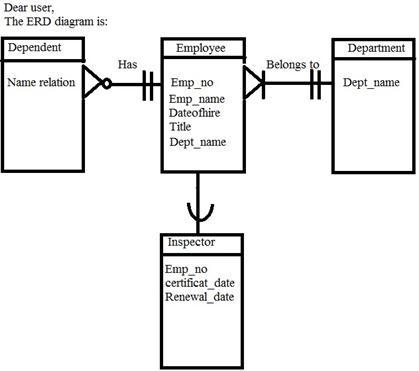
ERD diagram
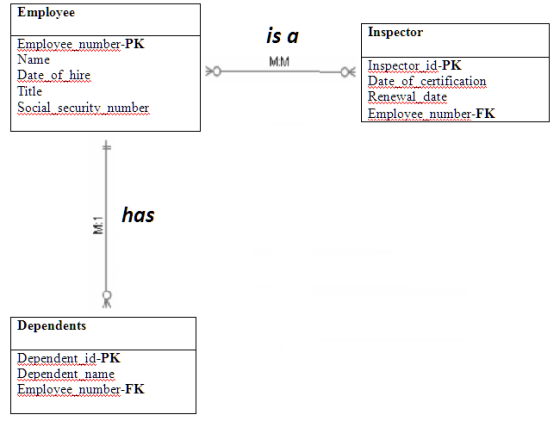
1NF:
1.All the cells should be atomic. The cells in the column Dependent memer name were non atomic ie it was multi value attribute column. So we decomposed it so that each cell has only one attribute value.
2.We ensured that all columns have alue of the same type
3.We inserted unique IDs ie the Employee IDs for rows.
4. We inserted rows to achieve cell atomicity
2NF:
1. We ensured that all non key attributes are dependent /can be derived from the key attributes.We split the table and inserted a junction table. <with employee ID as one column and certificate ID as other column>
3NF:
1. We further decomposed the table so that each column in the table can be derived only by the key column.
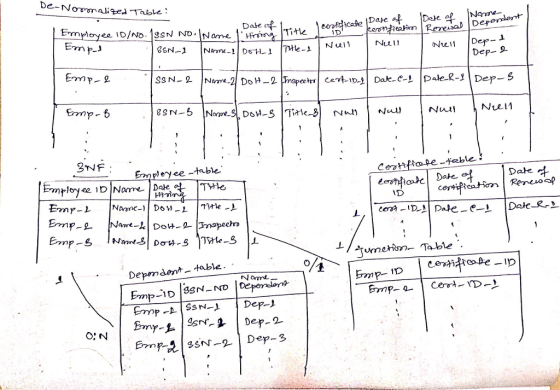
So after transforming into 3NF form we have :
1. Employee table with employee ID as the primary key .Other columns are Name, Date of hiring and title.
2. Certificate table which holds entries only when the employee title is =Inspector. The columns include certificate ID as the primary key, date of certification and date of renewal.
3. We have a junction table with columns as Employee ID and Certificate ID
4.We have a dependent table which contains the record of all dependents. Other columns are employee ID and SSN ID.
Relationships:
1. An employee may have 0 or more dependents.A dependent wll be mapped to one and only one employee
2.A certificate will be mapped to one and only one employee. An employee may have o or 1 certification depending on the title. Also a employee will be mapped to only one certificate when employee title=Inspector. This relationship is supported by the junction table.
Add Answer to:
Two-Bit Drilling Company keeps information on employees and
their dependents. Each employee has an employee number,...
Two-Bit Drilling Company keeps information on employees and their dependents. Each employee has an employee number, nam...
Two-Bit Drilling Company keeps information on employees and their dependents. Each employee has an employee number, name, date of hire, and title. If an employee is an inspector, then the date of certification and the renewal date for that certification should also be recorded in the system. For all employees, the SSN and department names should be kept. All dependents must be associated with one and only one employee. Some employees will not have dependents, while others will have many...
Two-Bit Drilling Company keeps information on employees and their insurance dependents. Each employee has an employee...
Two-Bit Drilling Company keeps information on employees and their insurance dependents. Each employee has an employee number, name, date of hire, and title. If an employee is an inspector, then the date of certification and the renewal date for that certification should also be recorded in the system. For all employees, the Social Security number and dependent names should be kept. All dependents must be associated with one and only one employee. Some employees will not have dependents, while others...
Given the following business scenarios, create Crow’s Foot ERDs using a specialization hierarchy if appropriate. (Make...
Given the following business scenarios, create Crow’s Foot ERDs using a specialization hierarchy if appropriate. (Make sure that you diagram parent-child relationships.) Two-Bit Drilling Company keeps information on employees and their dependents. Each employee has an employee number, name, date of hire, and title. If an employee is an inspector, then the date of certification and the renewal date for that certification should also be recorded in the system. For all employees, the SSN and department names should be kept....
Database
Two-Bit Drilling Company keeps information on employees and their insurance dependents. Each employee has an employee number, name, date of hire, and title. If anemployee is an inspector, then the date of certification and the renewal date for that certification should also be recorded in the system. For all employees, theSocialSecurity number and dependent names should be kept. All dependents must be associated with one and only one employee. Some employees will not have dependents, whileothers will have many dependents.
Crow's Foot ERD 1
Given the following business scenarios, create Crow’s Foot ERDs using a specialization hierarchy if appropriate. (Make sure that you diagram parent-childrelationships.)Two-Bit Drilling Company keeps information on employees and their dependents. Each employee has an employee number, name, date of hire, and title. If an employee is aninspector, then the date of certification and the renewal date for that certification should also be recorded in the system. For all employees, the SSN and departmentnames should be kept. All dependents must be...
484 Core Concepts of Accounting Information Systems a. Using Access, create an employee table sim- ilar...
 484 Core Concepts of Accounting Information Systems a. Using Access, create an employee table sim- ilar to the one shown in Figure 15-4. Create created. (Hint You can use the aforemen- tioned expression for the department code as a validation rule.) at least one record for this table b. Create validation rules for the listed restric tions and an accompanying validation text for each. Document your work by provid- ing a table outlining exactly what rules you c. Test each...
You have recently become the CFO for Beta Manufacturing, a small cap company that produces auto parts
 EX16_XL_COMP_GRADER_CAP_AS - Manufacturing 1.6 Project Description:You have recently become the CFO for Beta Manufacturing, a small cap company that produces auto parts. As you step into your new position, you have decided to compile a report that details all aspects of the business, including: employee tax withholding, facility management, sales data, and product inventory. To complete the task, you will duplicate existing formatting, utilize various conditional logic functions, complete an amortization table with financial functions, visualize data with PivotTables, and lastly...
 484 Core Concepts of Accounting Information Systems a. Using Access, create an employee table sim- ilar to the one shown in Figure 15-4. Create created. (Hint You can use the aforemen- tioned expression for the department code as a validation rule.) at least one record for this table b. Create validation rules for the listed restric tions and an accompanying validation text for each. Document your work by provid- ing a table outlining exactly what rules you c. Test each...
Most questions answered within 3 hours.
-
Where is the error in this code sequence?
String s1 = "Hello";
String s2 = "ello";...
asked 10 months ago -
Financial data for Joel de Paris, Inc., for last year
follow:
Joel de Paris, Inc.
Balance...
asked 10 months ago -
Consider this reaction:
Al2(SO4)3 (aq)+ BaCl3
(aq) Al2Cl6 (aq)- +
3BaSO4(s) . What is the...
asked 10 months ago -
Suppose that Savneet is considering increasing her
recent random sample from 20 car rentals to 40...
asked 10 months ago -
Trucks arrive at an unloading terminal at an average rate of 120
per hour.
Trucks arrive...
asked 10 months ago -
Why are methanol and ethanol completely soluble in water while
octanol is not very little soluble....
asked 10 months ago -
A facilities manager at a university reads in a research report
that the mean amount of...
asked 10 months ago -
When the CuSO4 is rehydrated by adding water to the anhydrous
compound, is this an endothermic...
asked 10 months ago -
A ray of sunlight is passing from diamond into crown glass; the
angle of incidence is...
asked 10 months ago -
A block of mass 0.249 kg is placed on top of a light, vertical
spring of...
asked 10 months ago -
how do the kidneys compensate in the presences of acidosis
a) trigger hyperventilate
b) reserve acid...
asked 10 months ago -
Question 501 pts
The rental rate of capital to the firm increases. Which of the
following...
asked 10 months ago