You go skydiving. Unfortunately, your parachute doesn't open. To try slow yourself down you spread your...
You go skydiving. Unfortunately, your parachute doesn't open. To try slow yourself down you spread your arms and legs out, so that your effective size becomes like a rectangle of height 1.8 m and width of 0.5 m. What is your terminal velocity if you have a mass of 65 kg? (Hint: set drag coefficient, C=1)
a) 15mph
b) 98 mph
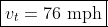
c) 76mph
Homework Answers
There are two forces acting: mg is the gravitational force of the Earth and Fdrag is the drag force of the air. The free-body diagram is shown below
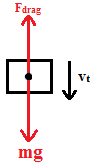
The drag force is given by
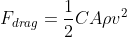
where C is the drag coefficient, A is the effective area, p is the density of air, v is the speed of the person.
There is no change in velocity when the terminal velocity is obtained. The acceleration of the person is zero. By Newton's second law of motion, the net force acting on the person must be zero. In other words, the terminal velocity is obtained when the drag force is equal to the gravitational force.

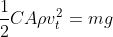


Substituting  we get

We know that  and
and 

Add Answer to:
You go skydiving. Unfortunately, your parachute doesn't open. To
try slow yourself down you spread your...
While skydiving, your parachute opens and you slow down from 50.0 m/s to 8.00 m/s in...
 While skydiving, your parachute opens and you slow down from 50.0 m/s to 8.00 m/s in 0.800 s. (a) Determine the distance you fall while the parachute is opening (b) Determine the magnitude of your acceleration during this time interval (c) Divide the acceleration found in (b) by g-9.80 m/s. Typically, some people feel faint if this exceeds 5 (5 g's). Will you feel faint? (d) What assumptions did you make in solving this problem?
 While skydiving, your parachute opens and you slow down from 50.0 m/s to 8.00 m/s in 0.800 s. (a) Determine the distance you fall while the parachute is opening (b) Determine the magnitude of your acceleration during this time interval (c) Divide the acceleration found in (b) by g-9.80 m/s. Typically, some people feel faint if this exceeds 5 (5 g's). Will you feel faint? (d) What assumptions did you make in solving this problem?
Most questions answered within 3 hours.
-
Where is the error in this code sequence?
String s1 = "Hello";
String s2 = "ello";...
asked 10 months ago -
Financial data for Joel de Paris, Inc., for last year
follow:
Joel de Paris, Inc.
Balance...
asked 10 months ago -
Consider this reaction:
Al2(SO4)3 (aq)+ BaCl3
(aq) Al2Cl6 (aq)- +
3BaSO4(s) . What is the...
asked 10 months ago -
Suppose that Savneet is considering increasing her
recent random sample from 20 car rentals to 40...
asked 10 months ago -
Trucks arrive at an unloading terminal at an average rate of 120
per hour.
Trucks arrive...
asked 10 months ago -
Why are methanol and ethanol completely soluble in water while
octanol is not very little soluble....
asked 10 months ago -
A facilities manager at a university reads in a research report
that the mean amount of...
asked 10 months ago -
When the CuSO4 is rehydrated by adding water to the anhydrous
compound, is this an endothermic...
asked 10 months ago -
A ray of sunlight is passing from diamond into crown glass; the
angle of incidence is...
asked 10 months ago -
A block of mass 0.249 kg is placed on top of a light, vertical
spring of...
asked 10 months ago -
how do the kidneys compensate in the presences of acidosis
a) trigger hyperventilate
b) reserve acid...
asked 10 months ago -
Question 501 pts
The rental rate of capital to the firm increases. Which of the
following...
asked 10 months ago