I have an aqueous solution containing HBr (aq) and Br2 (l). This turns the solution brown....
I have an aqueous solution containing HBr (aq) and Br2 (l). This turns the solution brown. How can I extract the Br2 from the solution without affecting the HBr?
Homework Answers

Add Answer to:
I have an aqueous solution containing HBr (aq) and Br2 (l). This
turns the solution brown....
6) For the reaction 4 HBr(aq) + O2(g) = 2 Br2(aq) + 2 H2O(l), K. -6.7...
 6) For the reaction 4 HBr(aq) + O2(g) = 2 Br2(aq) + 2 H2O(l), K. -6.7 x 10¹⁰. Use this information to calculate the equilibrium constant for each of the following reactions. a) 2 HBr(aq) + 12 O2(g) + Brz(aq) + H2O(1) b) 4 Br2(aq) + 4H2O(l) = 8 HBr(aq) + 2 O2(g)
An aqueous solution containing 15.0 g of NaOH is mixed with an aqueous solution containing 15.0...
An aqueous solution containing 15.0 g of NaOH is mixed with an aqueous solution containing 15.0 g of H2SO4. Is sodium hydroxide or sulfuric acid the limiting reactant? H2SO4(aq) + 2NaOH(aq) → Na2SO4(aq) + 2H2O(l)
MnO2(s) + HBr(aq) → MnBr2(aq) + Br2(l) (in acid) Reduction half reaction: Oxidation half reaction: Full...
MnO2(s) + HBr(aq) → MnBr2(aq) + Br2(l) (in acid) Reduction half reaction: Oxidation half reaction: Full balanced equation:
a) Determine the pH of an aqueous solution containing 0.750 mol/L thiophenol (C6H5SH), which is a...
a) Determine the pH of an aqueous solution containing 0.750 mol/L thiophenol (C6H5SH), which is a weak acid. (Ka(thiophenol) = 3.2 x 10⁻⁷ ) b)Determine the pH of an aqueous solution containing 0.750 mol/L thiophenol and 0.500 mol/L hydrochloric acid, HCl(aq).
determine the pH of an aqueous solution containing 0.650 mol/L thiophenol (C6H5SH), which is a weak...
determine the pH of an aqueous solution containing 0.650 mol/L thiophenol (C6H5SH), which is a weak acid (Ka(thiophenol)=3.2*10^-7) b. determine the pH of an aqueous solution containing 0.650 mol/L thiophenol and 0.500 mol/L hydrochloric acid, HCI(aq)
Which reaction describes the ionization of a strong acid in aqueous solution? A: LiOH(aq) --> Li+(aq)...
Which reaction describes the ionization of a strong acid in aqueous solution? A: LiOH(aq) --> Li+(aq) + OH- (aq) B: HBr(aq) + H2O(l) --> H2Br+(aq) + OH- (aq) C: HSO4ದaq) + H3O+(aq) --> H2O(l) + H2SO4(aq) D: HI(aq) + H2O(l) --> H3O+(aq) + I- (aq) Please explain why the answer would be a strong acid
Two aqueous hydrogen bromide solutions containing 1.00 wt% HBr (SG = 1.0041) and 65.0 wt% HBr...
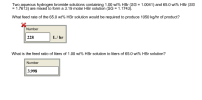 Two aqueous hydrogen bromide solutions containing 1.00 wt% HBr (SG
= 1.0041) and 65.0 wt% HBr (SG = 1.7613) are mixed to form a 3.19
molar HBr solution (SG = 1.1743).
Part B is correct, I just need Part A.
Two aqueous hydrogen bromide solutions containing 1.00 wt% HBr (SG
= 1.0041) and 65.0 wt% HBr (SG = 1.7613) are mixed to form a 3.19
molar HBr solution (SG = 1.1743).
Part B is correct, I just need Part A.
The peroxydisulfate ion (S2082) reacts with the iodide ion in aqueous solution via the reaction: 52082 (aq)+31-2S042- (aq)+ 13 (aq) An aqueous solution containing 0.050 M of S2082 ion and 0.072 M...
 The peroxydisulfate ion (S2082) reacts with the iodide ion in aqueous solution via the reaction: 52082 (aq)+31-2S042- (aq)+ 13 (aq) An aqueous solution containing 0.050 M of S2082 ion and 0.072 M of I- is prepared, and the progress of the reaction followed by measuring [I-]. The data obtained is given in the table below. Time (s) 0 400 800 1200 1600 IlM 0.072 0.057 0.046 0.037 0.029 Between 800 and 1200 s the average rate of decomposition of 12...
Balance the following redox reaction in basic solution: Br2(l) ----> BrO3-(aq) + Br-(aq)
Balance the following redox reaction in basic solution: Br2(l) ----> BrO3-(aq) + Br-(aq)
An aqueous solution containing 8.16 g of lead(II) nitrate is added to an aqueous solution containing...
 An aqueous solution containing 8.16 g of lead(II) nitrate is added to an aqueous solution containing 6.57 g of potassium chloride. Enter the balanced chemical equation for this reaction. Be sure to include all physical states. balanced chemical equation: Pb(NO3)2(aq) + 2 KCl(aq) + PbCl,(s) + 2 KNO3(aq) What is the limiting reactant? O potassium chloride lead(II) nitrate The percent yield for the reaction is 91.6%. How many grams of precipitate is recovered? precipitate recovered: How many grams of the...
 6) For the reaction 4 HBr(aq) + O2(g) = 2 Br2(aq) + 2 H2O(l), K. -6.7 x 10¹⁰. Use this information to calculate the equilibrium constant for each of the following reactions. a) 2 HBr(aq) + 12 O2(g) + Brz(aq) + H2O(1) b) 4 Br2(aq) + 4H2O(l) = 8 HBr(aq) + 2 O2(g)
 Two aqueous hydrogen bromide solutions containing 1.00 wt% HBr (SG
= 1.0041) and 65.0 wt% HBr (SG = 1.7613) are mixed to form a 3.19
molar HBr solution (SG = 1.1743).
Part B is correct, I just need Part A.
Two aqueous hydrogen bromide solutions containing 1.00 wt% HBr (SG
= 1.0041) and 65.0 wt% HBr (SG = 1.7613) are mixed to form a 3.19
molar HBr solution (SG = 1.1743).
Part B is correct, I just need Part A.
 The peroxydisulfate ion (S2082) reacts with the iodide ion in aqueous solution via the reaction: 52082 (aq)+31-2S042- (aq)+ 13 (aq) An aqueous solution containing 0.050 M of S2082 ion and 0.072 M of I- is prepared, and the progress of the reaction followed by measuring [I-]. The data obtained is given in the table below. Time (s) 0 400 800 1200 1600 IlM 0.072 0.057 0.046 0.037 0.029 Between 800 and 1200 s the average rate of decomposition of 12...
 An aqueous solution containing 8.16 g of lead(II) nitrate is added to an aqueous solution containing 6.57 g of potassium chloride. Enter the balanced chemical equation for this reaction. Be sure to include all physical states. balanced chemical equation: Pb(NO3)2(aq) + 2 KCl(aq) + PbCl,(s) + 2 KNO3(aq) What is the limiting reactant? O potassium chloride lead(II) nitrate The percent yield for the reaction is 91.6%. How many grams of precipitate is recovered? precipitate recovered: How many grams of the...
Most questions answered within 3 hours.
-
Where is the error in this code sequence?
String s1 = "Hello";
String s2 = "ello";...
asked 11 months ago -
Financial data for Joel de Paris, Inc., for last year
follow:
Joel de Paris, Inc.
Balance...
asked 11 months ago -
Consider this reaction:
Al2(SO4)3 (aq)+ BaCl3
(aq) Al2Cl6 (aq)- +
3BaSO4(s) . What is the...
asked 11 months ago -
Suppose that Savneet is considering increasing her
recent random sample from 20 car rentals to 40...
asked 11 months ago -
Trucks arrive at an unloading terminal at an average rate of 120
per hour.
Trucks arrive...
asked 11 months ago -
Why are methanol and ethanol completely soluble in water while
octanol is not very little soluble....
asked 11 months ago -
A facilities manager at a university reads in a research report
that the mean amount of...
asked 11 months ago -
When the CuSO4 is rehydrated by adding water to the anhydrous
compound, is this an endothermic...
asked 11 months ago -
A ray of sunlight is passing from diamond into crown glass; the
angle of incidence is...
asked 11 months ago -
A block of mass 0.249 kg is placed on top of a light, vertical
spring of...
asked 11 months ago -
how do the kidneys compensate in the presences of acidosis
a) trigger hyperventilate
b) reserve acid...
asked 11 months ago -
Question 501 pts
The rental rate of capital to the firm increases. Which of the
following...
asked 11 months ago