Which one of the following statements is true concerning the ratio of the molar heat capacities...
Which one of the following statements is true concerning the ratio of the molar heat capacities Cp/Cv for an ideal gas?
-
A) The ratio is always less than 1. D) The ratio is always 1.
-
B) The ratio is sometimes less than 1. E) The ratio is always greater than 1.
-
C) The ratio is sometimes greater than 1.
Homework Answers
According to the Mayer's formula the relation between  and
and
 is
given by-
is
given by-

 -------------(1)
Now the ratio-
 (using equation (1))
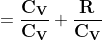


It means that the ratio is always greater than 1.
So option E is correct.
Add Answer to:
Which one of the following statements is true concerning the
ratio of the molar heat capacities...
Which of the following statements are true about the relationship between C P,mand CV, m? Check all that apply. o C...
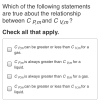 Which of the following statements are true about the relationship between C P,mand CV, m? Check all that apply. o CP,m can be greater or less than C v.m for a gas. CP.mis always greater than C V.m for a liquid. CP,mis always greater than C v,m for a gas. CP,m can be greater or less than C v,m for a liquid.
Ch 19 HW Relationships between Molar Heat Capacities 9 of 23 Constants The amount of heat needed to raise the temperatu...
 Ch 19 HW Relationships between Molar Heat Capacities 9 of 23 Constants The amount of heat needed to raise the temperature of 1 mole of a substance by one Celsius degree (or, equivalently, one kelvin) is called the molar heat capacity of the system, denoted by the letter C. If a small amount of heat dQ is put into n moles of a substance, and the resulting change in temperature for the system is dT, then Part A Consider an...
The amount of heat needed to raise the temperature of 1 mole of a substance by...
The amount of heat needed to raise the temperature of 1 mole of a substance by one Celsius degree (or, equivalently, one kelvin) is called the molar heat capacity of the system, denoted by the letter C. If a small amount of heat dQ is put into n moles of a substance, and the resulting change in temperature for the system is dT, then C=1ndQdT. This is the definition of molar heat capacity--the amount of heat Q added per infinitesimal...
Which of the following statements about the standard molar entropy (S°) is true? Select one: a....
Which of the following statements about the standard molar entropy (S°) is true? Select one: a. The standard molar entropies for a substance are determined from the heat capacity b. The standard molar entropies for elements in their standard states is zero c. S° for F2(g) is less than S° for Br2(g) because F2 is lighter than Br2 d. S° generally increases with the size of the molecule (I.e. the number of atoms) e. None of the above
.4 Recall that the adiabatic index is the ratio of the heat capacities at constant pressure...
 .4 Recall that the adiabatic index is the ratio of the heat capacities at constant pressure and at constant volume. Show that, for an ideal classical gas, the critical temperature gradient for the onset of convection (3.23) can be written as dx con where Cp is the thermal capacity per unit mass at constant pressure and g is the acceleration due to gravity. (Note that if the thermal capacity is high because of the absorption of heat by the excitation...
Which of the following statements is true of the debt to equity ratio? A. The higher the debt to equity ratio, the gre...
Which of the following statements is true of the debt to equity ratio? A. The higher the debt to equity ratio, the greater the company's financial risk. B. If the debt to equity ratio is less than 1, the company is financing more assets with debt than with equity. C. If the debt to equity ratio is greater than 1, the company is financing more assets with equity than with debt. D. The higher the debt to equity ratio, the...
Which of the following statements concerning existing projects is true?An existing project should be: I. Continued...
Which of the following statements concerning existing projects is true?An existing project should be: I. Continued when its continuing value is greater than both its liquidation and divestiture value. II. Liquidated when its liquidation value is greater than its divestiture value. III. Divested when its divestiture value is greater than both its continuing value and its liquidation value. Select one: a. I only b. II only c. I and II only d. I and III only e. II and III only Which of...
Which one of the following statements is true concerning the price-earnings (PE) ratio? 1) The PE...
 Which one of the following statements is true concerning the price-earnings (PE) ratio? 1) The PE ratio is a constant value for each firm. 2) A PE ratio of 16 indicates that investors are willing to pay $16 for every $1 of current earnings. 3) A high PE ratio indicates that a firm is undervalued. 4) PE ratios are unaffected by the accounting methods employed by a firm. 5) The PE ratio is classified as a profitability ratio. Question 2...
Which one of the following statements is NOT true concerning the equation below? N2(g) + 3...
Which one of the following statements is NOT true concerning the equation below? N2(g) + 3 H2(g) → 2 NH3(g) ΔH°rxn = -459.0 kJ A) The production of 1.00 mole of ammonia is accompanied by the production of 229.5 kJ of heat. B) The complete reaction of 1.00 moles of nitrogen requires 459 kJ of heat. C) The complete reaction of 1.00 moles of hydrogen produces 153 kJ of heat. D) The complete reaction of 0.8278 moles of hydrogen requires...
Which of the following statements concerning liquidity and debt is true? A) The greater use of...
Which of the following statements concerning liquidity and debt is true? A) The greater use of short-term debt, the lower the risk of illiquidity. B) Long-term debt is generally less costly than short-term debt. C) A firm can reduce its risk for illiquidity by shifting from short-term debt to long-term debt. D) The risk of illiquidity does not depend on the mix of short-term versus long-term debt.
 Which of the following statements are true about the relationship between C P,mand CV, m? Check all that apply. o CP,m can be greater or less than C v.m for a gas. CP.mis always greater than C V.m for a liquid. CP,mis always greater than C v,m for a gas. CP,m can be greater or less than C v,m for a liquid.
 Ch 19 HW Relationships between Molar Heat Capacities 9 of 23 Constants The amount of heat needed to raise the temperature of 1 mole of a substance by one Celsius degree (or, equivalently, one kelvin) is called the molar heat capacity of the system, denoted by the letter C. If a small amount of heat dQ is put into n moles of a substance, and the resulting change in temperature for the system is dT, then Part A Consider an...
 .4 Recall that the adiabatic index is the ratio of the heat capacities at constant pressure and at constant volume. Show that, for an ideal classical gas, the critical temperature gradient for the onset of convection (3.23) can be written as dx con where Cp is the thermal capacity per unit mass at constant pressure and g is the acceleration due to gravity. (Note that if the thermal capacity is high because of the absorption of heat by the excitation...
 Which one of the following statements is true concerning the price-earnings (PE) ratio? 1) The PE ratio is a constant value for each firm. 2) A PE ratio of 16 indicates that investors are willing to pay $16 for every $1 of current earnings. 3) A high PE ratio indicates that a firm is undervalued. 4) PE ratios are unaffected by the accounting methods employed by a firm. 5) The PE ratio is classified as a profitability ratio. Question 2...
Most questions answered within 3 hours.
-
Where is the error in this code sequence?
String s1 = "Hello";
String s2 = "ello";...
asked 11 months ago -
Financial data for Joel de Paris, Inc., for last year
follow:
Joel de Paris, Inc.
Balance...
asked 11 months ago -
Consider this reaction:
Al2(SO4)3 (aq)+ BaCl3
(aq) Al2Cl6 (aq)- +
3BaSO4(s) . What is the...
asked 11 months ago -
Suppose that Savneet is considering increasing her
recent random sample from 20 car rentals to 40...
asked 11 months ago -
Trucks arrive at an unloading terminal at an average rate of 120
per hour.
Trucks arrive...
asked 11 months ago -
Why are methanol and ethanol completely soluble in water while
octanol is not very little soluble....
asked 11 months ago -
A facilities manager at a university reads in a research report
that the mean amount of...
asked 11 months ago -
When the CuSO4 is rehydrated by adding water to the anhydrous
compound, is this an endothermic...
asked 11 months ago -
A ray of sunlight is passing from diamond into crown glass; the
angle of incidence is...
asked 11 months ago -
A block of mass 0.249 kg is placed on top of a light, vertical
spring of...
asked 11 months ago -
how do the kidneys compensate in the presences of acidosis
a) trigger hyperventilate
b) reserve acid...
asked 11 months ago -
Question 501 pts
The rental rate of capital to the firm increases. Which of the
following...
asked 11 months ago