a table of physical properties and saftey notes for the compounds biphenyl, methyl orange, acetone, hexane,...
a table of physical properties and saftey notes for the compounds biphenyl, methyl orange, acetone, hexane, and ethyl acetate.
Homework Answers


Add Answer to:
a table of physical properties and saftey notes for
the compounds biphenyl, methyl orange, acetone, hexane,...
research the physical and chemical properties of any two elements. Include Iodine and Acetone -- density...
research the physical and chemical properties of any two elements. Include Iodine and Acetone -- density -- boiling point -- melting point -- conductivity -- compounds containing the element found in nature (minerals) -- common chemical reactions -- Describe two uses for iodine elements.
EXPERIMENT 19 Part A: Physical Properties of Hydrocarbons Observe the results of the ignition test and...
EXPERIMENT 19 Part A: Physical Properties of Hydrocarbons Observe the results of the ignition test and record observations in the table below Draw the structures of each compound and predict its solubility in water Compounds Tested Structure Ignition Test Solubility in Water Methanol Acetone Hexane Cyclohexanol Toluene Part B: Reaction of Bromine with Hydrocarbons Alkenes tend to undergo addition reactions We have learned hydrogenation (addition of hydrogen) and hydration (addition of water) However, alkenes also undergo halogenation (addition of halogen)....
Physical Properties 10% the compounds below in order of increasing melting point. Briefly explain your re...
 Physical Properties 10% the compounds below in order of increasing melting point. Briefly explain your re 1. Place a) b) LiCI d) c) N2. KO CHs(CH2).СООН 2. Match the following compounds with MeOH their melting points. a. 69.3°C, -97.6°C, -210°C, 740°c b. -97.6°C, -210°C, 740°C, 69.3°C, respectively c. 740°C, 69.3°C, -97.6°C, -210°C, respectively d. res -210°C, 740°C, 69.3°C, -97.6°C, respectively 740°C, 69.3°C, -97.6°C, -210°C, respectively e. 3. Rank the following compounds in order of increasing water solubility (lowest first, to...
14) Consider the following compounds. (1) n-hexane, CH3CH CH2CH2CH CHs, molar mass 86.18 g/mole (II) n-pentanal,...
 14) Consider the following compounds. (1) n-hexane, CH3CH CH2CH2CH CHs, molar mass 86.18 g/mole (II) n-pentanal, CH3CH2CH2CH2CHO, molar mass 87.15 g/mole (III) i-hexane, CHsCH2CH2CH(CH3)2, molar mass = 86.18 g/mole (IV) sodium acetate, CH3 CO2Na, molar mass 82.03 g/mole (V) butanoic acid, CH3CH2CH2CO2H, molar mass 88.11 g/mole (VI) butane-diol, HOCH2CH:CH2CH2OH, molar mass = 92.14 g/mole (VIl) 2,2-dimethylbutane, CHaCH2C(CHaa, molar mass 86.18 g/mole (VII) Ethyl methyl ether, CHaCH2OCH2CH2CHa, molar mass 89.16 g/mole (IX) n-pentanol, C a) Arrange them in order of increasing...
A compound with the molecular formula of C7H16 has the following physical properties: mp= -123.8 C;...
A compound with the molecular formula of C7H16 has the following physical properties: mp= -123.8 C; bp= 79.2 C; density = 0.6739 g/mL. There are several compounds with that formula. Use a reference book to determine the name and the structural formula of the isomer with those specific properties. Hint: Use the boiling point index at the end of the section “Physical Constants of Organic Compounds” in the CRC Handbook of Chemistry and Physics. Determine the boiling point, water solubility...
38 Report Sheet . Identification of Substances by Physical Properties 8. When water and bromoform are...
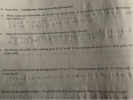 38 Report Sheet . Identification of Substances by Physical Properties 8. When water and bromoform are (See Table 3.1.) and bromoform are mixed, two layers form. Is the bottom layer water or bromoform? Sunce bromo form is more dense than a e botton layer is of brolno storm so the bottone s e 9. What solvent would you use to determine the density of zinc chloride Ca loupe o. Antoa e gо да се с о с will not dessous...
Data Table 1: Physical Properties of Copper and Copper Compounds State Species (s. aq) Color Name...
 Data Table 1: Physical Properties of Copper and Copper Compounds State Species (s. aq) Color Name noun Copper Curou Copper, Cu (a penny) Copper, Cu (recovered, wet) Copper, Cu (recovered, dry) Cu(NO3)2 Cu(OH)2 Cuo Cuso Table 2: Mass of Copper Before and After Performing the Copper Cycle Mass of the penny before any reaction 2.u Mass of the penny after reacting with concentrated HNO (aq) 1.86 Mass of copper used (i.e., difference between the two previous masses) 0.54 Mass of...
Name Structure 1) ethanol (ethyl alcohol) State (s), (0) H2O Notes CH-CH2-OH Sol., Insol CH4 Sol.,...
 Name Structure 1) ethanol (ethyl alcohol) State (s), (0) H2O Notes CH-CH2-OH Sol., Insol CH4 Sol., Insol. IS Is I No change 2) t-butyl alcohol (2-methyl-2- propanol) CH CH3-C-CH3 1 Is Is I No change OH 3) n-hexyl alcohol (1-hexanol) CH3CH,CH,CH,CHCH2-OH 4) dodecanol 5) 1,6-hexanediol CH CH CH CH CHCH OH ОН 6) decanoic acid Part A) save sample for part B OHS Insols decanoic acid Part B) changed to sodium decanoate after rxn with NaOH After adding the NaOH...
Acid/Base Extraction 1. Provide a flow chart detailing the acid/base extraction/separation of the compounds shown below....
 Acid/Base Extraction
1. Provide a flow chart detailing the acid/base
extraction/separation of the compounds shown below. Your answer
must employ the following reagents: methylene chloride,
hydrochloric acid (1M & 6M), sodium hydroxide (1M & 6M),
10% sodium bicarbonate (aq). Clearly indicate the product(s) and
layers formed following each step of your separation scheme.
IMPORTANT: p-cresol is soluble in sodium hydroxide solution but
insoluble in neutral water or sodium bicarbonate solution. 2-
ethylbenzoic acid is soluble in both sodium hydroxide and...
Acid/Base Extraction
1. Provide a flow chart detailing the acid/base
extraction/separation of the compounds shown below. Your answer
must employ the following reagents: methylene chloride,
hydrochloric acid (1M & 6M), sodium hydroxide (1M & 6M),
10% sodium bicarbonate (aq). Clearly indicate the product(s) and
layers formed following each step of your separation scheme.
IMPORTANT: p-cresol is soluble in sodium hydroxide solution but
insoluble in neutral water or sodium bicarbonate solution. 2-
ethylbenzoic acid is soluble in both sodium hydroxide and...
Pre-Laboratory Exercise: Plastics Identification I. List four properties that you will use in lab...
 can
someone help me find this information?
Pre-Laboratory Exercise: Plastics Identification I. List four properties that you will use in lab to determine the identity of the polymer samples 2. Describe the density test. What observation will help you determine the density of each polymer? What precautions should be taken in placing the sample in the solutions? 3. Write the name and abbreviation for the six recyclable polymers 2 huetn deisity polyetayene.HDpz poulene: PP 4. Given the list of wavenumber...
can
someone help me find this information?
Pre-Laboratory Exercise: Plastics Identification I. List four properties that you will use in lab to determine the identity of the polymer samples 2. Describe the density test. What observation will help you determine the density of each polymer? What precautions should be taken in placing the sample in the solutions? 3. Write the name and abbreviation for the six recyclable polymers 2 huetn deisity polyetayene.HDpz poulene: PP 4. Given the list of wavenumber...
 Physical Properties 10% the compounds below in order of increasing melting point. Briefly explain your re 1. Place a) b) LiCI d) c) N2. KO CHs(CH2).СООН 2. Match the following compounds with MeOH their melting points. a. 69.3°C, -97.6°C, -210°C, 740°c b. -97.6°C, -210°C, 740°C, 69.3°C, respectively c. 740°C, 69.3°C, -97.6°C, -210°C, respectively d. res -210°C, 740°C, 69.3°C, -97.6°C, respectively 740°C, 69.3°C, -97.6°C, -210°C, respectively e. 3. Rank the following compounds in order of increasing water solubility (lowest first, to...
 14) Consider the following compounds. (1) n-hexane, CH3CH CH2CH2CH CHs, molar mass 86.18 g/mole (II) n-pentanal, CH3CH2CH2CH2CHO, molar mass 87.15 g/mole (III) i-hexane, CHsCH2CH2CH(CH3)2, molar mass = 86.18 g/mole (IV) sodium acetate, CH3 CO2Na, molar mass 82.03 g/mole (V) butanoic acid, CH3CH2CH2CO2H, molar mass 88.11 g/mole (VI) butane-diol, HOCH2CH:CH2CH2OH, molar mass = 92.14 g/mole (VIl) 2,2-dimethylbutane, CHaCH2C(CHaa, molar mass 86.18 g/mole (VII) Ethyl methyl ether, CHaCH2OCH2CH2CHa, molar mass 89.16 g/mole (IX) n-pentanol, C a) Arrange them in order of increasing...
 38 Report Sheet . Identification of Substances by Physical Properties 8. When water and bromoform are (See Table 3.1.) and bromoform are mixed, two layers form. Is the bottom layer water or bromoform? Sunce bromo form is more dense than a e botton layer is of brolno storm so the bottone s e 9. What solvent would you use to determine the density of zinc chloride Ca loupe o. Antoa e gо да се с о с will not dessous...
 Data Table 1: Physical Properties of Copper and Copper Compounds State Species (s. aq) Color Name noun Copper Curou Copper, Cu (a penny) Copper, Cu (recovered, wet) Copper, Cu (recovered, dry) Cu(NO3)2 Cu(OH)2 Cuo Cuso Table 2: Mass of Copper Before and After Performing the Copper Cycle Mass of the penny before any reaction 2.u Mass of the penny after reacting with concentrated HNO (aq) 1.86 Mass of copper used (i.e., difference between the two previous masses) 0.54 Mass of...
 Name Structure 1) ethanol (ethyl alcohol) State (s), (0) H2O Notes CH-CH2-OH Sol., Insol CH4 Sol., Insol. IS Is I No change 2) t-butyl alcohol (2-methyl-2- propanol) CH CH3-C-CH3 1 Is Is I No change OH 3) n-hexyl alcohol (1-hexanol) CH3CH,CH,CH,CHCH2-OH 4) dodecanol 5) 1,6-hexanediol CH CH CH CH CHCH OH ОН 6) decanoic acid Part A) save sample for part B OHS Insols decanoic acid Part B) changed to sodium decanoate after rxn with NaOH After adding the NaOH...
 Acid/Base Extraction
1. Provide a flow chart detailing the acid/base
extraction/separation of the compounds shown below. Your answer
must employ the following reagents: methylene chloride,
hydrochloric acid (1M & 6M), sodium hydroxide (1M & 6M),
10% sodium bicarbonate (aq). Clearly indicate the product(s) and
layers formed following each step of your separation scheme.
IMPORTANT: p-cresol is soluble in sodium hydroxide solution but
insoluble in neutral water or sodium bicarbonate solution. 2-
ethylbenzoic acid is soluble in both sodium hydroxide and...
Acid/Base Extraction
1. Provide a flow chart detailing the acid/base
extraction/separation of the compounds shown below. Your answer
must employ the following reagents: methylene chloride,
hydrochloric acid (1M & 6M), sodium hydroxide (1M & 6M),
10% sodium bicarbonate (aq). Clearly indicate the product(s) and
layers formed following each step of your separation scheme.
IMPORTANT: p-cresol is soluble in sodium hydroxide solution but
insoluble in neutral water or sodium bicarbonate solution. 2-
ethylbenzoic acid is soluble in both sodium hydroxide and...
 can
someone help me find this information?
Pre-Laboratory Exercise: Plastics Identification I. List four properties that you will use in lab to determine the identity of the polymer samples 2. Describe the density test. What observation will help you determine the density of each polymer? What precautions should be taken in placing the sample in the solutions? 3. Write the name and abbreviation for the six recyclable polymers 2 huetn deisity polyetayene.HDpz poulene: PP 4. Given the list of wavenumber...
can
someone help me find this information?
Pre-Laboratory Exercise: Plastics Identification I. List four properties that you will use in lab to determine the identity of the polymer samples 2. Describe the density test. What observation will help you determine the density of each polymer? What precautions should be taken in placing the sample in the solutions? 3. Write the name and abbreviation for the six recyclable polymers 2 huetn deisity polyetayene.HDpz poulene: PP 4. Given the list of wavenumber...
Most questions answered within 3 hours.
-
Where is the error in this code sequence?
String s1 = "Hello";
String s2 = "ello";...
asked 11 months ago -
Financial data for Joel de Paris, Inc., for last year
follow:
Joel de Paris, Inc.
Balance...
asked 11 months ago -
Consider this reaction:
Al2(SO4)3 (aq)+ BaCl3
(aq) Al2Cl6 (aq)- +
3BaSO4(s) . What is the...
asked 11 months ago -
Suppose that Savneet is considering increasing her
recent random sample from 20 car rentals to 40...
asked 11 months ago -
Trucks arrive at an unloading terminal at an average rate of 120
per hour.
Trucks arrive...
asked 11 months ago -
Why are methanol and ethanol completely soluble in water while
octanol is not very little soluble....
asked 11 months ago -
A facilities manager at a university reads in a research report
that the mean amount of...
asked 11 months ago -
When the CuSO4 is rehydrated by adding water to the anhydrous
compound, is this an endothermic...
asked 11 months ago -
A ray of sunlight is passing from diamond into crown glass; the
angle of incidence is...
asked 11 months ago -
A block of mass 0.249 kg is placed on top of a light, vertical
spring of...
asked 11 months ago -
how do the kidneys compensate in the presences of acidosis
a) trigger hyperventilate
b) reserve acid...
asked 11 months ago -
Question 501 pts
The rental rate of capital to the firm increases. Which of the
following...
asked 11 months ago