Using heat of formation values from Appendix C of the textbook, calculate the standard enthalpy change...
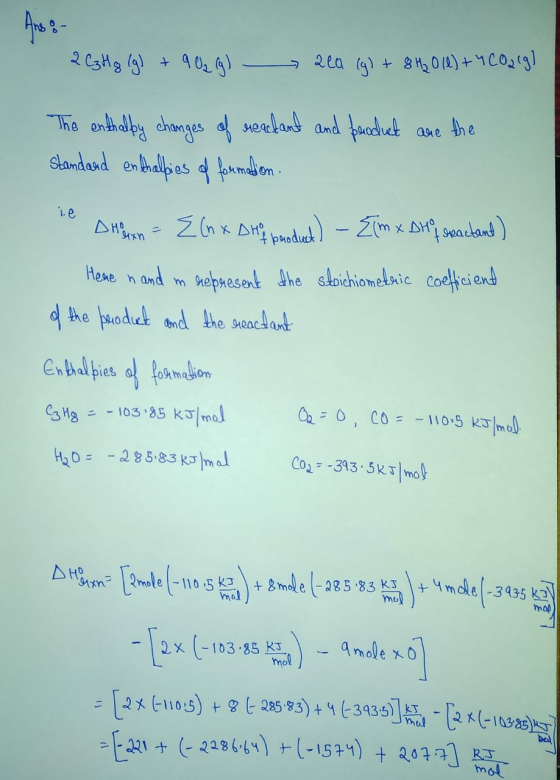
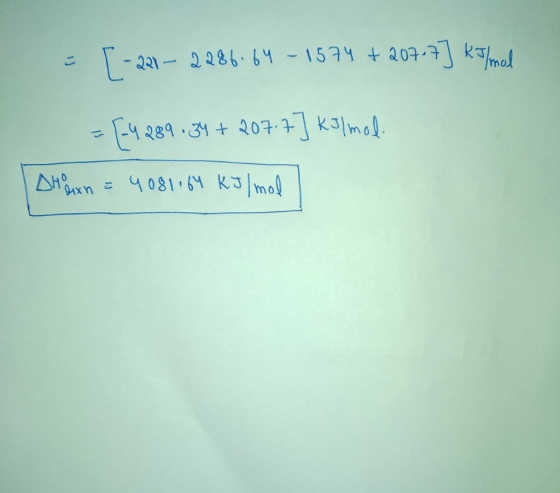
Using heat of formation values from Appendix C of the textbook, calculate the standard enthalpy change for the following reaction:
2 C3H8 (g) + 9 O2 (g) ----> 2 CO2 (g) + 8 H2O (l) + 4 CO2 (g)
Enthalpies of formation values
C3H8 (g) = -103.85 kJ/ mol , O2 (g) = 0 , CO (g) = -110.5 kJ/ mol , H20 (l) = -285.83 kJ/ mol , CO2 (g) = -393.5 kJ/ mol
Homework Answers
Dear student,
Please give a positive ratings to this answer.
With regards...
Add Answer to:
Using heat of formation values from Appendix C of the textbook,
calculate the standard enthalpy change...
Heat of Formation Calculations: 32) Use a standard enthalpies of formation (Ho) table to determine the...
Heat of Formation Calculations: 32) Use a standard enthalpies of formation (Ho) table to determine the change in enthalpy for each of these reactions Hrxn [n. Ho(products) - n. Ho(products)] CO (g): -110.5 kJ/mol; CO2 (g): -393.5 kJ/mol CH4 (g): -890.4 kJ/mol H2O (l): -285.8 kJ/mol; H2O (g): -241.8 kJ/mol H2S (g): -20.6 kJ/mol; NO: -90.2 kJ/mol NO2: +33.9 kJ/mol; HCl (g): -92.3 kJ/mol NaOH (s): -426.7 kJ/mol; SO2 (g): -296.8 kJ/mol a) CH4(g) + 2 O2(g) ---> CO2(g) +...
answer should be in sig figs. LReterences] TUTOR Calculating Enthalpy Change Using the standard formation enthalpies...
 answer should be in sig figs.
LReterences] TUTOR Calculating Enthalpy Change Using the standard formation enthalpies that follow, calculate the standard enthalpy change for this reaction. 2CO(g)+2NO(g)2CO2(g)+ N2(g) AH kJ Species AHo (kJ/mol) -110.5 CO(g) NO(g) CO2(g) 90.3 -393.5
answer should be in sig figs.
LReterences] TUTOR Calculating Enthalpy Change Using the standard formation enthalpies that follow, calculate the standard enthalpy change for this reaction. 2CO(g)+2NO(g)2CO2(g)+ N2(g) AH kJ Species AHo (kJ/mol) -110.5 CO(g) NO(g) CO2(g) 90.3 -393.5
The standard heat of formation, ΔH∘f, is defined as the enthalpy change for the formation of...
The standard heat of formation, ΔH∘f, is defined as the enthalpy change for the formation of one mole of substance from its constituent elements in their standard states. Thus, elements in their standard states have ΔH∘f=0. Heat of formation values can be used to calculate the enthalpy change of any reaction. Consider, for example, the reaction 2NO(g)+O2(g)⇌2NO2(g) with heat of formation values given by the following table: Substance ΔH∘f (kJ/mol) NO(g) 90.2 O2(g) 0 NO2(g) 33.2 Then the standard heat...
A.Using standard heats of formation, calculate the standard enthalpy change for the following reaction. N2(g) +...
A.Using standard heats of formation, calculate the standard enthalpy change for the following reaction. N2(g) + 3H2(g) = 2NH3(g) B.Using standard heats of formation, calculate the standard enthalpy change for the following reaction. CaCO3(s) = CaO(s) + CO2(g) C. A scientist measures the standard enthalpy change for the following reaction to be -2910.6 kJ: 2C2H6(g) + 7 O2(g) = 4CO2(g) + 6 H2O(g) Based on this value and the standard enthalpies of formation for the other substances, the standard enthalpy...
help asap 3. Calculate the standard enthalpy change, Hº, for the following reaction using standard enthalpies of for...
 help asap
3. Calculate the standard enthalpy change, Hº, for the following reaction using standard enthalpies of formation. (1 point) 2C2H2(g) + 502(g) → 4CO2(g) + 2H20(1) Standard Enthalpies of Formation AH for C2H2(g) = +226.7 kJ/mol AHfor CO2(g) = -393.5 kJ/mol AH for H2O(l) = -285.8 kJ/mol
help asap
3. Calculate the standard enthalpy change, Hº, for the following reaction using standard enthalpies of formation. (1 point) 2C2H2(g) + 502(g) → 4CO2(g) + 2H20(1) Standard Enthalpies of Formation AH for C2H2(g) = +226.7 kJ/mol AHfor CO2(g) = -393.5 kJ/mol AH for H2O(l) = -285.8 kJ/mol
Part A - Calculating an Enthalpy of Reaction from Enthalpies of Formation Calculate the enthalpy change...
Part A - Calculating an Enthalpy of Reaction from Enthalpies of Formation Calculate the enthalpy change for the reaction: 2 H2O2(l) → 2 H2O(l) + O2(g) using enthalpies of formation: ΔH∘f[H2O2]ΔH∘f[H2O]==−187.8 kJ/mol−285.8 kJ/mol Calculate the enthalpy change for the reaction: using enthalpies of formation: Multiple choice answers below: -98.0 kJ -196.0 kJ +98.0 kJ +196.0 kJ
5. Using standard heats of formation, calculate AH for 4 FeO (s) + O2(g) → 2...
 5. Using standard heats of formation, calculate AH for 4 FeO (s) + O2(g) → 2 Fe2O3 (s) AH1 of FeO (s) = -272.0 kJ/mol AHºf of Fe2O3 (s) = -825.5 kJ/mol 3. Given 3 C (s) + 4 H2(g) → C3H8 (9) AH = -103.85 kJ/mol C(s) + O2(g) + CO2(g) AH = -393.5 kJ/mol H2 (g) + 12 O2(g) → H2O (1) AH = -285.8 kJ/mol find AH for C3H8 (g) + 5 O2(g) → 3 CO2 (g)...
Using values from Appendix C in the textbook, calculate the standard enthalpy change for each of...
Using values from Appendix C in the textbook, calculate the standard enthalpy change for each of the following reactions. Link to Appendix C: https://media.pearsoncmg.com/ph/esm/esm_brown_chemistry_14/appendices/appendix-c.pdf 1. 2SO2(g)+O2(g)→2SO3(g) 2. Mg(OH)2(s)→MgO(s)+H2O(l) 3. N2O4(g)+4H2(g)→N2(g)+4H2O(g)N2O4(g)+4H2(g)→N2(g)+4H2O(g) 4. SiCl4(l)+2H2O(l)→SiO2(s)+4HCl(g)
need help with 2. Use the following enthalpies of formation to calculate an approximate enthalpy of...
 need help with
2. Use the following enthalpies of formation to calculate an approximate enthalpy of reaction, AHrxn for: (5 pts) C3H8 (g) + 502 (g) → 3CO2 (g) + 4 H20 (1) C(s) + O2 (g) - CO2 (g); AH = - 393.5 kJ/mol H2(g) + 42 02 (g) - H20 (1); AH = - 285.5 kJ/mol 3 C(s) + 4 H2(g) → C3H8 (g); AH r = - 103.8 kJ/mol
need help with
2. Use the following enthalpies of formation to calculate an approximate enthalpy of reaction, AHrxn for: (5 pts) C3H8 (g) + 502 (g) → 3CO2 (g) + 4 H20 (1) C(s) + O2 (g) - CO2 (g); AH = - 393.5 kJ/mol H2(g) + 42 02 (g) - H20 (1); AH = - 285.5 kJ/mol 3 C(s) + 4 H2(g) → C3H8 (g); AH r = - 103.8 kJ/mol
Using the standard heats of formation that follow, calculate the standard enthalpy change for the following...
 Using the standard heats of formation that follow, calculate the standard enthalpy change for the following reaction. Species ΔΗΡ(kJ/mol) CO2(g) -393.5 C2H2(g) 226.7 H2O(g)241.8
 answer should be in sig figs.
LReterences] TUTOR Calculating Enthalpy Change Using the standard formation enthalpies that follow, calculate the standard enthalpy change for this reaction. 2CO(g)+2NO(g)2CO2(g)+ N2(g) AH kJ Species AHo (kJ/mol) -110.5 CO(g) NO(g) CO2(g) 90.3 -393.5
answer should be in sig figs.
LReterences] TUTOR Calculating Enthalpy Change Using the standard formation enthalpies that follow, calculate the standard enthalpy change for this reaction. 2CO(g)+2NO(g)2CO2(g)+ N2(g) AH kJ Species AHo (kJ/mol) -110.5 CO(g) NO(g) CO2(g) 90.3 -393.5
 help asap
3. Calculate the standard enthalpy change, Hº, for the following reaction using standard enthalpies of formation. (1 point) 2C2H2(g) + 502(g) → 4CO2(g) + 2H20(1) Standard Enthalpies of Formation AH for C2H2(g) = +226.7 kJ/mol AHfor CO2(g) = -393.5 kJ/mol AH for H2O(l) = -285.8 kJ/mol
help asap
3. Calculate the standard enthalpy change, Hº, for the following reaction using standard enthalpies of formation. (1 point) 2C2H2(g) + 502(g) → 4CO2(g) + 2H20(1) Standard Enthalpies of Formation AH for C2H2(g) = +226.7 kJ/mol AHfor CO2(g) = -393.5 kJ/mol AH for H2O(l) = -285.8 kJ/mol
 5. Using standard heats of formation, calculate AH for 4 FeO (s) + O2(g) → 2 Fe2O3 (s) AH1 of FeO (s) = -272.0 kJ/mol AHºf of Fe2O3 (s) = -825.5 kJ/mol 3. Given 3 C (s) + 4 H2(g) → C3H8 (9) AH = -103.85 kJ/mol C(s) + O2(g) + CO2(g) AH = -393.5 kJ/mol H2 (g) + 12 O2(g) → H2O (1) AH = -285.8 kJ/mol find AH for C3H8 (g) + 5 O2(g) → 3 CO2 (g)...
 need help with
2. Use the following enthalpies of formation to calculate an approximate enthalpy of reaction, AHrxn for: (5 pts) C3H8 (g) + 502 (g) → 3CO2 (g) + 4 H20 (1) C(s) + O2 (g) - CO2 (g); AH = - 393.5 kJ/mol H2(g) + 42 02 (g) - H20 (1); AH = - 285.5 kJ/mol 3 C(s) + 4 H2(g) → C3H8 (g); AH r = - 103.8 kJ/mol
need help with
2. Use the following enthalpies of formation to calculate an approximate enthalpy of reaction, AHrxn for: (5 pts) C3H8 (g) + 502 (g) → 3CO2 (g) + 4 H20 (1) C(s) + O2 (g) - CO2 (g); AH = - 393.5 kJ/mol H2(g) + 42 02 (g) - H20 (1); AH = - 285.5 kJ/mol 3 C(s) + 4 H2(g) → C3H8 (g); AH r = - 103.8 kJ/mol
 Using the standard heats of formation that follow, calculate the standard enthalpy change for the following reaction. Species ΔΗΡ(kJ/mol) CO2(g) -393.5 C2H2(g) 226.7 H2O(g)241.8
Most questions answered within 3 hours.
-
Where is the error in this code sequence?
String s1 = "Hello";
String s2 = "ello";...
asked 11 months ago -
Financial data for Joel de Paris, Inc., for last year
follow:
Joel de Paris, Inc.
Balance...
asked 11 months ago -
Consider this reaction:
Al2(SO4)3 (aq)+ BaCl3
(aq) Al2Cl6 (aq)- +
3BaSO4(s) . What is the...
asked 11 months ago -
Suppose that Savneet is considering increasing her
recent random sample from 20 car rentals to 40...
asked 11 months ago -
Trucks arrive at an unloading terminal at an average rate of 120
per hour.
Trucks arrive...
asked 11 months ago -
Why are methanol and ethanol completely soluble in water while
octanol is not very little soluble....
asked 11 months ago -
A facilities manager at a university reads in a research report
that the mean amount of...
asked 11 months ago -
When the CuSO4 is rehydrated by adding water to the anhydrous
compound, is this an endothermic...
asked 11 months ago -
A ray of sunlight is passing from diamond into crown glass; the
angle of incidence is...
asked 11 months ago -
A block of mass 0.249 kg is placed on top of a light, vertical
spring of...
asked 11 months ago -
how do the kidneys compensate in the presences of acidosis
a) trigger hyperventilate
b) reserve acid...
asked 11 months ago -
Question 501 pts
The rental rate of capital to the firm increases. Which of the
following...
asked 11 months ago