What is the Cyclomatic Complexity for the following pseudo-code fragment? i=1; n=10; while (i<n) do ...
What is the Cyclomatic Complexity for the following pseudo-code fragment?
i=1;
n=10;
while (i<n) do
j=i+1;
while (j<n) do
if A[i]<A[j] then
swap(A[i], A[j]);
end if
end while;
i=i+1;
end while;
CC = E – N + 2P
E = number of edges (transfers in control)
N = number of nodes
P = number of disconnected parts of the flow graph (e.g. a calling program and a subroutine)
Homework Answers
Flow graph for this program will be

number of nodes =N= 7
number of edges=E=9
number of disconnected part of flow graph=P=1
Cyclomatic Complexity= E-N+2P
= 9-7+2(1)
= 4
NODE 1,2,3 ARE CONDITION NODES
Add Answer to:
What is the Cyclomatic Complexity for the following pseudo-code
fragment?
i=1;
n=10;
while (i<n)
do
...
What is the cyclomatic complexity of the following pseudo code program segment? Use line numbers in...
What is the cyclomatic complexity of the following pseudo code program segment? Use line numbers in the left column to indicate independent paths. Hint: Draw a flowchart and draw execution lines through the flowchart. 1) Read (A, B) 2) If (A>B) 3) Print A 4) Else 5) Print B 6) While (A>B) 7) A = A-1 8) End
c++ What is the worst-case complexity of the following code fragment: for(i = 0; i <...
c++ What is the worst-case complexity of the following code fragment: for(i = 0; i < N; i++) { for(j = 0; j < N; j++) { sequence of constant time statements } } for(i = N; i > 0; i--) { sequence of constant time statements }
What are the Big-Oh and Omega orders of the following code fragment? What is Tilde approximation?...
What are the Big-Oh and Omega orders of the following code fragment? What is Tilde approximation? The fragment is prameterized on the variable n. Assume that you are measuring the number of swap calls. for(int j=0;j<n-1;j++){ int z = j; for (int i=j+1; i<n; i++){ if(a[i] < a[z]){ z=i;} } if(z!= j){ swap(a[j], a[z]); //count these } }
2. What is the output of the following code fragment? n = 1; while (n <=...
2. What is the output of the following code fragment? n = 1; while (n <= 5) { n++; cout << n << ' '; a.1 2 3 4 5 b. 1 2 3 4 c. 1 1 1 forever d. 2 3 4 5 e. 2 3 4 5 6 3. What is the termination condition for the following While loop? while (beta > 0 && beta < 10) { cout << beta << endl; cin >> beta; }...
Consider the following pseudo-code: // Assume i, j, k are integers for i = 1 to...
Consider the following pseudo-code: // Assume i, j, k are integers for i = 1 to n do for j = n-i+1 to n { k = 1; while (k*k <= j) { perform <op>; k = k + 1; } } Find an expression for f(n), the number of times is performed. Find g(n) so that f(n) is Θ(g(n)). Prove your answer.
1(5 pts): For each code fragment below, give the complexity of the algorithm (O or Θ)....
 1(5 pts): For each code fragment below, give the complexity of the algorithm (O or Θ). Give the tightest possible upper bound as the input size variable increases. The input size variable in these questions is exclusively n. Complexity Code public static int recursiveFunction (int n)f f( n <= 0 ) return 0; return recursiveFunction (n - 1) 1; for(int i 0i <n; i+) j=0; for ( int j k=0; i; k < < j++) for (int j; m <...
What is the output of the following code fragment? int i = 1; while( i <=...
 What is the output of the following code fragment? int i = 1; while( i <= 5 ) if(i == 2 || i == 4) System.out.println(i + ":" + " is an even index) System.out.println("i: " + i); i++;
What is the Big-Oh order of the following code fragment? The fragment is parametrized on the...
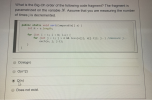 What is the Big-Oh order of the following code fragment? The fragment is parametrized on the variable N. Assume that you are measuring the number of times j is decremented. public static void sort(Comparable[] a) { int N-a.length; for (int i = 1; i < N;i++) { for (int j = i; j > && less(a[5], a[j-1]); j--) //measure j -- exch(a, j, j-1); O(nlogn) O O(n^2) Q(n) Does not exist.
What is the complexity of the following nested loops? for i = n to 1 step...
What is the complexity of the following nested loops? for i = n to 1 step -1 do j ← i while j ≥ 1 Θ(j) statement j ← ëj/2û endwhile endfor
Please use induction Consider the following code fragment: int i -1; int s=1; while (i <-...
 Please use induction
Consider the following code fragment: int i -1; int s=1; while (i <- n) Show that at the start of every iteration holds using induction
Please use induction
Consider the following code fragment: int i -1; int s=1; while (i <- n) Show that at the start of every iteration holds using induction
 1(5 pts): For each code fragment below, give the complexity of the algorithm (O or Θ). Give the tightest possible upper bound as the input size variable increases. The input size variable in these questions is exclusively n. Complexity Code public static int recursiveFunction (int n)f f( n <= 0 ) return 0; return recursiveFunction (n - 1) 1; for(int i 0i <n; i+) j=0; for ( int j k=0; i; k < < j++) for (int j; m <...
 What is the output of the following code fragment? int i = 1; while( i <= 5 ) if(i == 2 || i == 4) System.out.println(i + ":" + " is an even index) System.out.println("i: " + i); i++;
 What is the Big-Oh order of the following code fragment? The fragment is parametrized on the variable N. Assume that you are measuring the number of times j is decremented. public static void sort(Comparable[] a) { int N-a.length; for (int i = 1; i < N;i++) { for (int j = i; j > && less(a[5], a[j-1]); j--) //measure j -- exch(a, j, j-1); O(nlogn) O O(n^2) Q(n) Does not exist.
 Please use induction
Consider the following code fragment: int i -1; int s=1; while (i <- n) Show that at the start of every iteration holds using induction
Please use induction
Consider the following code fragment: int i -1; int s=1; while (i <- n) Show that at the start of every iteration holds using induction
Most questions answered within 3 hours.
-
Where is the error in this code sequence?
String s1 = "Hello";
String s2 = "ello";...
asked 11 months ago -
Financial data for Joel de Paris, Inc., for last year
follow:
Joel de Paris, Inc.
Balance...
asked 11 months ago -
Consider this reaction:
Al2(SO4)3 (aq)+ BaCl3
(aq) Al2Cl6 (aq)- +
3BaSO4(s) . What is the...
asked 11 months ago -
Suppose that Savneet is considering increasing her
recent random sample from 20 car rentals to 40...
asked 11 months ago -
Trucks arrive at an unloading terminal at an average rate of 120
per hour.
Trucks arrive...
asked 11 months ago -
Why are methanol and ethanol completely soluble in water while
octanol is not very little soluble....
asked 11 months ago -
A facilities manager at a university reads in a research report
that the mean amount of...
asked 11 months ago -
When the CuSO4 is rehydrated by adding water to the anhydrous
compound, is this an endothermic...
asked 11 months ago -
A ray of sunlight is passing from diamond into crown glass; the
angle of incidence is...
asked 11 months ago -
A block of mass 0.249 kg is placed on top of a light, vertical
spring of...
asked 11 months ago -
how do the kidneys compensate in the presences of acidosis
a) trigger hyperventilate
b) reserve acid...
asked 11 months ago -
Question 501 pts
The rental rate of capital to the firm increases. Which of the
following...
asked 11 months ago