. A 3.4 kg block is initially at rest. This block is pushed in the +x...
.
A 3.4 kg block is initially at rest. This block is pushed in the +x direction by a constant, horizontal force = 54.8 N over a level surface that is of varying materials, and so its effective coefficient of friction is dependent upon the position, x. This coefficient of friction can be calculated as a function x: 0.5(1-x/4), so it decreases as the block moves from its initial position to its final position, 4 meters further in the +x direction, ending at 0 when x = 4 m. Find the block's speed when it has moved the 4 meters. Enter your answer to the tenth's place.
HINT: Notice that the equation for the coefficient of friction is based on postiion, x, and not time, t. And so, you should look to set-up the equations in terms of dx instead of dt. Remember that the chain rule shows: ax =dvx/dt = vx dvx/dx. You can use this to rewrite the differential equation from a derivative with respect to time into a derivative with respect to position. See the top of p. 280 for this result.
.
Homework Answers


Add Answer to:
.
A 3.4 kg block is initially at rest. This block is pushed in the
+x...
A 4.4 kg block is initially at rest. This block is pushed in the +x direction...
A 4.4 kg block is initially at rest. This block is pushed in the +x direction by a constant, horizontal force = 45 N over a level surface that is of varying materials, and so its effective coefficient of friction is dependent upon the position, x. This coefficient of friction can be calculated as a function x: 0.2(1-x/4), so it decreases as the block moves from its initial position to its final position, 4 meters further in the +x direction,...
A block of mass m is at rest at the origin at t = 0. It...
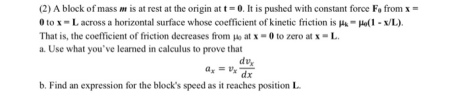 A block of mass m is at rest at the origin at t = 0. It is pushed with constant force F_0 from x = 0 to x = L across a horizontal surface whose coefficient of kinetic friction is mu_k = mu_0 (1-x/L). That is, the coefficient of friction decreases from mu_0 at x = 0 to zero at x = L. a. Use what you've learned in calculus to prove that a_x = v_x dv_x/dx b. Find an...
A 2.7 kg block initially in motion is pushed along d horizontal oor by d orce...
 A 2.7 kg block initially in motion is pushed along d horizontal oor by d orce of magnitude 20 N at an angle θ 35 with the horizontal. The coefficient o kinetic friction between the block and floor s 0.25 (a) Calculate the magnitude of the frictlonal force on the block from the floor. (b) Calculate the magnitude of the block's acceleration n/s2
a) A 24 Kg block is pushed against a vertical surface. The coefficient of friction between...
a) A 24 Kg block is pushed against a vertical surface. The coefficient of friction between the surface and the block is 0.16. If the angle is 30o, what is the minimum magnitude of P to hold the block still? b) A 4 Kg block is placed at rest at a vertical height of 30 meters on a plane inclined at 4o with the horizontal. If the surface is frictionless, how fast will the block be moving when it gets...
4. A 6-kg block (my), initially at rest on a rough shelf, is connected to a...
 4. A 6-kg block (my), initially at rest on a rough shelf, is connected to a 4-kg block (m2) that hangs by an inextensible string of negligible mass passing over a pulley. The uniform disk-shaped pulley, having a mass of 3.0-kg and a radius of 10 cm, rotates about the symmetry axis through its center. The 6-kg block, which is attached to the spring, is initially pushed against the spring compressing it a distance of 30 cm from its equilibrium...
A block of mass m = 4.5 kg is attached to a spring with spring constant k = 710 N/m.
 A block of mass m = 4.5 kg is attached to a spring with spring constant k = 710 N/m. It is initially at rest on an inclined plane that is at an angle of θ = 25° with respect to the horizontal, and the coefficient of kinetic friction between the block and the plane is μk=0.18. In the initial position, where the spring is compressed by a distance of d = 0.12 m, the mass is at its lowest...
A block of mass m = 3.5 kg is attached to a spring with spring constant k = 780 N/m
 A block of mass m = 3.5 kg is attached to a spring with spring constant k = 780 N/m. It is initially at rest on an inclined plane that is at an angle of θ = 28° with respect to the horizontal, and the coefficient of kinetic friction between the block and the plane is μk = 0.19. In the initial position, where the spring is compressed by a distance of d = 0.19 m, the mass is at...
A block of mass m is pushed against an ideal spring of constant of k, compressing...
A block of mass m is pushed against an ideal spring of constant of k, compressing it over a distance x with respect to its natural length. When the block is released, it moves up a rough ramp of inclination θ and coefficient of friction μk.What is the maximum distance (d) that the block travels up the incline? You MUST use conservation of energy to solve this problem. Epress your answers in term of m, g, k, μk and θ.
A block of mass m = 2.1 kg is attached to a single spring of spring...
 A block of mass m = 2.1 kg is attached to a single spring of spring constant k = 4.3 and allowed to oscillate on a horizontal, frictionless surface while restricted to move in the x-direction. The equilibrium position of the block is x = 0m. At time t = 0s the mass is at position x =-0.7m and moving with x-component of velocity vx-1.79. what is the x- component of velocity at time t = 5.3s? Answer in meters...
consider a toy car of mass m that moves along the x-axis. It's position as a...
consider a toy car of mass m that moves along the x-axis. It's position as a function of time is the equation x=x0+v0t+at^2 where x0,v0, and a are all constants. Use calculus to find the equation for the velocity if the object as a function of time by taking the derivative of the position with respect to time: v=dx/dt
 A block of mass m is at rest at the origin at t = 0. It is pushed with constant force F_0 from x = 0 to x = L across a horizontal surface whose coefficient of kinetic friction is mu_k = mu_0 (1-x/L). That is, the coefficient of friction decreases from mu_0 at x = 0 to zero at x = L. a. Use what you've learned in calculus to prove that a_x = v_x dv_x/dx b. Find an...
 A 2.7 kg block initially in motion is pushed along d horizontal oor by d orce of magnitude 20 N at an angle θ 35 with the horizontal. The coefficient o kinetic friction between the block and floor s 0.25 (a) Calculate the magnitude of the frictlonal force on the block from the floor. (b) Calculate the magnitude of the block's acceleration n/s2
 4. A 6-kg block (my), initially at rest on a rough shelf, is connected to a 4-kg block (m2) that hangs by an inextensible string of negligible mass passing over a pulley. The uniform disk-shaped pulley, having a mass of 3.0-kg and a radius of 10 cm, rotates about the symmetry axis through its center. The 6-kg block, which is attached to the spring, is initially pushed against the spring compressing it a distance of 30 cm from its equilibrium...
 A block of mass m = 2.1 kg is attached to a single spring of spring constant k = 4.3 and allowed to oscillate on a horizontal, frictionless surface while restricted to move in the x-direction. The equilibrium position of the block is x = 0m. At time t = 0s the mass is at position x =-0.7m and moving with x-component of velocity vx-1.79. what is the x- component of velocity at time t = 5.3s? Answer in meters...
Most questions answered within 3 hours.
-
Where is the error in this code sequence?
String s1 = "Hello";
String s2 = "ello";...
asked 10 months ago -
Financial data for Joel de Paris, Inc., for last year
follow:
Joel de Paris, Inc.
Balance...
asked 10 months ago -
Consider this reaction:
Al2(SO4)3 (aq)+ BaCl3
(aq) Al2Cl6 (aq)- +
3BaSO4(s) . What is the...
asked 10 months ago -
Suppose that Savneet is considering increasing her
recent random sample from 20 car rentals to 40...
asked 10 months ago -
Trucks arrive at an unloading terminal at an average rate of 120
per hour.
Trucks arrive...
asked 10 months ago -
Why are methanol and ethanol completely soluble in water while
octanol is not very little soluble....
asked 10 months ago -
A facilities manager at a university reads in a research report
that the mean amount of...
asked 10 months ago -
When the CuSO4 is rehydrated by adding water to the anhydrous
compound, is this an endothermic...
asked 10 months ago -
A ray of sunlight is passing from diamond into crown glass; the
angle of incidence is...
asked 10 months ago -
A block of mass 0.249 kg is placed on top of a light, vertical
spring of...
asked 10 months ago -
how do the kidneys compensate in the presences of acidosis
a) trigger hyperventilate
b) reserve acid...
asked 10 months ago -
Question 501 pts
The rental rate of capital to the firm increases. Which of the
following...
asked 10 months ago