I need help with these questions, I just dont get it Consider the equilibrium between chromate...
I need help with these questions, I just dont get it
Consider the equilibrium between chromate (CrO42-) and
dichromate (Cr2O72-) in aqueous acid.
2CrO4^2-(aq) + 2H^+(aq) ⇌ Cr2O7^2-(aq) + H2O(l)
Answer the following questions about the above
equilibrium.
1.To an orange colored equilibrium mixture, concentrated sulfuric
acid is added. What do you expect to observe for the color of the
reaction mixture? Explain your answer and give reasons.
2. To an orange colored equilibrium mixture, a few drops of ammonia (a base) is added. What do you expect to observe for the color of the reaction mixture? Explain your answer and give reasons.
2CrO42-(aq) is yellow
Cr2O72-(aq) is orange
Homework Answers
First off, you have to consider that the CrO42- ion tends towards a yellow color, while the Cr2O72- ion tends more towards an orange color.
1. If sulfuric acid is added to the equilibrium, the orange color should be more noticeable since the equilibrium would shift to the right (products). The addition of the acid increases the H+ concentration in the reagents side, so the equilibrium shifts towards the right.
2. This time the color of the reaction should tend more towards the yellow. This is because you are adding a base to the mixture, which is going to counter against the acid and therefore diminish the concentration of the latter in the mixture. This would make the equilibrium to shift towards the left (reagents), and therefore to the yellow color.
Add Answer to:
I need help with these questions, I just dont get it
Consider the equilibrium between chromate...
Another interesting equilibrium system is that between the polyatomic ions chromate, CrO42-, and dichromate, Cr2O72-. In...
Another interesting equilibrium system is that between the polyatomic ions chromate, CrO42-, and dichromate, Cr2O72-. In an acidic environment (high H3O+), the chromate will react to form dichromate ion. Barium will react with chromate, but NOT dichromate, to form an insoluble precipitate. 2 CrO42- (aq, yellow) + 2 H3O+ (aq) <---> Cr2O72- (aq, orange) + 2 H2O (l) Describe and explain how the chemical equilibrium will shift and what changes you would observe under the following scenarios: a) Addition of...
Another interesting equilibrium system is that between the polyatomic ions chromate, CrO42-, and dichromate, Cr2O72-. In...
Another interesting equilibrium system is that between the polyatomic ions chromate, CrO42-, and dichromate, Cr2O72-. In an acidic environment (high H3O+), the chromate will react to form dichromate ion. Barium will react with chromate, but NOT dichromate, to form an insoluble precipitate. 2 CrO42- (aq, yellow) + 2 H3O+ (aq) <---> Cr2O72- (aq, orange) + 2 H2O (l) Describe and explain how the chemical equilibrium will shift and what changes you would observe under the following scenarios: a) Addition of...
Please explain in words and in equation. (5 pts) Chromium (VI) forms two different oxyanions, the orange dichromate...
 Please explain in words and in equation.
(5 pts) Chromium (VI) forms two different oxyanions, the orange dichromate ion, Cr207, and the yellow chromate ion, CrO42- The equilibrium reaction between the two ions is Cr2O72- +H20 (1) orange 2 CrO42- + 2 H+ (aq) yellow At equilibrium the solution starts out looking amber a color between orange and yellow. Explain what would happen to the solution of sodium hydroxide is added. 2-
Please explain in words and in equation.
(5 pts) Chromium (VI) forms two different oxyanions, the orange dichromate ion, Cr207, and the yellow chromate ion, CrO42- The equilibrium reaction between the two ions is Cr2O72- +H20 (1) orange 2 CrO42- + 2 H+ (aq) yellow At equilibrium the solution starts out looking amber a color between orange and yellow. Explain what would happen to the solution of sodium hydroxide is added. 2-
5. Answer questions based on the following two equilibria. Explain your answers. 2Cr042 (aq) + 2H(aq)...
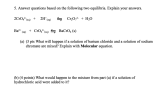 5. Answer questions based on the following two equilibria. Explain your answers. 2Cr042 (aq) + 2H(aq) — Cr2O72- + H20 Ba2+ (aq) + CrO2 (aq) → BaCrO4(s) (a) (3 pts What will happen if a solution of barium chloride and a solution of sodium chromate are mixed? Explain with Molecular equation. (b) (4 points) What would happen to the mixture from part (a) if a solution of hydrochloric acid were added to it? 3. (6 pts) How do you describe...
Answer questions #1-6 please Observations and Interpretations to be Handed In For Activity: Observations and Interpretations...
 Answer questions #1-6 please
Observations and Interpretations to be Handed In For Activity: Observations and Interpretations 1) Balance the chromate / dichromate equilibrium equation: 2 Cro. (aq) + H(aq) + Cryo,'(aq) + H2O(1) (unbalanced equation) 2) What was the original color of the K,CrO solution? If the above equilibrium is established in the original solution, which species, Cro, (aq), or Cro" (aq) appears to be present in greatest amount? 3) What color did you observe after adding the 3M H2SO,...
Answer questions #1-6 please
Observations and Interpretations to be Handed In For Activity: Observations and Interpretations 1) Balance the chromate / dichromate equilibrium equation: 2 Cro. (aq) + H(aq) + Cryo,'(aq) + H2O(1) (unbalanced equation) 2) What was the original color of the K,CrO solution? If the above equilibrium is established in the original solution, which species, Cro, (aq), or Cro" (aq) appears to be present in greatest amount? 3) What color did you observe after adding the 3M H2SO,...
Hi, I need help in these two questions, mostly on setting up the equations. Also, how...
Hi, I need help in these two questions, mostly on setting up the equations. Also, how different is it that this question is asking for molarity of "sodium chromate soln" and not "sodium dichromate soln."? thanks in advance! 1. Chromate and ferrous ions react in acidic solution to form chromic and ferric ions, respectively. If 0.9422 grams of iron(II) bisulfate dissolved in sulfuric acid solution requires 24.83 mL of sodium chromate solution for complete titration, what is the molarity of...
late for class please just help with these dont have time to make more posts 4....
 late for class please just
help with these dont have time to make more posts
4. The equilibrium constant values for a number of reactions are listed below. Indicate whether the products or reactants are favored. Reaction Which side is favored? NH3(aq) + H2O(l) 5 NH4+ (aq) + OH(aq) K = 5.0 x 10¹² 2 HBr 5 2 Hz Brz K = 5.8 x 10⁻¹⁸ CH3CH(OH)COOH(aq) = CH3CH(OH)COO"(aq) + H+(aq) K= 1.4 x 10⁻⁴ 5. Hydrogen chloride can be made...
late for class please just
help with these dont have time to make more posts
4. The equilibrium constant values for a number of reactions are listed below. Indicate whether the products or reactants are favored. Reaction Which side is favored? NH3(aq) + H2O(l) 5 NH4+ (aq) + OH(aq) K = 5.0 x 10¹² 2 HBr 5 2 Hz Brz K = 5.8 x 10⁻¹⁸ CH3CH(OH)COOH(aq) = CH3CH(OH)COO"(aq) + H+(aq) K= 1.4 x 10⁻⁴ 5. Hydrogen chloride can be made...
EXPERIMENT 8 Post-Lab Questions Section Name: 1 Consider the following system at equilibrium in a closed...
 EXPERIMENT 8 Post-Lab Questions Section Name: 1 Consider the following system at equilibrium in a closed container (pressure at 1 atm): NaOH(s) CO,(0) NaliCO. (s) Ar 0 Concentration of CO: gas present at equilibrium can be decreased by True or False (T or F) adding Na gas to double the pressure adding more NaOH increasing the volume of the container lowering the temperature (10 pts) 2. 2Cro (aq. yellow) 2H,0-(aq) Cr o (aq, orange) + 3H20D (AH-ve) a. What would...
need help with 6a and 6b Experiment 16: Reaction Rates and Equilibrium Part I CUCL 6...
 need help with 6a and 6b
Experiment 16: Reaction Rates and Equilibrium Part I CUCL 6 H-0 grece CuiH-O 4 CTat Was Ini Experiment 16: Reaction Rates and Equitibrium Cu(OH): (s) 5. Consider the reaction: Cu (aq) + 2 OH(aq) Prodict whether the reaction shifts toward reactants or towards products with cach of the following changes Shift toward reactants or shift toward products? Change fadats SmMEH towaid CuCl; (Cu) added Shift Dwands NaOH (OH) added Shift pwar rtaetant HCI (H)...
need help with 6a and 6b
Experiment 16: Reaction Rates and Equilibrium Part I CUCL 6 H-0 grece CuiH-O 4 CTat Was Ini Experiment 16: Reaction Rates and Equitibrium Cu(OH): (s) 5. Consider the reaction: Cu (aq) + 2 OH(aq) Prodict whether the reaction shifts toward reactants or towards products with cach of the following changes Shift toward reactants or shift toward products? Change fadats SmMEH towaid CuCl; (Cu) added Shift Dwands NaOH (OH) added Shift pwar rtaetant HCI (H)...
please help Chemical Equilibria Predictions and Data Equilibrium #1 Fe3+(20)_ SCNN) = FeSCN2+(ag) yellow red Stress...
 please help
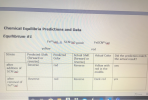
Chemical Equilibria Predictions and Data Equilibrium #1 Fe3+(20)_ SCNN) = FeSCN2+(ag) yellow red Stress Predicted Shift Predicted Actual Shift Actual Color Did the prediction match (forward or Color (forward or the actual result? reverse) reverse) after Reverse red Reverse Yellow with yes addition of red in the SCN(2) middle. Reverse red Reverse Dark red yes after removal of Festaw Focus Equilibrium #2 Cu(NH3)) Cu2+ (a) + 44 45 ) pale blue dark blue Stress Predicted Shift (forward or...
please help
Chemical Equilibria Predictions and Data Equilibrium #1 Fe3+(20)_ SCNN) = FeSCN2+(ag) yellow red Stress Predicted Shift Predicted Actual Shift Actual Color Did the prediction match (forward or Color (forward or the actual result? reverse) reverse) after Reverse red Reverse Yellow with yes addition of red in the SCN(2) middle. Reverse red Reverse Dark red yes after removal of Festaw Focus Equilibrium #2 Cu(NH3)) Cu2+ (a) + 44 45 ) pale blue dark blue Stress Predicted Shift (forward or...
 Please explain in words and in equation.
(5 pts) Chromium (VI) forms two different oxyanions, the orange dichromate ion, Cr207, and the yellow chromate ion, CrO42- The equilibrium reaction between the two ions is Cr2O72- +H20 (1) orange 2 CrO42- + 2 H+ (aq) yellow At equilibrium the solution starts out looking amber a color between orange and yellow. Explain what would happen to the solution of sodium hydroxide is added. 2-
Please explain in words and in equation.
(5 pts) Chromium (VI) forms two different oxyanions, the orange dichromate ion, Cr207, and the yellow chromate ion, CrO42- The equilibrium reaction between the two ions is Cr2O72- +H20 (1) orange 2 CrO42- + 2 H+ (aq) yellow At equilibrium the solution starts out looking amber a color between orange and yellow. Explain what would happen to the solution of sodium hydroxide is added. 2-
 5. Answer questions based on the following two equilibria. Explain your answers. 2Cr042 (aq) + 2H(aq) — Cr2O72- + H20 Ba2+ (aq) + CrO2 (aq) → BaCrO4(s) (a) (3 pts What will happen if a solution of barium chloride and a solution of sodium chromate are mixed? Explain with Molecular equation. (b) (4 points) What would happen to the mixture from part (a) if a solution of hydrochloric acid were added to it? 3. (6 pts) How do you describe...
 Answer questions #1-6 please
Observations and Interpretations to be Handed In For Activity: Observations and Interpretations 1) Balance the chromate / dichromate equilibrium equation: 2 Cro. (aq) + H(aq) + Cryo,'(aq) + H2O(1) (unbalanced equation) 2) What was the original color of the K,CrO solution? If the above equilibrium is established in the original solution, which species, Cro, (aq), or Cro" (aq) appears to be present in greatest amount? 3) What color did you observe after adding the 3M H2SO,...
Answer questions #1-6 please
Observations and Interpretations to be Handed In For Activity: Observations and Interpretations 1) Balance the chromate / dichromate equilibrium equation: 2 Cro. (aq) + H(aq) + Cryo,'(aq) + H2O(1) (unbalanced equation) 2) What was the original color of the K,CrO solution? If the above equilibrium is established in the original solution, which species, Cro, (aq), or Cro" (aq) appears to be present in greatest amount? 3) What color did you observe after adding the 3M H2SO,...
 late for class please just
help with these dont have time to make more posts
4. The equilibrium constant values for a number of reactions are listed below. Indicate whether the products or reactants are favored. Reaction Which side is favored? NH3(aq) + H2O(l) 5 NH4+ (aq) + OH(aq) K = 5.0 x 10¹² 2 HBr 5 2 Hz Brz K = 5.8 x 10⁻¹⁸ CH3CH(OH)COOH(aq) = CH3CH(OH)COO"(aq) + H+(aq) K= 1.4 x 10⁻⁴ 5. Hydrogen chloride can be made...
late for class please just
help with these dont have time to make more posts
4. The equilibrium constant values for a number of reactions are listed below. Indicate whether the products or reactants are favored. Reaction Which side is favored? NH3(aq) + H2O(l) 5 NH4+ (aq) + OH(aq) K = 5.0 x 10¹² 2 HBr 5 2 Hz Brz K = 5.8 x 10⁻¹⁸ CH3CH(OH)COOH(aq) = CH3CH(OH)COO"(aq) + H+(aq) K= 1.4 x 10⁻⁴ 5. Hydrogen chloride can be made...
 EXPERIMENT 8 Post-Lab Questions Section Name: 1 Consider the following system at equilibrium in a closed container (pressure at 1 atm): NaOH(s) CO,(0) NaliCO. (s) Ar 0 Concentration of CO: gas present at equilibrium can be decreased by True or False (T or F) adding Na gas to double the pressure adding more NaOH increasing the volume of the container lowering the temperature (10 pts) 2. 2Cro (aq. yellow) 2H,0-(aq) Cr o (aq, orange) + 3H20D (AH-ve) a. What would...
 need help with 6a and 6b
Experiment 16: Reaction Rates and Equilibrium Part I CUCL 6 H-0 grece CuiH-O 4 CTat Was Ini Experiment 16: Reaction Rates and Equitibrium Cu(OH): (s) 5. Consider the reaction: Cu (aq) + 2 OH(aq) Prodict whether the reaction shifts toward reactants or towards products with cach of the following changes Shift toward reactants or shift toward products? Change fadats SmMEH towaid CuCl; (Cu) added Shift Dwands NaOH (OH) added Shift pwar rtaetant HCI (H)...
need help with 6a and 6b
Experiment 16: Reaction Rates and Equilibrium Part I CUCL 6 H-0 grece CuiH-O 4 CTat Was Ini Experiment 16: Reaction Rates and Equitibrium Cu(OH): (s) 5. Consider the reaction: Cu (aq) + 2 OH(aq) Prodict whether the reaction shifts toward reactants or towards products with cach of the following changes Shift toward reactants or shift toward products? Change fadats SmMEH towaid CuCl; (Cu) added Shift Dwands NaOH (OH) added Shift pwar rtaetant HCI (H)...
 please help
Chemical Equilibria Predictions and Data Equilibrium #1 Fe3+(20)_ SCNN) = FeSCN2+(ag) yellow red Stress Predicted Shift Predicted Actual Shift Actual Color Did the prediction match (forward or Color (forward or the actual result? reverse) reverse) after Reverse red Reverse Yellow with yes addition of red in the SCN(2) middle. Reverse red Reverse Dark red yes after removal of Festaw Focus Equilibrium #2 Cu(NH3)) Cu2+ (a) + 44 45 ) pale blue dark blue Stress Predicted Shift (forward or...
please help
Chemical Equilibria Predictions and Data Equilibrium #1 Fe3+(20)_ SCNN) = FeSCN2+(ag) yellow red Stress Predicted Shift Predicted Actual Shift Actual Color Did the prediction match (forward or Color (forward or the actual result? reverse) reverse) after Reverse red Reverse Yellow with yes addition of red in the SCN(2) middle. Reverse red Reverse Dark red yes after removal of Festaw Focus Equilibrium #2 Cu(NH3)) Cu2+ (a) + 44 45 ) pale blue dark blue Stress Predicted Shift (forward or...
Most questions answered within 3 hours.
-
Where is the error in this code sequence?
String s1 = "Hello";
String s2 = "ello";...
asked 11 months ago -
Financial data for Joel de Paris, Inc., for last year
follow:
Joel de Paris, Inc.
Balance...
asked 11 months ago -
Consider this reaction:
Al2(SO4)3 (aq)+ BaCl3
(aq) Al2Cl6 (aq)- +
3BaSO4(s) . What is the...
asked 11 months ago -
Suppose that Savneet is considering increasing her
recent random sample from 20 car rentals to 40...
asked 11 months ago -
Trucks arrive at an unloading terminal at an average rate of 120
per hour.
Trucks arrive...
asked 11 months ago -
Why are methanol and ethanol completely soluble in water while
octanol is not very little soluble....
asked 11 months ago -
A facilities manager at a university reads in a research report
that the mean amount of...
asked 11 months ago -
When the CuSO4 is rehydrated by adding water to the anhydrous
compound, is this an endothermic...
asked 11 months ago -
A ray of sunlight is passing from diamond into crown glass; the
angle of incidence is...
asked 11 months ago -
A block of mass 0.249 kg is placed on top of a light, vertical
spring of...
asked 11 months ago -
how do the kidneys compensate in the presences of acidosis
a) trigger hyperventilate
b) reserve acid...
asked 11 months ago -
Question 501 pts
The rental rate of capital to the firm increases. Which of the
following...
asked 11 months ago