1.Which of the following statements is true according to Keynesian monetary theory? Group of answer choices...
1.Which of the following statements is true according to Keynesian monetary theory?
Group of answer choices
Stable business expectations means that a decrease in interest rates will increase planned investment.
The liquidity trap means that an increase in the money supply may not cause interest rates to fall.
Monetary policy is more effective in stimulating AD than fiscal policy.
The proper target for setting monetary policy is the supply of money.
2.
The money supply has a value of $12 trillion, the potential level of GDP is $18 trillion, and the velocity of money is 3. According to the quantity theory of money an increase in money supply of $6 trillion will ___ the price level from ___.
Group of answer choices
increase, 2 to 3
increase, 12 to 18
decrease, 2 to 1
decrease, 18 to 15.7
Homework Answers
1) Option A is correct.
Option B is correct.
Option C is incorrect as fiscal policy is more effective than monetary policy to raise AD.
The target of monetary policy is the supply of money, interest rate and supply of bank credit. Thus we cannot say that it is only supply of money which makes this option incorrect.
2) Quantity theory of money says that Money supply * Velocity of money = Price * GDP
M * V = P * T
12 * 3 = P * 18
P = 2
When money supply rises by 6 trillion,
18 * 3 = P * 18
P = 3
Thus option A is correct.
Add Answer to:
1.Which of the following statements is true according to
Keynesian monetary theory?
Group of answer choices...
7. According to the theory of liquidity preference, decreasing the money supply will nominal interest rates...
 7. According to the theory of liquidity preference, decreasing the money supply will nominal interest rates in the short run, and, according to the Fisher effect, decreasing the money supply will nominal interest rates in the long run. A) increase; increase B) increase; decrease C) decrease; decrease D) decrease; increase 8. If neither investment nor consumption depends on the interest rate, then the IS curve is , and_ policy has no effect on output. A) vertical; monetary B) horizontal; monetary...
What was the name of the monetary policy Keynesian economists utilized in the 1960s in order...
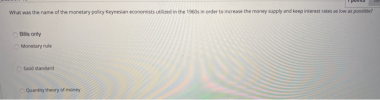 What was the name of the monetary policy Keynesian economists utilized in the 1960s in order to increase the money supply and keep interest rates as low as possible? Bills only Monetary rule Gold standard Quantity theory of money
1. Using a graph, show the impact of the contractionary monetary policy using Keynesian analysis. 2....
1. Using a graph, show the impact of the contractionary monetary policy using Keynesian analysis. 2. To create 3% growth in the economy, monetarists think the money supply should: a) increase by more than 3% yearly b) incr. less than 3% yearly c)incr. at 3% yearly d)decrease 3% yearly e) be constant 3. Use two graphs to depict what would happen If the fed buys a lot more T bonds than it sells, show the effect it will have in...
Answer all of the questions please! Question 17 1 pts According to Keynesian theory, what determines...
 Answer all of the questions please!
Question 17 1 pts According to Keynesian theory, what determines the value of money in a fiat monetary system? the opportunity cost of money, which is the interest rate the purchasing power of money the fact that each dollar is redeemable for 1/42 oz of gold the dollar is pegged to the British pound D Question 19 1 pts What determines the value of money in a commodity money system? The supply and demand...
Answer all of the questions please!
Question 17 1 pts According to Keynesian theory, what determines the value of money in a fiat monetary system? the opportunity cost of money, which is the interest rate the purchasing power of money the fact that each dollar is redeemable for 1/42 oz of gold the dollar is pegged to the British pound D Question 19 1 pts What determines the value of money in a commodity money system? The supply and demand...
Given the normal IS-LM and AD-AS DescriptionA liquidity trap is a situation, described in Keynesian economics,...
 Given the normal IS-LM and AD-AS
DescriptionA liquidity trap is a situation, described in Keynesian
economics, in which, "after the rate of interest has fallen to a
certain level, liquidity preference may become virtually absolute
in the sense that almost everyone prefers holding cash rather than
holding a debt which yields so low a rate of interest."
(1) Show the effect of the increase of M by the government using graphs. (Be careful about intersection points in the graphs.) (2)...
Given the normal IS-LM and AD-AS
DescriptionA liquidity trap is a situation, described in Keynesian
economics, in which, "after the rate of interest has fallen to a
certain level, liquidity preference may become virtually absolute
in the sense that almost everyone prefers holding cash rather than
holding a debt which yields so low a rate of interest."
(1) Show the effect of the increase of M by the government using graphs. (Be careful about intersection points in the graphs.) (2)...
5. In the Keynesian model which of the following would be most likely to have the largest impact on aggregate demand a. an increase in the money supply b. a change in government expenditure c. a chan...
 5. In the Keynesian model which of the following would be most likely to have the largest impact on aggregate demand a. an increase in the money supply b. a change in government expenditure c. a change in investment expectations d. both a and c e. both b and c 6. In the Keynesian theory of liquidity demand and the interest rate which of the following occurs during excess supply of money. a. individuals sell bonds, driving interest rates down...
Which of the statements is true about monetary policy? a) Decrease in the money supply lowers...
Which of the statements is true about monetary policy? a) Decrease in the money supply lowers short-term interest rates and encourage investment and consumption demand. b) Monetary policy is determined by the Congress. c) Higher money supply does not have a permanent effect on economic activity because it results only in a higher price level in the long run. d) Monetary policy has the most immediate impact on the economy, but implementation of such a policy is usually slow.
The equation of exchange is given by MXV = PxQ, where M is the money supply,...
 The equation of exchange is given by MXV = PxQ, where M is the money supply, V is the velocity of money, P is the economy's price level, and Q is Real GDP. Suppose the following diagram shows the current aggregate demand (AD) and aggregate supply (AS) curves in a hypothetical economy. 18 AS 15 آ AD 12 AS PRICE LEVEL 6 AD 3 0 0 3 15 18 6 9 12 REAL GDP (Trillions of dollars) What is the...
Tightening monetary policy causes interest rates to __________ and aggregate demand to __________. Group of answer...
Tightening monetary policy causes interest rates to __________ and aggregate demand to __________. Group of answer choices rise / increase fall / increase rise / decrease fall / decrease
According to the Crowding out theory, if the government engages in expansionary fiscal policy, which of...
 According to the Crowding out theory, if the government engages in expansionary fiscal policy, which of the following will take place? an increase in the deficit, an increase in demand for loanable funds, an increase in interest rates and a decrease in AD an increase in the deficit, an increase in demand for loanable funds, a decrease in interest rates and a decrease in AD an increase in the deficit, a decrease in demand for loanable funds, a decrease interest...
 7. According to the theory of liquidity preference, decreasing the money supply will nominal interest rates in the short run, and, according to the Fisher effect, decreasing the money supply will nominal interest rates in the long run. A) increase; increase B) increase; decrease C) decrease; decrease D) decrease; increase 8. If neither investment nor consumption depends on the interest rate, then the IS curve is , and_ policy has no effect on output. A) vertical; monetary B) horizontal; monetary...
 What was the name of the monetary policy Keynesian economists utilized in the 1960s in order to increase the money supply and keep interest rates as low as possible? Bills only Monetary rule Gold standard Quantity theory of money
 Answer all of the questions please!
Question 17 1 pts According to Keynesian theory, what determines the value of money in a fiat monetary system? the opportunity cost of money, which is the interest rate the purchasing power of money the fact that each dollar is redeemable for 1/42 oz of gold the dollar is pegged to the British pound D Question 19 1 pts What determines the value of money in a commodity money system? The supply and demand...
Answer all of the questions please!
Question 17 1 pts According to Keynesian theory, what determines the value of money in a fiat monetary system? the opportunity cost of money, which is the interest rate the purchasing power of money the fact that each dollar is redeemable for 1/42 oz of gold the dollar is pegged to the British pound D Question 19 1 pts What determines the value of money in a commodity money system? The supply and demand...
 Given the normal IS-LM and AD-AS
DescriptionA liquidity trap is a situation, described in Keynesian
economics, in which, "after the rate of interest has fallen to a
certain level, liquidity preference may become virtually absolute
in the sense that almost everyone prefers holding cash rather than
holding a debt which yields so low a rate of interest."
(1) Show the effect of the increase of M by the government using graphs. (Be careful about intersection points in the graphs.) (2)...
Given the normal IS-LM and AD-AS
DescriptionA liquidity trap is a situation, described in Keynesian
economics, in which, "after the rate of interest has fallen to a
certain level, liquidity preference may become virtually absolute
in the sense that almost everyone prefers holding cash rather than
holding a debt which yields so low a rate of interest."
(1) Show the effect of the increase of M by the government using graphs. (Be careful about intersection points in the graphs.) (2)...
 5. In the Keynesian model which of the following would be most likely to have the largest impact on aggregate demand a. an increase in the money supply b. a change in government expenditure c. a change in investment expectations d. both a and c e. both b and c 6. In the Keynesian theory of liquidity demand and the interest rate which of the following occurs during excess supply of money. a. individuals sell bonds, driving interest rates down...
 The equation of exchange is given by MXV = PxQ, where M is the money supply, V is the velocity of money, P is the economy's price level, and Q is Real GDP. Suppose the following diagram shows the current aggregate demand (AD) and aggregate supply (AS) curves in a hypothetical economy. 18 AS 15 آ AD 12 AS PRICE LEVEL 6 AD 3 0 0 3 15 18 6 9 12 REAL GDP (Trillions of dollars) What is the...
 According to the Crowding out theory, if the government engages in expansionary fiscal policy, which of the following will take place? an increase in the deficit, an increase in demand for loanable funds, an increase in interest rates and a decrease in AD an increase in the deficit, an increase in demand for loanable funds, a decrease in interest rates and a decrease in AD an increase in the deficit, a decrease in demand for loanable funds, a decrease interest...
Most questions answered within 3 hours.
-
Where is the error in this code sequence?
String s1 = "Hello";
String s2 = "ello";...
asked 11 months ago -
Financial data for Joel de Paris, Inc., for last year
follow:
Joel de Paris, Inc.
Balance...
asked 11 months ago -
Consider this reaction:
Al2(SO4)3 (aq)+ BaCl3
(aq) Al2Cl6 (aq)- +
3BaSO4(s) . What is the...
asked 11 months ago -
Suppose that Savneet is considering increasing her
recent random sample from 20 car rentals to 40...
asked 11 months ago -
Trucks arrive at an unloading terminal at an average rate of 120
per hour.
Trucks arrive...
asked 11 months ago -
Why are methanol and ethanol completely soluble in water while
octanol is not very little soluble....
asked 11 months ago -
A facilities manager at a university reads in a research report
that the mean amount of...
asked 11 months ago -
When the CuSO4 is rehydrated by adding water to the anhydrous
compound, is this an endothermic...
asked 11 months ago -
A ray of sunlight is passing from diamond into crown glass; the
angle of incidence is...
asked 11 months ago -
A block of mass 0.249 kg is placed on top of a light, vertical
spring of...
asked 11 months ago -
how do the kidneys compensate in the presences of acidosis
a) trigger hyperventilate
b) reserve acid...
asked 11 months ago -
Question 501 pts
The rental rate of capital to the firm increases. Which of the
following...
asked 11 months ago