Modify Dlinkedlist.java so it includes a new method named getPriorNode that accepts the String value of...
Modify Dlinkedlist.java so it includes a new method named getPriorNode that accepts the String value of a potential element in the doubly linked list and returns the string value of the predecessor node (or an appriopriate message String if there is no such node or predecessor.
class DLinkedList
{
/**
The Node class stores a list element
and a reference to the next node.
*/
private class Node
{
String value; // Value of a list element
Node next; // Next node in the list
Node prev; // Previous element in the list
/**
Constructor.
@param val The element to be stored in the node.
@param n The reference to the successor node.
@param p The reference to the predecessor node.
*/
Node(String val, Node n, Node p)
{
value = val;
next = n;
prev = p;
}
/**
Constructor.
@param val The element to be stored in the node.
*/
Node(String val)
{
// Just call the other (sister) constructor
this(val, null, null);
}
}
private Node first; // Head of the list
private Node last; // Last element on the list
/**
Constructor.
*/
public DLinkedList()
{
first = null;
last = null;
}
/**
The isEmpty method checks to see if the list
is empty.
@return true if list is empty, false otherwise.
*/
public boolean isEmpty()
{
return first == null;
}
/**
The size method returns the length of the list.
@return The number of elements in the list.
*/
public int size()
{
int count = 0;
Node p = first;
while (p != null)
{
// There is an element at p
count ++;
p = p.next;
}
return count;
}
/**
The add method adds to the end of the list.
@param e The value to add.
*/
public void add(String e)
{
if (isEmpty())
{
last = new Node(e);
first = last;
}
else
{
// Add to end of existing list
last.next = new Node(e, null, last);
last = last.next;
}
}
/**
This add method adds an element at an index.
@param e The element to add to the list.
@param index The index at which to add.
@exception IndexOutOfBoundsException
When the index is out of
bounds.
*/
public void add(int index, String e)
{
if (index < 0 || index > size())
{
String message = String.valueOf(index);
throw new IndexOutOfBoundsException(message);
}
// Index is at least 0
if (index == 0)
{
// New element goes at beginning
Node p = first; // Old first
first = new Node(e, p, null);
if (p != null)
p.prev = first;
if (last == null)
last = first;
return;
}
// pred will point to the predecessor
// of the new
node.
Node pred = first;
for (int k = 1; k <= index - 1; k++)
{
pred = pred.next;
}
// Splice in a node with the new element
// We want to go from pred-- succ to
// pred--middle--succ
Node succ = pred.next;
Node middle = new Node(e, succ, pred);
pred.next = middle;
if (succ == null)
last = middle;
else
succ.prev = middle;
}
/**
The toString method computes the string
representation of the list.
@return The string representation of the
linked list.
*/
public String toString()
{
StringBuilder strBuilder = new StringBuilder();
// Use p to walk down the linked list
Node p = first;
while (p != null)
{
strBuilder.append(p.value + "\n");
p = p.next;
}
return strBuilder.toString();
}
/**
The remove method removes the element
at a given position.
@param index The position of the element
to remove.
@return The element removed.
@exception IndexOutOfBoundsException When
index is out of bounds.
*/
public String remove(int index)
{
if (index < 0 || index >= size())
{
String message = String.valueOf(index);
throw new IndexOutOfBoundsException(message);
}
// Locate the node targeted for removal
Node target = first;
for (int k = 1; k <= index; k++)
target = target.next;
String element = target.value; // Element to return
Node pred = target.prev; // Node before the target
Node succ = target.next; // Node after the target
// Route forward and back pointers around
// the node to be removed
if (pred == null)
first = succ;
else
pred.next = succ;
if (succ == null)
last = pred;
else
succ.prev = pred;
return element;
}
/**
The remove method removes an element from the list.
@param element The element to remove.
@return true if the element was removed, false otherwise.
*/
public boolean remove(String element)
{
if (isEmpty())
return false;
// Locate the node targeted for removal
Node target = first;
while (target != null
&& !element.equals(target.value))
target = target.next;
if (target == null)
return false;
Node pred = target.prev; // Node before the target
Node succ = target.next; // Node after the target
// Route forward and back pointers around
// the node to be removed
if (pred == null)
first = succ;
else
pred.next = succ;
if (succ == null)
last = pred;
else
succ.prev = pred;
return true;
}
public static void main(String [] args)
{
DLinkedList ll = new DLinkedList();
ll.add("Amy");
ll.add("Bob");
ll.add(0, "Al");
ll.add(2, "Beth");
ll.add(4, "Carol");
System.out.println("The elements of the list are:");
System.out.println(ll);
}
}
Homework Answers
Java Program:
class DLinkedList
{
/**
The Node class stores a list element
and a reference to the next node.
*/
private class Node
{
String value; // Value of a list element
Node next; // Next node in the list
Node prev; // Previous element in the list
/**
Constructor.
@param val The element to be stored in the node.
@param n The reference to the successor node.
@param p The reference to the predecessor node.
*/
Node(String val, Node n, Node p)
{
value = val;
next = n;
prev = p;
}
/**
Constructor.
@param val The element to be stored in the node.
*/
Node(String val)
{
// Just call the other (sister) constructor
this(val, null, null);
}
}
private Node first; // Head of the list
private Node last; // Last element on the list
/**
Constructor.
*/
public DLinkedList()
{
first = null;
last = null;
}
/**
The isEmpty method checks to see if the list
is empty.
@return true if list is empty, false otherwise.
*/
public boolean isEmpty()
{
return first == null;
}
/**
The size method returns the length of the list.
@return The number of elements in the list.
*/
public int size()
{
int count = 0;
Node p = first;
while (p != null)
{
// There is an element at p
count ++;
p = p.next;
}
return count;
}
/**
The add method adds to the end of the list.
@param e The value to add.
*/
public void add(String e)
{
if (isEmpty())
{
last = new Node(e);
first = last;
}
else
{
// Add to end of existing list
last.next = new Node(e, null, last);
last = last.next;
}
}
/**
This add method adds an element at an index.
@param e The element to add to the list.
@param index The index at which to add.
@exception IndexOutOfBoundsException
When the index is out of bounds.
*/
public void add(int index, String e)
{
if (index < 0 || index > size())
{
String message = String.valueOf(index);
throw new IndexOutOfBoundsException(message);
}
// Index is at least 0
if (index == 0)
{
// New element goes at beginning
Node p = first; // Old first
first = new Node(e, p, null);
if (p != null)
p.prev = first;
if (last == null)
last = first;
return;
}
// pred will point to the predecessor
// of the new node.
Node pred = first;
for (int k = 1; k <= index - 1; k++)
{
pred = pred.next;
}
// Splice in a node with the new element
// We want to go from pred-- succ to
// pred--middle--succ
Node succ = pred.next;
Node middle = new Node(e, succ, pred);
pred.next = middle;
if (succ == null)
last = middle;
else
succ.prev = middle;
}
/**
The toString method computes the string
representation of the list.
@return The string representation of the
linked list.
*/
public String toString()
{
StringBuilder strBuilder = new StringBuilder();
// Use p to walk down the linked list
Node p = first;
while (p != null)
{
strBuilder.append(p.value + "\n");
p = p.next;
}
return strBuilder.toString();
}
/**
The remove method removes the element
at a given position.
@param index The position of the element
to remove.
@return The element removed.
@exception IndexOutOfBoundsException When
index is out of bounds.
*/
public String remove(int index)
{
if (index < 0 || index >= size())
{
String message = String.valueOf(index);
throw new IndexOutOfBoundsException(message);
}
// Locate the node targeted for removal
Node target = first;
for (int k = 1; k <= index; k++)
target = target.next;
String element = target.value; // Element to return
Node pred = target.prev; // Node before the target
Node succ = target.next; // Node after the target
// Route forward and back pointers around
// the node to be removed
if (pred == null)
first = succ;
else
pred.next = succ;
if (succ == null)
last = pred;
else
succ.prev = pred;
return element;
}
/**
The remove method removes an element from the list.
@param element The element to remove.
@return true if the element was removed, false otherwise.
*/
public boolean remove(String element)
{
if (isEmpty())
return false;
// Locate the node targeted for removal
Node target = first;
while (target != null
&& !element.equals(target.value))
target = target.next;
if (target == null)
return false;
Node pred = target.prev; // Node before the target
Node succ = target.next; // Node after the target
// Route forward and back pointers around
// the node to be removed
if (pred == null)
first = succ;
else
pred.next = succ;
if (succ == null)
last = pred;
else
succ.prev = pred;
return true;
}
/**
The getPriorNode method returns the element prior to it if passed
element exists.
If doesn't exist returns false
*/
public String getPriorNode(String element)
{
if (isEmpty())
return "List Empty.";
// Locate the node targeted for value
Node target = first;
while (target != null &&
!element.equals(target.value))
{
target = target.next;
}
//Checking target node
if (target == null)
return "Element doesn't exist in
the list.";
// Node before the target
Node pred = target.prev;
//Checking previous node
if (pred == null)
return "Element is the first
element in the list.";
else
return pred.value;
}
public static void main(String [] args)
{
DLinkedList ll = new DLinkedList();
ll.add("Amy");
ll.add("Bob");
ll.add(0, "Al");
ll.add(2, "Beth");
ll.add(4, "Carol");
System.out.println("The elements of the list are:");
System.out.println(ll);
System.out.println("\n\n Node before Beth: " +
ll.getPriorNode("Beth"));
System.out.println("\n\n Node before Al: " +
ll.getPriorNode("Al"));
System.out.println("\n\n Node before XYZ: " +
ll.getPriorNode("XYZ") + " \n");
}
}
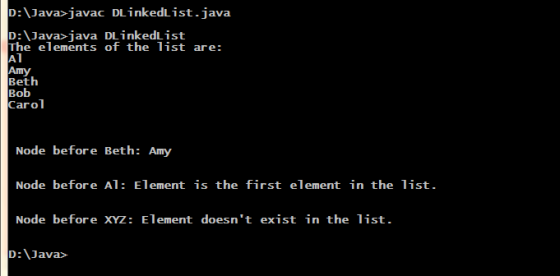
Sample Run:
Add Answer to:
Modify Dlinkedlist.java so it includes a new method named
getPriorNode that accepts the String value of...
n JAVA, students will create a linked list structure that will be used to support a...
n JAVA, students will create a linked list structure that will be used to support a role playing game. The linked list will represent the main character inventory. The setting is a main character archeologist that is traveling around the jungle in search of an ancient tomb. The user can add items in inventory by priority as they travel around (pickup, buy, find), drop items when their bag is full, and use items (eat, spend, use), view their inventory as...
Please use Java programming: Modify both ArrayList and LinkedList classes and add the following method to...
Please use Java programming: Modify both ArrayList and LinkedList classes and add the following method to both classes: public void reverseThisList(), This method will reverse the lists. When testing the method: print out the original list, call the new method, then print out the list again ------------------------------------------------------------------------- //ARRAY LIST class: public class ArrayList<E> implements List<E> { /** Array of elements in this List. */ private E[] data; /** Number of elements currently in this List. */ private int size; /**...
In Java Language. Modify the LinkedPostionalList class to support a method swap(p,q) that causes the underlying...
In Java Language. Modify the LinkedPostionalList class to support a method swap(p,q) that causes the underlying nodes referenced by positions p and q to be exchanged for each other. Relink the existing nodes, do not create any new nodes. ---------------------------------------------------------------------------------------------------------------------------------------------------------------------- package lists; import java.util.Iterator; import java.util.NoSuchElementException; public class LinkedPositionalList implements PositionalList { //---------------- nested Node class ---------------- /** * Node of a doubly linked list, which stores a reference to its * element and to both the previous and next...
Java Programming: The following is my code: public class KWSingleLinkedList<E> { public void setSize(int size)...
Java Programming: The following is my code: public class KWSingleLinkedList<E> { public void setSize(int size) { this.size = size; } /** Reference to list head. */ private Node<E> head = null; /** The number of items in the list */ private int size = 0; /** Add an item to the front of the list. @param item The item to be added */ public void addFirst(E...
Create a complete LinkedList class which implements all of the methods listed below using dynamic memory...
Create a complete LinkedList class which implements all of the methods listed below using dynamic memory allocation. You will need a Node class to represent each node in the list. The list should store String values. Include a main method which tests all the methods of your list. Also answer these questions: What is the time complexity (using big-O notation) of these operations in your linked list? add(String val) add(int index, String val) get(int index) remove(String val) Submit three files:...
solve this Q in java languege Write a method that return DoublyLinkedList as reversed string For...
solve this Q in java languege Write a method that return DoublyLinkedList as reversed string For example: If the elements of a list is 1, 2, 3, 4, 5, 6 the reverse string should be 6, 5, 4, 3, 2, 1 implement reverse method you have two steps: 1- you should start traversing from the last element of DoublyLinkedList (the previous of the trailer) 2- you should add the element inside each node to string don't forget the space in...
Problem 3 (List Implementation) (35 points): Write a method in the DoublyLList class that deletes the...
Problem 3 (List Implementation) (35 points): Write a method in the DoublyLList class that deletes the first item containing a given value from a doubly linked list. The header of the method is as follows: public boolean removeValue(T aValue) where T is the general type of the objects in the list and the methods returns true if such an item is found and deleted. Include testing of the method in a main method of the DoublyLList class. ------------------------------------------------------------------------------------- /** A...
(1) Implement the countKey(T element) method, which should return a count of the number of times...
(1) Implement the countKey(T element) method, which should return a count of the number of times that the given key (the element) is found in the list. (2) Implement the indexOf(T element) method, which is similar as the indexOf method in the String class. It returns the index (the position starting from the head node) of the first occurrence of the given element, or -1, if the element does not occur in the list. You will need to track the...
Q1: You can find a file that defines the CircularlyLinked List class similar to what we...
 Q1: You can find a file that defines the CircularlyLinked List class similar to what we discussed in the class. Download the file and work on it. Your task is to: 1. Complete the missing methods in the file as discussed in the class. Search for the comment/" MISSING / in the file to see the methods that need to be completed. 2. Add the following methods to the class a. public Node getMin 1. Task: find the node with...
-Fill in the reverse method below to return a new DoublyLinkedList consisting of the same elements...
-Fill in the reverse method below to return a new DoublyLinkedList consisting of the same elements in reverse order. -The reverse method must not modify the original DoublyLinkedList. -The reverse method must run in linear time. Can someone answer this for me, please? In Java public class DoublyLinkedList { int size; Node firstNode; Node lastNode; public DoublyLinkedList() { size = 0; firstNode = null; lastNode = null; } // Problem 1 (15 pts) // Fill in the method below to...
 Q1: You can find a file that defines the CircularlyLinked List class similar to what we discussed in the class. Download the file and work on it. Your task is to: 1. Complete the missing methods in the file as discussed in the class. Search for the comment/" MISSING / in the file to see the methods that need to be completed. 2. Add the following methods to the class a. public Node getMin 1. Task: find the node with...
Most questions answered within 3 hours.
-
Where is the error in this code sequence?
String s1 = "Hello";
String s2 = "ello";...
asked 11 months ago -
Financial data for Joel de Paris, Inc., for last year
follow:
Joel de Paris, Inc.
Balance...
asked 11 months ago -
Consider this reaction:
Al2(SO4)3 (aq)+ BaCl3
(aq) Al2Cl6 (aq)- +
3BaSO4(s) . What is the...
asked 11 months ago -
Suppose that Savneet is considering increasing her
recent random sample from 20 car rentals to 40...
asked 11 months ago -
Trucks arrive at an unloading terminal at an average rate of 120
per hour.
Trucks arrive...
asked 11 months ago -
Why are methanol and ethanol completely soluble in water while
octanol is not very little soluble....
asked 11 months ago -
A facilities manager at a university reads in a research report
that the mean amount of...
asked 11 months ago -
When the CuSO4 is rehydrated by adding water to the anhydrous
compound, is this an endothermic...
asked 11 months ago -
A ray of sunlight is passing from diamond into crown glass; the
angle of incidence is...
asked 11 months ago -
A block of mass 0.249 kg is placed on top of a light, vertical
spring of...
asked 11 months ago -
how do the kidneys compensate in the presences of acidosis
a) trigger hyperventilate
b) reserve acid...
asked 11 months ago -
Question 501 pts
The rental rate of capital to the firm increases. Which of the
following...
asked 11 months ago