To observe the effect of copper on protein structure, my lab student devised an experiment wherein...
To observe the effect of copper on protein structure, my lab student devised an experiment wherein he added aliquots of a copper stock solution to a cuvette containing a protein in 50 mM MOPS buffer, pH 7.55 (pKa = 7.20). He then measured the electronic absorption spectrum of the protein after the addition of each copper aliquot. However, to stabilize the copper ions in the Cu(I) oxidation state, the copper stock solution needed to contain 0.10 M HCl. If he added too much Cu(I), Joey risked exceeding the buffer capacity of the protein solution, resulting in a dramatic decrease in the pH of the solution and altered structure of the protein.
If Joey begins with 500 ul (1 ul = 1x10⁻⁶ L) of protein solution and adds 10 ul aliquots of the Cu(I) solution, how many aliquots can Joey add before the pH drops below 7.0? (Assume that the addition of Cu(I) has a negligible effect on the total concentration and volume of the buffer.)
Homework Answers
Steps to solve the proble:
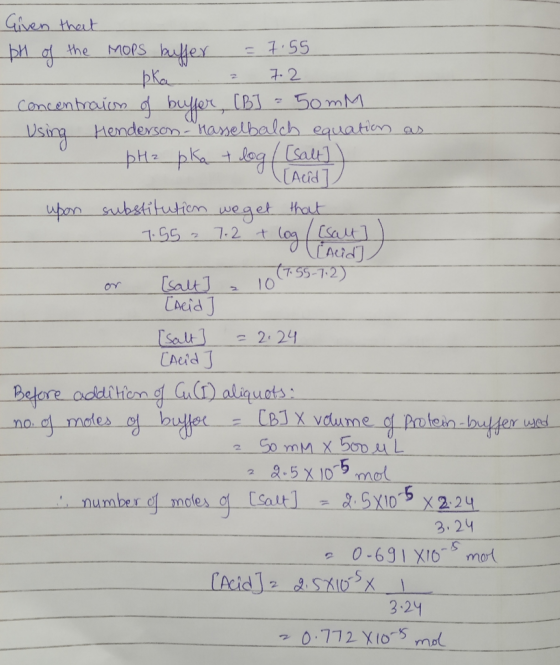
Step 1: Determine the concentration ratio of salt:acid for the given buffer solution using Henderson-Hasselbalch equation.
Step 2: Determine the moles of salt and acid present in the buffer used before the addition of HCl.
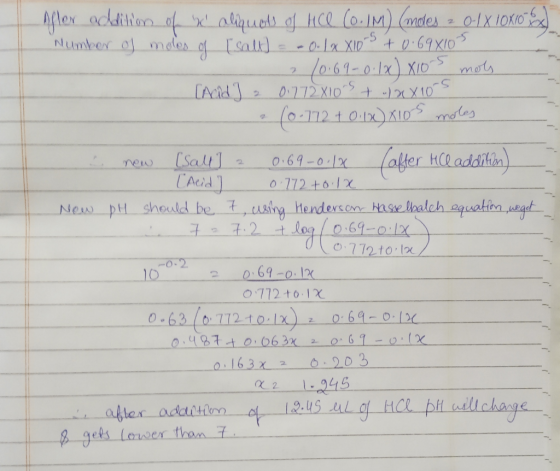
Step 3: After addition of 'x' aliquots of 0.1 M HCl the salt will get neutralized and acid concentration will increase. Therefore determine new salt and acid concentrations.
Step 4:Using Henderson-Hasselbalch equation, solve for 'x'
Add Answer to:
To observe the effect of copper on protein structure, my lab
student devised an experiment wherein...
Most questions answered within 3 hours.
-
Where is the error in this code sequence?
String s1 = "Hello";
String s2 = "ello";...
asked 11 months ago -
Financial data for Joel de Paris, Inc., for last year
follow:
Joel de Paris, Inc.
Balance...
asked 11 months ago -
Consider this reaction:
Al2(SO4)3 (aq)+ BaCl3
(aq) Al2Cl6 (aq)- +
3BaSO4(s) . What is the...
asked 11 months ago -
Suppose that Savneet is considering increasing her
recent random sample from 20 car rentals to 40...
asked 11 months ago -
Trucks arrive at an unloading terminal at an average rate of 120
per hour.
Trucks arrive...
asked 11 months ago -
Why are methanol and ethanol completely soluble in water while
octanol is not very little soluble....
asked 11 months ago -
A facilities manager at a university reads in a research report
that the mean amount of...
asked 11 months ago -
When the CuSO4 is rehydrated by adding water to the anhydrous
compound, is this an endothermic...
asked 11 months ago -
A ray of sunlight is passing from diamond into crown glass; the
angle of incidence is...
asked 11 months ago -
A block of mass 0.249 kg is placed on top of a light, vertical
spring of...
asked 11 months ago -
how do the kidneys compensate in the presences of acidosis
a) trigger hyperventilate
b) reserve acid...
asked 11 months ago -
Question 501 pts
The rental rate of capital to the firm increases. Which of the
following...
asked 11 months ago