Symbolic and numerical tax incidence: Consider a market described by the following equations: ?? =?+1−?? ??...
Symbolic and numerical tax incidence: Consider a market described by the following equations: ?? =?+1−?? ?? = ? Here A is a fixed parameter. Answer the following questions.
a. Solve for the equilibrium price and quantity.
b. Now suppose a specific tax, ? > 0, is imposed on this market that has to be paid to the government by suppliers. Using ?∗ and ?, give the new price paid by buyers and the new price received by sellers. Solve for the price paid by buyers, the price received by sellers, and the after tax equilibrium quantity.
c. Determine the marginal effect of an increase in the tax rate ? on the price paid by the buyer and the quantity sold in the market.
d. How does the tax incidence on the buyer vary with A? In no more than two sentences, provide an economic explanation in terms of elasticity of demand.
e. Now suppose the same tax from part (b) is changed so that it must be paid to the government by buyers. Using ?∗ and ?, give the new price paid by buyers and the new price received by sellers. Solve for the price paid by buyers, the price received by sellers, and the after tax equilibrium quantity. ?
f. Compare your answers to parts (b) and (e). Provide a brief explanation (no more than 3 sentences) for your results. Note your answer will be related to the logic of problem 2 part (d), you might want to work through that problem before you answer this.
Homework Answers
Hi, Welcome to Chegg.
(a) Equilibrium exists where Qd=Qs


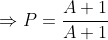
hence equilibrium price is,

Put this into Qs to get the equilibrium amount of Quantity,

(b) When a tax t is imposed that has to be paid by suppliers. (Let t = tau i.e. rate of tax)
The new Qs equation is

New Equilibrium price, when new Qs and Qd equates

 (1)
(1)
Above given price represents price paid by buyer, price received by seller is given by

Hence the optimal quantity is given by
 (2)
(2)
Which is lesser than the quantity in previous part.
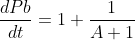
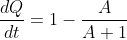
(c) Differentiating (1) and (2) w.r.t t to get the marginal effect of an increase in t on optimal P and Q respectively.
(d) If A is high, it means that the elasticity of demand is high, i.e. a price increase may lead to relatively higher decrease in quantity demanded and vice versa in case the value of A is lower. Similarly, the tax incidence on buyer varies directly with A.
Add Answer to:
Symbolic and numerical tax incidence: Consider a market
described by the following equations: ?? =?+1−?? ??...
Most questions answered within 3 hours.
-
Where is the error in this code sequence?
String s1 = "Hello";
String s2 = "ello";...
asked 11 months ago -
Financial data for Joel de Paris, Inc., for last year
follow:
Joel de Paris, Inc.
Balance...
asked 11 months ago -
Consider this reaction:
Al2(SO4)3 (aq)+ BaCl3
(aq) Al2Cl6 (aq)- +
3BaSO4(s) . What is the...
asked 11 months ago -
Suppose that Savneet is considering increasing her
recent random sample from 20 car rentals to 40...
asked 11 months ago -
Trucks arrive at an unloading terminal at an average rate of 120
per hour.
Trucks arrive...
asked 11 months ago -
Why are methanol and ethanol completely soluble in water while
octanol is not very little soluble....
asked 11 months ago -
A facilities manager at a university reads in a research report
that the mean amount of...
asked 11 months ago -
When the CuSO4 is rehydrated by adding water to the anhydrous
compound, is this an endothermic...
asked 11 months ago -
A ray of sunlight is passing from diamond into crown glass; the
angle of incidence is...
asked 11 months ago -
A block of mass 0.249 kg is placed on top of a light, vertical
spring of...
asked 11 months ago -
how do the kidneys compensate in the presences of acidosis
a) trigger hyperventilate
b) reserve acid...
asked 11 months ago -
Question 501 pts
The rental rate of capital to the firm increases. Which of the
following...
asked 11 months ago