In the absence of a digital millimeter, the value of a resistor can be decoded using...
In the absence of a digital millimeter, the value of a resistor can be decoded using the color bands printed on the body of the resistor. Using online resources, describe the 4-band-code and 5-band-code coding/decoding process. What are the disadvantages of using the color coding technique?
Homework Answers
4 BAND COLOUR CODING
4 band color code resistor has 3 color bands on left side and one color band on right side. The 3 color bands on left side are very close to each other and the 4th color band on right side is separated from first 3 bands with some space.
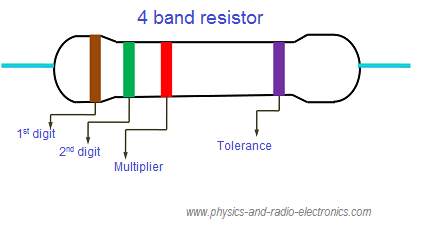
The 3 color bands on the left side are grouped together to indicate the resistors resistance value and the 4thcolor band on the right side indicates the tolerance of the resistor.
The 1st color band on the resistor indicates the 1stsignificant value or 1st digit of the resistors resistance and the 2nd color band indicates 2nd significant value or 2nd digit of the resistors resistance. The 3rd color band is the decimal multiplier and the 4th color band indicates the resistors tolerance.
The 1st and 2nd color bands together make up a 2 digit number and the 3rd color band or multiplier is multiplied with this 2 digit number to obtain the resistance value of the resistor.
If the 4th color band or tolerance band is left blank, it is considered as the 3 band resistor and the tolerance for the 3 band resistor is assumed to be 20%.
Resistors that are manufactured for military use may also include an extra band called 5th band which indicates resistor failure rate.
Example:
If the colors on a 4 band resistor is in this order: brown, green, red and violet (as shown in figure). The values of color bands will be like this: Brown = 1, Green = 5, Red = 102 or 100, Violet = 0.10%.
The first and second color bands are grouped together to make up a two digit number 15. The 3rd color band red has a value of 100. This value is multiplied with the two digit number I.e., 15 x 100 = 1500 ohms. Violet specifies that the tolerance is 0.10%.
Therefore, the resistor color coded with brown-green-red-violet would have a resistance of 1500 ohms with a tolerance of ± 0.10%
5 BAND COLOUR CODING
A 5 band color code resistor has 4 color bands on left side and one color band on right side. The 4 color bands on left side are very close to each other and the 5th color band on right side is separated from the first 4 bands with some space.
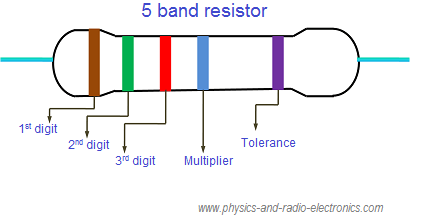
The 4 color bands on the left side are grouped together to represent the resistance value of a resistor and the 5th color band on the right side indicates the tolerance of the resistor.
- The 1st color band indicates the 1st significant value or 1st digit of the resistors value.
- The 2nd color band indicates the 2nd significant value or 2nd digit of the resistor value.
- The 3rd color band indicates the 3rd significant value or 3rd digit of the resistors value.
- The 4th color band is the decimal multiplier.
- The 5th color band indicates the resistors tolerance.
The 1st, 2nd and 3rd color bands together make up a 3 digit number and the 4th color band or multiplier is multiplied with this 3 digit number to obtain the resistance value of the resistor.
Example:
If the colors on a 5 band resistor is in this order: brown, green, red, blue and violet (as shown in figure). The values of color bands will be like this: Brown = 1, Green = 5, Red = 2, blue = 106, Violet = 0.10%.
1st digit, green has a value of 5 which is the second digit and red has a value of 2 which is the 3rd digit. The first, second and third color bands together make up a three digit number 152. The 4th color band blue has a value of 106. This value is multiplied with the three digit number 152 I.e., 152 x 106 = 152MΩ. Violet specifies that the tolerance is 0.10%.
Therefore, the resistor color coded with brown-green-red-blue-violet would have a resistance of 152MΩ with a tolerance of ± 0.10%.
How to read or decode resistor color codes
The placement of the color bands on the resistor is very important. Generally, the color bands placed closest to the lead or end of the resistor is considered as the first band. The next to the first band is second band and so on. Another way is the extra space between the two bands (3rd and 4th bands) also indicates the reading direction.
If you feel difficult to find the resistance of the resistor by using its color bands, you can directly find the resistance by using ohmmeter or multimeter.
DISADVANTAGES OF COLOUR CODING
The color coding technique has somed For blind people, it is impossible to find the resistance of the resistor, because they cannot see the colors coated on the resistor. Another drawbacki recognizing the difference between two colors in an over heated resistor is very difficult.
Add Answer to:
In the absence of a digital millimeter, the value of a resistor
can be decoded using...
Most questions answered within 3 hours.
-
Where is the error in this code sequence?
String s1 = "Hello";
String s2 = "ello";...
asked 11 months ago -
Financial data for Joel de Paris, Inc., for last year
follow:
Joel de Paris, Inc.
Balance...
asked 11 months ago -
Consider this reaction:
Al2(SO4)3 (aq)+ BaCl3
(aq) Al2Cl6 (aq)- +
3BaSO4(s) . What is the...
asked 11 months ago -
Suppose that Savneet is considering increasing her
recent random sample from 20 car rentals to 40...
asked 11 months ago -
Trucks arrive at an unloading terminal at an average rate of 120
per hour.
Trucks arrive...
asked 11 months ago -
Why are methanol and ethanol completely soluble in water while
octanol is not very little soluble....
asked 11 months ago -
A facilities manager at a university reads in a research report
that the mean amount of...
asked 11 months ago -
When the CuSO4 is rehydrated by adding water to the anhydrous
compound, is this an endothermic...
asked 11 months ago -
A ray of sunlight is passing from diamond into crown glass; the
angle of incidence is...
asked 11 months ago -
A block of mass 0.249 kg is placed on top of a light, vertical
spring of...
asked 11 months ago -
how do the kidneys compensate in the presences of acidosis
a) trigger hyperventilate
b) reserve acid...
asked 11 months ago -
Question 501 pts
The rental rate of capital to the firm increases. Which of the
following...
asked 11 months ago