How do i do this
According to Kepler's Laws, planets have elliptical orbits, with the sun at one of the foci. The farthest Pluto gets from the sun is 7.4 billion kilometers. The closest it gets to the sun is 4.4 billion kilometers. Find the equation of the orbit of Pluto.
Homework Answers
x^2/a^2 = y^2/b^2 = 1
(x, y, a & b are in billions of miles).
The minor axis b is given by
b^2 = a^2 - c^2, where c is the distance of either focus from the middle, which in this case is 5.9 - 4.4 = 1.5. That means b^2 = 32.56; b = 5.71
The orbit equation is
(x/5.9)^2 + (y/5.71)^2 = 1
6.) According to Kepler's Laws, planets have elliptical orbits, with the sun at one of the foci. The farthest Pluto gets from the sun is 7.4 billion kilometers. The closest it gets to the sun...
 6.) According to Kepler's Laws, planets have elliptical orbits, with the sun at one of the foci. The farthest Pluto gets from the sun is 7.4 billion kilometers. The closest it gets to the sun is 4.4 billion kilometers. Find the equation of Pluto's orbit assuming a center at (0,0). 7.) An arch in the shape of the upper half of an ellipse is used to support a bridge that is to span a river 20 meters wide. The center...
1 points SPreCalc7112.065.MI. My Notes Ask Your Teacher The planets move around the sun in elliptical orbits with the sun at one focus. The point in the orbit at which the planet is closest to the su...
 1 points SPreCalc7112.065.MI. My Notes Ask Your Teacher The planets move around the sun in elliptical orbits with the sun at one focus. The point in the orbit at which the planet is closest to the sun is called perihelion, and the point at which it is farthest is called aphelion. These points are the vertices of the orbit. A planet's distance from the sun is 207,000,000 km at perihelion and 249,000,000 km at aphelion. Find an equation for the...
For the following exercises, use Kepler's Law, which states that the square of the time, T...
 For the following exercises, use Kepler's Law, which states that the square of the time, T (measured in Earth years), required for a planet to orbit the Sun varies directly with the cube of the mean distance, a (measured in billions of miles), that the planet is from the Sun. a. Use Mars's time of 2 and mean distance of 0.142 billion miles, find the equation relating T and a. (Enter an equation in terms of T and a. Round...
PLEASE HELP TO ANSWER THIS LAB ACTIVITY Activity 3: Kepler's Second Law: Objects in elliptical orbits...
 PLEASE HELP TO ANSWER THIS LAB ACTIVITY
Activity 3: Kepler's Second Law: Objects in elliptical orbits sweep oul equal areas in'equal times. This implies that the orbital speed of a planet around the sun is not uniform - it moves farthest away (known as APHELION). In this section we will calculate the difference in this fastest at the point closest to the sun (known as the PERIHELION) and slowest at the point speed using Pluto as an example. Pluto's orbit...
PLEASE HELP TO ANSWER THIS LAB ACTIVITY
Activity 3: Kepler's Second Law: Objects in elliptical orbits sweep oul equal areas in'equal times. This implies that the orbital speed of a planet around the sun is not uniform - it moves farthest away (known as APHELION). In this section we will calculate the difference in this fastest at the point closest to the sun (known as the PERIHELION) and slowest at the point speed using Pluto as an example. Pluto's orbit...
(1) Halley's Comet and Kepler's Laws: Halley's Comet orbits the Sun every 76.0 years. Its elliptical...
 (1) Halley's Comet and Kepler's Laws: Halley's Comet orbits the Sun every 76.0 years. Its elliptical orbit has an eccentricity of 0.97. Using that information and the Kepler material in Math Insight Box 3.2 (p.70) and Figures 3.16, 3.17 and 3.18: 40 points total] (a) Find the comet's average distance from the Sun (semimajor axis, a) (b) Find its closest and furthest distances from the Sun: the Perihelion & Aphelion distances.
14. -0 points SColAlg7 7.2.066.MI. 0/100 Submissions Used My Notes Ask Your Teacher The planets move...
 14. -0 points SColAlg7 7.2.066.MI. 0/100 Submissions Used My Notes Ask Your Teacher The planets move around the sun in elliptical orbits with the sun at one focus. The point in the orbit at which the planet is closest to the sun is called perihelion, and the point at which it is farthest is called aphelion. These points are the vertices of the orbit. Aphelion Perihelion With an eccentricity of 0.25, a certain planet's orbit is the most eccentric in...
Pluto's distance P(t)(in billions of kilometers) from the sun as a function of time t (in...
Pluto's distance P(t)(in billions of kilometers) from the sun as a function of time t (in years) can be modeled by a sinusoidal expression of the form a.sin(b.t)d At year t=0, Pluto is at its average distance from the sun, which is 6.9 billion kilometers. In 66 years, it is at its closest point to the sun, which is 4.4 billion kilometers away. Find P(t)
please answer and show work for all parts of equation Kepler's Law, which states that the...
 please answer and show work for all parts
of equation
Kepler's Law, which states that the square of the time, T (measured in Earth years), required for a planet to orbit the Sun varies directly with the cube of the mean distance, d (measured in billions of kilometers), that the planet is from the Sun. 19 a. It takes Saturn approximately 30 Earth years to orbit the Sun with a mean distance of 1.4 billion kilometers. Use this information to...
please answer and show work for all parts
of equation
Kepler's Law, which states that the square of the time, T (measured in Earth years), required for a planet to orbit the Sun varies directly with the cube of the mean distance, d (measured in billions of kilometers), that the planet is from the Sun. 19 a. It takes Saturn approximately 30 Earth years to orbit the Sun with a mean distance of 1.4 billion kilometers. Use this information to...
For the ellipse shown above, what is the distance from one focus to the center of...
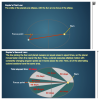 For the ellipse shown above, what is the distance from one focus
to the center of the ellipse?
Distance =
Kepler's First Law: The orbits of the planets are ellipses, with the Sun at one focus of the ellipse. Sun Focus point-→ . Kepler's Second Law: The line joining the Sun and planet sweeps out equal areas in equal times, so the planet moves faster when it is nearer the Sun. Thus, a planet executes elliptical motion with constantly changing...
For the ellipse shown above, what is the distance from one focus
to the center of the ellipse?
Distance =
Kepler's First Law: The orbits of the planets are ellipses, with the Sun at one focus of the ellipse. Sun Focus point-→ . Kepler's Second Law: The line joining the Sun and planet sweeps out equal areas in equal times, so the planet moves faster when it is nearer the Sun. Thus, a planet executes elliptical motion with constantly changing...
Solving Direct Variation Problems For the following exercises, use Kepler's Law, which states that the square...
 Solving Direct Variation Problems For the following exercises, use Kepler's Law, which states that the square of the time, T (measured in Earth years), required for a planet to orbit the Sun varies directly with the cube of the mean distance, a (measured in billions of kilometers), that the planet is from the Sun. a. Use Uranus's time of 84 and mean distance of 2.871 billion kilometers, find the equation relating T and a. (Enter an equation in terms of...
 6.) According to Kepler's Laws, planets have elliptical orbits, with the sun at one of the foci. The farthest Pluto gets from the sun is 7.4 billion kilometers. The closest it gets to the sun is 4.4 billion kilometers. Find the equation of Pluto's orbit assuming a center at (0,0). 7.) An arch in the shape of the upper half of an ellipse is used to support a bridge that is to span a river 20 meters wide. The center...
 1 points SPreCalc7112.065.MI. My Notes Ask Your Teacher The planets move around the sun in elliptical orbits with the sun at one focus. The point in the orbit at which the planet is closest to the sun is called perihelion, and the point at which it is farthest is called aphelion. These points are the vertices of the orbit. A planet's distance from the sun is 207,000,000 km at perihelion and 249,000,000 km at aphelion. Find an equation for the...
 For the following exercises, use Kepler's Law, which states that the square of the time, T (measured in Earth years), required for a planet to orbit the Sun varies directly with the cube of the mean distance, a (measured in billions of miles), that the planet is from the Sun. a. Use Mars's time of 2 and mean distance of 0.142 billion miles, find the equation relating T and a. (Enter an equation in terms of T and a. Round...
 PLEASE HELP TO ANSWER THIS LAB ACTIVITY
Activity 3: Kepler's Second Law: Objects in elliptical orbits sweep oul equal areas in'equal times. This implies that the orbital speed of a planet around the sun is not uniform - it moves farthest away (known as APHELION). In this section we will calculate the difference in this fastest at the point closest to the sun (known as the PERIHELION) and slowest at the point speed using Pluto as an example. Pluto's orbit...
PLEASE HELP TO ANSWER THIS LAB ACTIVITY
Activity 3: Kepler's Second Law: Objects in elliptical orbits sweep oul equal areas in'equal times. This implies that the orbital speed of a planet around the sun is not uniform - it moves farthest away (known as APHELION). In this section we will calculate the difference in this fastest at the point closest to the sun (known as the PERIHELION) and slowest at the point speed using Pluto as an example. Pluto's orbit...
 (1) Halley's Comet and Kepler's Laws: Halley's Comet orbits the Sun every 76.0 years. Its elliptical orbit has an eccentricity of 0.97. Using that information and the Kepler material in Math Insight Box 3.2 (p.70) and Figures 3.16, 3.17 and 3.18: 40 points total] (a) Find the comet's average distance from the Sun (semimajor axis, a) (b) Find its closest and furthest distances from the Sun: the Perihelion & Aphelion distances.
 14. -0 points SColAlg7 7.2.066.MI. 0/100 Submissions Used My Notes Ask Your Teacher The planets move around the sun in elliptical orbits with the sun at one focus. The point in the orbit at which the planet is closest to the sun is called perihelion, and the point at which it is farthest is called aphelion. These points are the vertices of the orbit. Aphelion Perihelion With an eccentricity of 0.25, a certain planet's orbit is the most eccentric in...
 please answer and show work for all parts
of equation
Kepler's Law, which states that the square of the time, T (measured in Earth years), required for a planet to orbit the Sun varies directly with the cube of the mean distance, d (measured in billions of kilometers), that the planet is from the Sun. 19 a. It takes Saturn approximately 30 Earth years to orbit the Sun with a mean distance of 1.4 billion kilometers. Use this information to...
please answer and show work for all parts
of equation
Kepler's Law, which states that the square of the time, T (measured in Earth years), required for a planet to orbit the Sun varies directly with the cube of the mean distance, d (measured in billions of kilometers), that the planet is from the Sun. 19 a. It takes Saturn approximately 30 Earth years to orbit the Sun with a mean distance of 1.4 billion kilometers. Use this information to...
 For the ellipse shown above, what is the distance from one focus
to the center of the ellipse?
Distance =
Kepler's First Law: The orbits of the planets are ellipses, with the Sun at one focus of the ellipse. Sun Focus point-→ . Kepler's Second Law: The line joining the Sun and planet sweeps out equal areas in equal times, so the planet moves faster when it is nearer the Sun. Thus, a planet executes elliptical motion with constantly changing...
For the ellipse shown above, what is the distance from one focus
to the center of the ellipse?
Distance =
Kepler's First Law: The orbits of the planets are ellipses, with the Sun at one focus of the ellipse. Sun Focus point-→ . Kepler's Second Law: The line joining the Sun and planet sweeps out equal areas in equal times, so the planet moves faster when it is nearer the Sun. Thus, a planet executes elliptical motion with constantly changing...
 Solving Direct Variation Problems For the following exercises, use Kepler's Law, which states that the square of the time, T (measured in Earth years), required for a planet to orbit the Sun varies directly with the cube of the mean distance, a (measured in billions of kilometers), that the planet is from the Sun. a. Use Uranus's time of 84 and mean distance of 2.871 billion kilometers, find the equation relating T and a. (Enter an equation in terms of...
Most questions answered within 3 hours.
-
Where is the error in this code sequence?
String s1 = "Hello";
String s2 = "ello";...
asked 11 months ago -
Financial data for Joel de Paris, Inc., for last year
follow:
Joel de Paris, Inc.
Balance...
asked 11 months ago -
Consider this reaction:
Al2(SO4)3 (aq)+ BaCl3
(aq) Al2Cl6 (aq)- +
3BaSO4(s) . What is the...
asked 11 months ago -
Suppose that Savneet is considering increasing her
recent random sample from 20 car rentals to 40...
asked 11 months ago -
Trucks arrive at an unloading terminal at an average rate of 120
per hour.
Trucks arrive...
asked 11 months ago -
Why are methanol and ethanol completely soluble in water while
octanol is not very little soluble....
asked 11 months ago -
A facilities manager at a university reads in a research report
that the mean amount of...
asked 11 months ago -
When the CuSO4 is rehydrated by adding water to the anhydrous
compound, is this an endothermic...
asked 11 months ago -
A ray of sunlight is passing from diamond into crown glass; the
angle of incidence is...
asked 11 months ago -
A block of mass 0.249 kg is placed on top of a light, vertical
spring of...
asked 11 months ago -
how do the kidneys compensate in the presences of acidosis
a) trigger hyperventilate
b) reserve acid...
asked 11 months ago -
Question 501 pts
The rental rate of capital to the firm increases. Which of the
following...
asked 11 months ago