A light ray leaves point A in the figure, reflects from the mirror, and reaches point B.
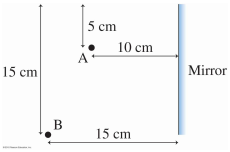
A light ray leaves point A in Figure 1, reflects from the mirror, and reaches point B. How far below the top edge does the ray strike the mirror? What if the distance from point B to the mirror was reduced by 5 cm?
Homework Answers
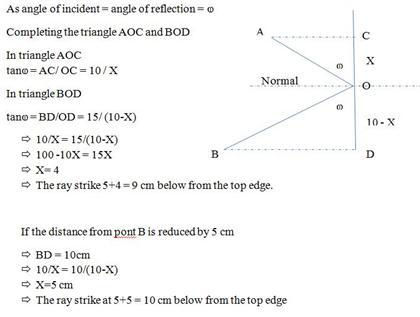
 The incident and reflected light rays will form two right angled triangles as shownFrom the laws of reflection,the angle of incidence = the angle of reflectionx / 10 cm = (10 cm - x) / 15 cm15 x = 100 - 10x25x = 100x = 4 cmTherefore the light ray will strike the mirror at 9 cm below the top edge
Add Answer to:
A light ray leaves point A in the figure, reflects from the mirror, and reaches point B.
A vertical mirror is placed at the origin. A ray of light coming from A is...
 A vertical mirror is placed at the origin. A ray of light coming
from A is reflected by the mirror so that it passes through B. How
far from the bottom does the ray hit the mirror? The coordinates
are A=(10.5, 15.1) and B=(15.9, 4.9), in centimetres.
A vertical mirror is placed at the origin. A ray of light coming
from A is reflected by the mirror so that it passes through B. How
far from the bottom does the ray hit the mirror? The coordinates
are A=(10.5, 15.1) and B=(15.9, 4.9), in centimetres.
1. A ray is incident on a mirror as shown in the following figure. If the...
 1. A ray is incident on a mirror as shown in the
following figure. If the mirror is tilted by , calculate the angle
change of the reflected ray
ClesS A ray is incident on a mirror as shown in the following figure. If the mirror is tilted by 8e, calculate the angle change of the reflected ray. 1. . Consider the following retroreflector (a device that reflects light back to its source), which consists of two perpendicular mirrors. Prove...
1. A ray is incident on a mirror as shown in the
following figure. If the mirror is tilted by , calculate the angle
change of the reflected ray
ClesS A ray is incident on a mirror as shown in the following figure. If the mirror is tilted by 8e, calculate the angle change of the reflected ray. 1. . Consider the following retroreflector (a device that reflects light back to its source), which consists of two perpendicular mirrors. Prove...
Here is a figure that shows a light ray that is H=23cm parallel to and above...
 Here is a figure that shows a light ray that is H=23cm parallel
to and above the ground.
The light ray goes through a medium with an index of refraction
of n1=1.2, and some of it reflects and some of it
refracts.
The refracting part goes into a medium with an index of
refraction of n2=1.5.
If the angle ? = 30 degrees:
What is the distance between point A and point B (in
cm)?
What is the angle between...
Here is a figure that shows a light ray that is H=23cm parallel
to and above the ground.
The light ray goes through a medium with an index of refraction
of n1=1.2, and some of it reflects and some of it
refracts.
The refracting part goes into a medium with an index of
refraction of n2=1.5.
If the angle ? = 30 degrees:
What is the distance between point A and point B (in
cm)?
What is the angle between...
3. A ray of light is reflected from two plane mirror surfaces as shown in the figure. What are th...
 3. A ray of light is reflected from two plane mirror surfaces as shown in the figure. What are the correct values of α and β? 26° 얘) Value of a-? Value of B7
3. A ray of light is reflected from two plane mirror surfaces as shown in the figure. What are the correct values of α and β? 26° 얘) Value of a-? Value of B7
3. A ray of light is reflected from two plane mirror surfaces as shown in the figure. What are the correct values of α and β? 26° 얘) Value of a-? Value of B7
A monochromatic light ray enters a glass sphere of radius 5 cm from air as shown in the figure. The incident ray is parallel to the diameter AOB with a separation of h = 4 cm. After entering the glass sphere, the ray crosses the diameter AOB at a certain
 A monochromatic light ray enters a glass sphere of radius 5 cm from air as shown in the figure. The incident ray is parallel to the diameter AOB with a separation of h = 4 cm. After entering the glass sphere, the ray crosses the diameter AOB at a certain point between center O and point B.mainly ask (d) and (e)(d) If incident light is unpolarized, is the reflected light at point P perfectly polarized? If not, find another separation...
A plane mirror and a concave mirror (f = 7.90 cm) are facing each other and...
A plane mirror and a concave mirror (f = 7.90 cm) are facing each other and are separated by a distance of 18.0 cm. An object is placed between the mirrors and is 9.0 cm from each mirror. Consider the light from the object that reflects first from the plane mirror and then from the concave mirror. Draw the ray diagram. What is the distance of the image (di) produced by the concave mirror?
A light ray enters a rectangular block of plastic at an angle of 01-42.0° and emerges...
 A light ray enters a rectangular block of plastic at an angle of 01-42.0° and emerges at an angle of θ2-78.09, as shown in Figure P35.71. Figure P35.71 (a) Determine the index of refraction of the plastic (b) If the light ray enters the plastic at a point L 50.0 cm from the bottom edge, how long does it take the light ray to travel through the plastic? ns
The drawing shows a ray of light traveling from point A to point B, a distance...
 The drawing shows a ray of light traveling from point A to point B, a distance of 6.40 m in a material than has an index of refraction n1. At point B, the light encounters a different substance whose index of refraction is n 1.63. The light strikes the interface at the critical angle of c-40.9°. How much time does it take for the light to travel from A to B? 21.63 Number Units
A light ray strikes a plane mirror lying flat on a horizontal floor, making...
 Problem 25.1.01 A light ray strikes a plane mirror lying flat on a horizontal floor, making an angle of incidence of O; = 64.2º. After reflecting from the mirror, the ray makes a spot on a vertical wall. The wall is a horizontal distance d = 1.08 m from the point of reflection, as shown. How high from the floor is the spot on the wall? (Neglect the thickness of the mirror.)
 A vertical mirror is placed at the origin. A ray of light coming
from A is reflected by the mirror so that it passes through B. How
far from the bottom does the ray hit the mirror? The coordinates
are A=(10.5, 15.1) and B=(15.9, 4.9), in centimetres.
A vertical mirror is placed at the origin. A ray of light coming
from A is reflected by the mirror so that it passes through B. How
far from the bottom does the ray hit the mirror? The coordinates
are A=(10.5, 15.1) and B=(15.9, 4.9), in centimetres.
 1. A ray is incident on a mirror as shown in the
following figure. If the mirror is tilted by , calculate the angle
change of the reflected ray
ClesS A ray is incident on a mirror as shown in the following figure. If the mirror is tilted by 8e, calculate the angle change of the reflected ray. 1. . Consider the following retroreflector (a device that reflects light back to its source), which consists of two perpendicular mirrors. Prove...
1. A ray is incident on a mirror as shown in the
following figure. If the mirror is tilted by , calculate the angle
change of the reflected ray
ClesS A ray is incident on a mirror as shown in the following figure. If the mirror is tilted by 8e, calculate the angle change of the reflected ray. 1. . Consider the following retroreflector (a device that reflects light back to its source), which consists of two perpendicular mirrors. Prove...
 Here is a figure that shows a light ray that is H=23cm parallel
to and above the ground.
The light ray goes through a medium with an index of refraction
of n1=1.2, and some of it reflects and some of it
refracts.
The refracting part goes into a medium with an index of
refraction of n2=1.5.
If the angle ? = 30 degrees:
What is the distance between point A and point B (in
cm)?
What is the angle between...
Here is a figure that shows a light ray that is H=23cm parallel
to and above the ground.
The light ray goes through a medium with an index of refraction
of n1=1.2, and some of it reflects and some of it
refracts.
The refracting part goes into a medium with an index of
refraction of n2=1.5.
If the angle ? = 30 degrees:
What is the distance between point A and point B (in
cm)?
What is the angle between...
 3. A ray of light is reflected from two plane mirror surfaces as shown in the figure. What are the correct values of α and β? 26° 얘) Value of a-? Value of B7
3. A ray of light is reflected from two plane mirror surfaces as shown in the figure. What are the correct values of α and β? 26° 얘) Value of a-? Value of B7
3. A ray of light is reflected from two plane mirror surfaces as shown in the figure. What are the correct values of α and β? 26° 얘) Value of a-? Value of B7
 A light ray enters a rectangular block of plastic at an angle of 01-42.0° and emerges at an angle of θ2-78.09, as shown in Figure P35.71. Figure P35.71 (a) Determine the index of refraction of the plastic (b) If the light ray enters the plastic at a point L 50.0 cm from the bottom edge, how long does it take the light ray to travel through the plastic? ns
 The drawing shows a ray of light traveling from point A to point B, a distance of 6.40 m in a material than has an index of refraction n1. At point B, the light encounters a different substance whose index of refraction is n 1.63. The light strikes the interface at the critical angle of c-40.9°. How much time does it take for the light to travel from A to B? 21.63 Number Units
 Problem 25.1.01 A light ray strikes a plane mirror lying flat on a horizontal floor, making an angle of incidence of O; = 64.2º. After reflecting from the mirror, the ray makes a spot on a vertical wall. The wall is a horizontal distance d = 1.08 m from the point of reflection, as shown. How high from the floor is the spot on the wall? (Neglect the thickness of the mirror.)
Most questions answered within 3 hours.
-
Where is the error in this code sequence?
String s1 = "Hello";
String s2 = "ello";...
asked 10 months ago -
Financial data for Joel de Paris, Inc., for last year
follow:
Joel de Paris, Inc.
Balance...
asked 10 months ago -
Consider this reaction:
Al2(SO4)3 (aq)+ BaCl3
(aq) Al2Cl6 (aq)- +
3BaSO4(s) . What is the...
asked 10 months ago -
Suppose that Savneet is considering increasing her
recent random sample from 20 car rentals to 40...
asked 10 months ago -
Trucks arrive at an unloading terminal at an average rate of 120
per hour.
Trucks arrive...
asked 10 months ago -
Why are methanol and ethanol completely soluble in water while
octanol is not very little soluble....
asked 10 months ago -
A facilities manager at a university reads in a research report
that the mean amount of...
asked 10 months ago -
When the CuSO4 is rehydrated by adding water to the anhydrous
compound, is this an endothermic...
asked 10 months ago -
A ray of sunlight is passing from diamond into crown glass; the
angle of incidence is...
asked 10 months ago -
A block of mass 0.249 kg is placed on top of a light, vertical
spring of...
asked 10 months ago -
how do the kidneys compensate in the presences of acidosis
a) trigger hyperventilate
b) reserve acid...
asked 10 months ago -
Question 501 pts
The rental rate of capital to the firm increases. Which of the
following...
asked 10 months ago