please help
(a) What should be the concentration of pollutant in the effluent leaving the lagoon?
(b) If the input waste concentration suddenly increased to 100 mg/L, what the concentration in the effluent be 7 days later?
C)A Nonconservative of pullutant with rate constant k=0.20/d.
Homework Answers
In steady flow regime entering volumetric flow rate and effluent flow rate are equal
So rate of change of pollutant is given by:
d(C·V) dt = C_in·Q - C·Q
(C pollutant concentration, V volume of the lagoon, Q volumetric flow rate)
Since V is constant
V·(dC/dt) = Q·(C_in - C)
<=>
(dC/dt) = (Q/V)·(C_in - C)
At steady state conditions
dC/dt = 0
Hence
C = C_in = 10 mg/L
b)
For this part you need to solve the differential equation from part a)
In difference to part a)) input concentration is 100 mg/l
(dC/dt) = (100 m³/d / 1200 m³)·(100 mg/L - C)
Or simply (with C in mg/L and t in days)
(dC/dt) = (1/12)·(100 - C)
To solve this 1st order differential equation separate variables and integrate
1/(100 - C) dC = (1/12) dt
=>
1/(100 - C) dC = (1/12) dt
=>
integral 1/(100 - C) dC =integral (1/12) dt
=>
- ln(100 - C) = (1/12)·t + a
(a is the constant of integration)
Apply initial condition to find it:
C(t=0) = 10
<=>
- ln(100 - 10) = (1/12)·0 + a
a = - ln(90)
Hence,
- ln(100 - C) = (1/12)·t - ln(90)
<=>
100 - C = e^(ln(90) - (1/12)·t) = e^(ln(90)) · e^(-(1/12)·t)
<=>
C = 100 - 90·e^(-(1/12)·t)
After 7 days:
C = 100 - 90·e^(-(1/12)·7) = 49.8 (mg/L)
A lagoon with volume 1,000 m3 has been receiving a steady flow of a nonconservative pollutant...
A lagoon with volume 1,000 m3 has been receiving a steady flow of a nonconservative pollutant with reaction rate of .20/day at a rate of 100 m3/day for a long enough time to assume that steady-state conditions apply. The waste entering the lagoon has a concentration of 100 mg/L. Assume completely mixed conditions. If the input waste concentration suddenly decreased to 10mg/L, what would the concentration in the effluent be 10 days later?
please explain good Question 4 (20 points) A lagoon with volume 1.200 m' has been receiving...
 please explain good
Question 4 (20 points) A lagoon with volume 1.200 m' has been receiving a steady flow of conservative waste at a rale of 100 m'iday for a long enough time to assume steady state conditions apply. The waste entering the lagoon has a concentration of 10 mg/L. Assuming completely mixed conditions. a) What would be the concentration of pollutant in the effluent leaving the lagoon? (10 points) b) If the input waste concentration suddenly increased to 100...
please explain good
Question 4 (20 points) A lagoon with volume 1.200 m' has been receiving a steady flow of conservative waste at a rale of 100 m'iday for a long enough time to assume steady state conditions apply. The waste entering the lagoon has a concentration of 10 mg/L. Assuming completely mixed conditions. a) What would be the concentration of pollutant in the effluent leaving the lagoon? (10 points) b) If the input waste concentration suddenly increased to 100...
11. A lagoon with constant volume of 450,000 m' is being used to treat two separate...
 11. A lagoon with constant volume of 450,000 m' is being used to treat two separate waste streams. One has a flow rate of 5.0 m/s and a waste concentration of 500 mg/L. The other has a flow rate of 1 m/s and a waste concentration of 1500mg/L. The pollutant has a reaction rate coefficient (k) of 0.3/day. Assuming the pollutant is well mixed in the lagoon, find the steady-state concentration of pollutant in the lagoon. (10 Points)
1. A lagoon is to be designed to remove a nonconservative pollutant with an input flow...
 1. A lagoon is to be designed to remove a nonconservative pollutant with an input flow of 150 m3/d, and the concentration is 20 mg/L. The volume of this lagoon is 3000 m², and the first order reaction rate of the pollutant is 0.20/day. Assuming it is a complete mixing, please calculate the pollutant concentration in the effluent. - (4 Marks). tt Assume that the gas above the soda in a bottle of soft drink is pure CO2 with a...
You are designing a sewage lagoon to accommodate an input flow of 0.1 m3/min. At steady-state,...
You are designing a sewage lagoon to accommodate an input flow of 0.1 m3/min. At steady-state, the effluent (also at 0.1 m3/min) from the lagoon must not exceed a BOD of 10 mg/L. Assume the lagoon is well mixed, that there are no additional inputs to the lagoon and that the BOD degrades with a reaction rate constant equal to 0.1 day-1. What is the volume of the lagoon needed to achieve the effluent BOD goal if the influent BOD...
A well-mixed lagoon is used to pre-treat an agricultural waste stream before it is sent to...
A well-mixed lagoon is used to pre-treat an agricultural waste stream before it is sent to the local municipal wastewater treatment plant. The waste stream has a flow rate of 400 m3/d and contains 300 mg/L of biodegradable waste. The waste decomposes via a first- order biodegradation process with a rate constant of 0.35 d-1. How large must the lagoon be in order to drive the concentration of waste down to 20 mg/L (as required by the municipal wastewater treatment...
A lake with volume 10^3 m^3 is fed by a pollution-free stream with flow rate 5...
 A lake with volume 10^3 m^3 is fed by a pollution-free stream with flow rate 5 m^3/min. A factory dumps 0.1 m^3/s of a non-conservative waste with concentration 100 mg/L into the lake. The pollutant has a reaction rate coefficient K of 0.2/day. Assuming the pollutant is well mixed in the lake; find the steady-state concentration of pollutant in lake.
1. A lake with constant volume 10 x 106 m3 is fed by a pollution-free stream...
 1. A lake with constant volume 10 x 106 m3 is fed by a pollution-free stream with a flowrate 50 m3/s. A factory dumps 5 m3/s of nonconservative waste with concentration 100 mg/L into the lake. The pollution has a reaction coefficient 0.25 day1. Assume the pollution is well mixed in the lake. Find steady state concentration of pollution in the lake.
The wastewater coming from small development was treated by the string of 2 ponds. The initial...
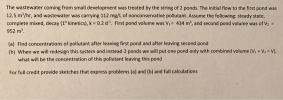 The wastewater coming from small development was treated by the string of 2 ponds. The initial flow to the first pond was 12.5 m/hr, and wastewater was carrying 112 mg/L of nonconservative pollutant. Assume the following: steady state, complete mixed, decay (1° kinetics), k = 0.2 d1. First pond volume was V1= 434 m3, and second pond volume was of V2 = 952 m2 (a) Find concentrations of pollutant after leaving first pond and after leaving second pond (b) When...
Question 23 A sewage lagoon that has a surface area of 10 ha and a depth...
 Question 23 A sewage lagoon that has a surface area of 10 ha and a depth of receiving 8620.0 m/d of sewage containing 80.0 mg/L of biodegradable 1.2 m is con taminant. At steady state, the effluent from the lagoon must not exceed 22.0 mg/L of biodegradable contaminant. Assuming the lagoon is well mixed and that there are no losses or gains of water in the lagoon other coeff A 0.33 d than the sewage input, what biodegradation reaction rate...
 please explain good
Question 4 (20 points) A lagoon with volume 1.200 m' has been receiving a steady flow of conservative waste at a rale of 100 m'iday for a long enough time to assume steady state conditions apply. The waste entering the lagoon has a concentration of 10 mg/L. Assuming completely mixed conditions. a) What would be the concentration of pollutant in the effluent leaving the lagoon? (10 points) b) If the input waste concentration suddenly increased to 100...
please explain good
Question 4 (20 points) A lagoon with volume 1.200 m' has been receiving a steady flow of conservative waste at a rale of 100 m'iday for a long enough time to assume steady state conditions apply. The waste entering the lagoon has a concentration of 10 mg/L. Assuming completely mixed conditions. a) What would be the concentration of pollutant in the effluent leaving the lagoon? (10 points) b) If the input waste concentration suddenly increased to 100...
 11. A lagoon with constant volume of 450,000 m' is being used to treat two separate waste streams. One has a flow rate of 5.0 m/s and a waste concentration of 500 mg/L. The other has a flow rate of 1 m/s and a waste concentration of 1500mg/L. The pollutant has a reaction rate coefficient (k) of 0.3/day. Assuming the pollutant is well mixed in the lagoon, find the steady-state concentration of pollutant in the lagoon. (10 Points)
 1. A lagoon is to be designed to remove a nonconservative pollutant with an input flow of 150 m3/d, and the concentration is 20 mg/L. The volume of this lagoon is 3000 m², and the first order reaction rate of the pollutant is 0.20/day. Assuming it is a complete mixing, please calculate the pollutant concentration in the effluent. - (4 Marks). tt Assume that the gas above the soda in a bottle of soft drink is pure CO2 with a...
 A lake with volume 10^3 m^3 is fed by a pollution-free stream with flow rate 5 m^3/min. A factory dumps 0.1 m^3/s of a non-conservative waste with concentration 100 mg/L into the lake. The pollutant has a reaction rate coefficient K of 0.2/day. Assuming the pollutant is well mixed in the lake; find the steady-state concentration of pollutant in lake.
 1. A lake with constant volume 10 x 106 m3 is fed by a pollution-free stream with a flowrate 50 m3/s. A factory dumps 5 m3/s of nonconservative waste with concentration 100 mg/L into the lake. The pollution has a reaction coefficient 0.25 day1. Assume the pollution is well mixed in the lake. Find steady state concentration of pollution in the lake.
 The wastewater coming from small development was treated by the string of 2 ponds. The initial flow to the first pond was 12.5 m/hr, and wastewater was carrying 112 mg/L of nonconservative pollutant. Assume the following: steady state, complete mixed, decay (1° kinetics), k = 0.2 d1. First pond volume was V1= 434 m3, and second pond volume was of V2 = 952 m2 (a) Find concentrations of pollutant after leaving first pond and after leaving second pond (b) When...
 Question 23 A sewage lagoon that has a surface area of 10 ha and a depth of receiving 8620.0 m/d of sewage containing 80.0 mg/L of biodegradable 1.2 m is con taminant. At steady state, the effluent from the lagoon must not exceed 22.0 mg/L of biodegradable contaminant. Assuming the lagoon is well mixed and that there are no losses or gains of water in the lagoon other coeff A 0.33 d than the sewage input, what biodegradation reaction rate...
Most questions answered within 3 hours.
-
Where is the error in this code sequence?
String s1 = "Hello";
String s2 = "ello";...
asked 11 months ago -
Financial data for Joel de Paris, Inc., for last year
follow:
Joel de Paris, Inc.
Balance...
asked 11 months ago -
Consider this reaction:
Al2(SO4)3 (aq)+ BaCl3
(aq) Al2Cl6 (aq)- +
3BaSO4(s) . What is the...
asked 11 months ago -
Suppose that Savneet is considering increasing her
recent random sample from 20 car rentals to 40...
asked 11 months ago -
Trucks arrive at an unloading terminal at an average rate of 120
per hour.
Trucks arrive...
asked 11 months ago -
Why are methanol and ethanol completely soluble in water while
octanol is not very little soluble....
asked 11 months ago -
A facilities manager at a university reads in a research report
that the mean amount of...
asked 11 months ago -
When the CuSO4 is rehydrated by adding water to the anhydrous
compound, is this an endothermic...
asked 11 months ago -
A ray of sunlight is passing from diamond into crown glass; the
angle of incidence is...
asked 11 months ago -
A block of mass 0.249 kg is placed on top of a light, vertical
spring of...
asked 11 months ago -
how do the kidneys compensate in the presences of acidosis
a) trigger hyperventilate
b) reserve acid...
asked 11 months ago -
Question 501 pts
The rental rate of capital to the firm increases. Which of the
following...
asked 11 months ago