6 - The null hypothesis for a chi-square contingency test of independence for two variables...
Answer
True
False
Homework Answers
Add Answer to:
6 - The null hypothesis for a chi-square contingency test of independence for two variables...
3) The chi-square test for independence between two categorical variables is a a. Two tailed test...
3) The chi-square test for independence between two categorical variables is a a. Two tailed test b. Right tailed test c. Left tailed test d. Left tailed or right tailed depending on null hypothesis.
Question 1 In a chi -square test of independence , the null hypothesis states that-----------. a....
Question 1 In a chi -square test of independence , the null hypothesis states that-----------. a. the two variables of interest are related in the population. b. the column frequencies equal the row frequencies c. the sum of the and the column frequencies equal the total frequency d. the two variables of interest are unrelated in the population Question 2 A survey asked people whether they identified as a morning person, night person, or had no preference. a. 270 replied...
QUESTION 58 The chi-square test of independence does not allow us to state that one variable...
 QUESTION 58 The chi-square test of independence does not allow us to state that one variable causes a change in another variable when the null hypothesis is rejected. True False QUESTION 59 When performing a hypothesis test to compare two or more population proportions, the expected frequencies must always be integer values. True False QUESTION 60
Part1. Chi-Square Test of Independence. Given the following contingency table, conduct a Chi-square test of independence....
Part1. Chi-Square Test of Independence. Given the following contingency table, conduct a Chi-square test of independence. What is the overall count (i.e. sample size)? Category 1 Category 2 1 2 3 4 1 120 112 100 110 2 127 115 120 124 3 118 115 110 124 442 365 1,396 358 2,790 None of the above Part 2. Chi-Square Test of Independence. What is the total for column 4? 442 365 1,396 358 None of the above Part 3....
The chi-square test for independence is similar to a correlation in that it evaluates the relationship...
The chi-square test for independence is similar to a correlation in that it evaluates the relationship between two variables. True or false. Explain your answer.
Istanbul Aydin Oniversitesi Elektronik Sine S The Alternative Hypothesis (H)) for the Chi-Square test of independence...
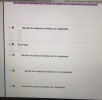 Istanbul Aydin Oniversitesi Elektronik Sine S The Alternative Hypothesis (H)) for the Chi-Square test of independence should specify OA) that the two categorical variables are independent B) No of them C) that the two numerical variables are not independent OD) that the two categorical variables are not independent that the two numerical variables are independent
Suppose that you wish to perform a chi-square test of independence. The two variables under consideration...
Suppose that you wish to perform a chi-square test of independence. The two variables under consideration are sex and blood type. True or false, if the two variables are not associated, we would expect that in the sample, the number of women with a given blood type would be roughly equal to the number of men with the same blood type? If the statement is false, rewrite it so that it is true.
When we carry out a chi-square test of independence, the chi-square statistic is based on (rxc)-1...
When we carry out a chi-square test of independence, the chi-square statistic is based on (rxc)-1 degrees of freedom, where r and c denote, respectively, the number of rows and columns in the contingency table. True or false
You are doing a chi- square test for independence and find a significant result. What can conclude? A The null hypothesis is correct and there is no difference in the proportion of count in your singl...
You are doing a chi- square test for independence and find a significant result. What can conclude? A The null hypothesis is correct and there is no difference in the proportion of count in your single row. B . The null hypothesis is incorrect and there is probably a relationship between the two variables of interest. C.The null hypothesis is correct and there is no relationship between your two variables of interest. D.The null hypothesis is incorrect and there is...
Skewness and kurtosis should not be tested when using the chi-square test of independence. True or...
Skewness and kurtosis should not be tested when using the chi-square test of independence. True or False The major difference between the Mann-Whitney U-test and the Kruskal-Wallis H test is the number of independent variables. True or False
 QUESTION 58 The chi-square test of independence does not allow us to state that one variable causes a change in another variable when the null hypothesis is rejected. True False QUESTION 59 When performing a hypothesis test to compare two or more population proportions, the expected frequencies must always be integer values. True False QUESTION 60
 Istanbul Aydin Oniversitesi Elektronik Sine S The Alternative Hypothesis (H)) for the Chi-Square test of independence should specify OA) that the two categorical variables are independent B) No of them C) that the two numerical variables are not independent OD) that the two categorical variables are not independent that the two numerical variables are independent
Most questions answered within 3 hours.
-
Where is the error in this code sequence?
String s1 = "Hello";
String s2 = "ello";...
asked 11 months ago -
Financial data for Joel de Paris, Inc., for last year
follow:
Joel de Paris, Inc.
Balance...
asked 11 months ago -
Consider this reaction:
Al2(SO4)3 (aq)+ BaCl3
(aq) Al2Cl6 (aq)- +
3BaSO4(s) . What is the...
asked 11 months ago -
Suppose that Savneet is considering increasing her
recent random sample from 20 car rentals to 40...
asked 11 months ago -
Trucks arrive at an unloading terminal at an average rate of 120
per hour.
Trucks arrive...
asked 11 months ago -
Why are methanol and ethanol completely soluble in water while
octanol is not very little soluble....
asked 11 months ago -
A facilities manager at a university reads in a research report
that the mean amount of...
asked 11 months ago -
When the CuSO4 is rehydrated by adding water to the anhydrous
compound, is this an endothermic...
asked 11 months ago -
A ray of sunlight is passing from diamond into crown glass; the
angle of incidence is...
asked 11 months ago -
A block of mass 0.249 kg is placed on top of a light, vertical
spring of...
asked 11 months ago -
how do the kidneys compensate in the presences of acidosis
a) trigger hyperventilate
b) reserve acid...
asked 11 months ago -
Question 501 pts
The rental rate of capital to the firm increases. Which of the
following...
asked 11 months ago