or which of the following situations would a repeated-measures design have the maximum advantage...
a. when very few subjects are available and individual differences are small
b. when many subjects are available and individual differences are small
c. when very few subjects are available and individual differences are large
d. when many subjects are available and individual differences are large
Homework Answers
Add Answer to:
or which of the following situations would a repeated-measures design have the maximum advantage...
7. An advantage of the matched groups research design is that it: provides a less ambiguous interpretation of the results than the repeated measures design. has more statistical power th...
7. An advantage of the matched groups research design is that it: provides a less ambiguous interpretation of the results than the repeated measures design. has more statistical power than the between-groups design with random assignment. requires fewer research subjects than the repeated measures design. has more statistical power than the repeated measures design. 8. One way to increase the statistical power within a between-groups design is to: have each participant contribute two data points per condition. match participants on...
When assumptions are violated in repeated-measures ANOVA, a non-parametric test called Friedman’s ANOVA can be used...
When assumptions are violated in repeated-measures ANOVA, a non-parametric test called Friedman’s ANOVA can be used in which situations? a. For any repeated-measures ANOVA design. b. When you have only one independent variable. c. When you have two or more independent variables. d. Never for repeated-measures ANOVA.
A within-subjects design is to the whereas a between-subjects design is to the a. Repeated-measures ANOVA;...
 A within-subjects design is to the whereas a between-subjects design is to the a. Repeated-measures ANOVA; One-way ANOVA. b. One-way ANOVA; Chi-square test for independence, c. One-way ANOVA; Repeated-measures ANOVA. d. Dependent samples t-test; Repeated-measures ANOVA
Question 2 The primary advantage of the related samples design is that it controls for ________...
Question 2 The primary advantage of the related samples design is that it controls for ________ that may artificially increase the observed differences between means in other types of studies. Group of answer choices degrees of freedom MD individual differences the effect of the treatment Question 3 A manager would like to know if the performance of sales representatives significantly (α = .05) improves over the first 6 months of employment. For 5 new sales representatives, the number of sales...
contrasting a repeated measures research design with matched subjects and independent measures designs A graduate student...
 contrasting a repeated measures research design with matched
subjects and independent measures designs
A graduate student is interested in whether journaling can affect grief and healing. She has participants who have been widowed within the past 10-14 months complete a battery of psychological questionnaires before and after journaling about their daily problems for 2 months. The first time the graduate student conducted this study, she used a repeated-measures design and compared the widows' and widowers' baseline scores with their scores...
contrasting a repeated measures research design with matched
subjects and independent measures designs
A graduate student is interested in whether journaling can affect grief and healing. She has participants who have been widowed within the past 10-14 months complete a battery of psychological questionnaires before and after journaling about their daily problems for 2 months. The first time the graduate student conducted this study, she used a repeated-measures design and compared the widows' and widowers' baseline scores with their scores...
True or False 4. The formula used in repeated-measures t statistic Is used with a matched-subjects...
 True or False 4. The formula used in repeated-measures t statistic Is used with a matched-subjects design even though the design uses two separate samples. .One advantage of a repeated-measures design is that it typically requires owa nts than an independent-measures design. When computing difference scores' (D values) the sign of the difference(+or-'s not nt. You need to record only the size of the difference. Power is 14. To get a big effect size, you should increase N. Power analysis...
5. A step-by-step hypothesis test for a repeated measures design Aa Aa E Consider the following...
 5. A step-by-step hypothesis test for a repeated measures design Aa Aa E Consider the following data from a repeated-measures design. You want to use a repeated-measures t test to test the null hypothesis Ho: D 0 (the null hypothesis states that the mean difference for the general population is zero). The data consist of five observations, each with two measurements, A and B, taken before and after a treatment. Assume the population of the differences in these measurements are...
An advantage of a within-subjects design as compared to a between-subjects design is... a. All of...
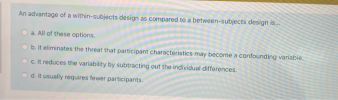 An advantage of a within-subjects design as compared to a between-subjects design is... a. All of these options. b. it eliminates the threat that participant characteristics may become a confounding variable. c. it reduces the variability by subtracting out the individual differences. d. it usually requires fewer participants.
5. A two-tailed hypothesis test for a repeated-measures design A graduate student is interested in whether...
 5. A two-tailed hypothesis test for a repeated-measures design A graduate student is interested in whether jounaling can affect grief and healing. For her study, she selects a random sample of 64 adults who have been widowed within the past 10 to 14 months. The subjects complete a battery of psychological questionnaires before and after spending two months journaling about their emotions. Before the two months of journaling, the mean score on the impact of event scale-avoidance subscale, which measures...
Consider the following data from a repeated-measures design. You want to use a repeated-measures t test...
 Consider the following data from a repeated-measures design. You want to use a repeated-measures t test to test the null hypothesis H_0: mu_D = 0 (the null hypothesis states that the mean difference for the general population is zero). The data consist of five observations, each with two measurements, A and B, taken before and after a treatment. Assume the population of the differences in these measurements are normally distributed. Complete the following table by calculating the differences and the...
 A within-subjects design is to the whereas a between-subjects design is to the a. Repeated-measures ANOVA; One-way ANOVA. b. One-way ANOVA; Chi-square test for independence, c. One-way ANOVA; Repeated-measures ANOVA. d. Dependent samples t-test; Repeated-measures ANOVA
 contrasting a repeated measures research design with matched
subjects and independent measures designs
A graduate student is interested in whether journaling can affect grief and healing. She has participants who have been widowed within the past 10-14 months complete a battery of psychological questionnaires before and after journaling about their daily problems for 2 months. The first time the graduate student conducted this study, she used a repeated-measures design and compared the widows' and widowers' baseline scores with their scores...
contrasting a repeated measures research design with matched
subjects and independent measures designs
A graduate student is interested in whether journaling can affect grief and healing. She has participants who have been widowed within the past 10-14 months complete a battery of psychological questionnaires before and after journaling about their daily problems for 2 months. The first time the graduate student conducted this study, she used a repeated-measures design and compared the widows' and widowers' baseline scores with their scores...
 True or False 4. The formula used in repeated-measures t statistic Is used with a matched-subjects design even though the design uses two separate samples. .One advantage of a repeated-measures design is that it typically requires owa nts than an independent-measures design. When computing difference scores' (D values) the sign of the difference(+or-'s not nt. You need to record only the size of the difference. Power is 14. To get a big effect size, you should increase N. Power analysis...
 5. A step-by-step hypothesis test for a repeated measures design Aa Aa E Consider the following data from a repeated-measures design. You want to use a repeated-measures t test to test the null hypothesis Ho: D 0 (the null hypothesis states that the mean difference for the general population is zero). The data consist of five observations, each with two measurements, A and B, taken before and after a treatment. Assume the population of the differences in these measurements are...
 An advantage of a within-subjects design as compared to a between-subjects design is... a. All of these options. b. it eliminates the threat that participant characteristics may become a confounding variable. c. it reduces the variability by subtracting out the individual differences. d. it usually requires fewer participants.
 5. A two-tailed hypothesis test for a repeated-measures design A graduate student is interested in whether jounaling can affect grief and healing. For her study, she selects a random sample of 64 adults who have been widowed within the past 10 to 14 months. The subjects complete a battery of psychological questionnaires before and after spending two months journaling about their emotions. Before the two months of journaling, the mean score on the impact of event scale-avoidance subscale, which measures...
 Consider the following data from a repeated-measures design. You want to use a repeated-measures t test to test the null hypothesis H_0: mu_D = 0 (the null hypothesis states that the mean difference for the general population is zero). The data consist of five observations, each with two measurements, A and B, taken before and after a treatment. Assume the population of the differences in these measurements are normally distributed. Complete the following table by calculating the differences and the...
Most questions answered within 3 hours.
-
Where is the error in this code sequence?
String s1 = "Hello";
String s2 = "ello";...
asked 11 months ago -
Financial data for Joel de Paris, Inc., for last year
follow:
Joel de Paris, Inc.
Balance...
asked 11 months ago -
Consider this reaction:
Al2(SO4)3 (aq)+ BaCl3
(aq) Al2Cl6 (aq)- +
3BaSO4(s) . What is the...
asked 11 months ago -
Suppose that Savneet is considering increasing her
recent random sample from 20 car rentals to 40...
asked 11 months ago -
Trucks arrive at an unloading terminal at an average rate of 120
per hour.
Trucks arrive...
asked 11 months ago -
Why are methanol and ethanol completely soluble in water while
octanol is not very little soluble....
asked 11 months ago -
A facilities manager at a university reads in a research report
that the mean amount of...
asked 11 months ago -
When the CuSO4 is rehydrated by adding water to the anhydrous
compound, is this an endothermic...
asked 11 months ago -
A ray of sunlight is passing from diamond into crown glass; the
angle of incidence is...
asked 11 months ago -
A block of mass 0.249 kg is placed on top of a light, vertical
spring of...
asked 11 months ago -
how do the kidneys compensate in the presences of acidosis
a) trigger hyperventilate
b) reserve acid...
asked 11 months ago -
Question 501 pts
The rental rate of capital to the firm increases. Which of the
following...
asked 11 months ago