principle of moments
Using the principle of transmissibility, the force F can be slid along its line of action to point B. At point B, the force F creates an angle φ with the shed. (Part C figure) What is Mfx , the contribution to the moment about point O made by the x component of the force at point B? What is Mfy , the contribution to the moment about point O made by the y component of the force Fat point B? What is the total moment Mdue to the force F about point O? Assume that moments acting counterclockwise about point O are positive whereas moments acting clockwise are negative.
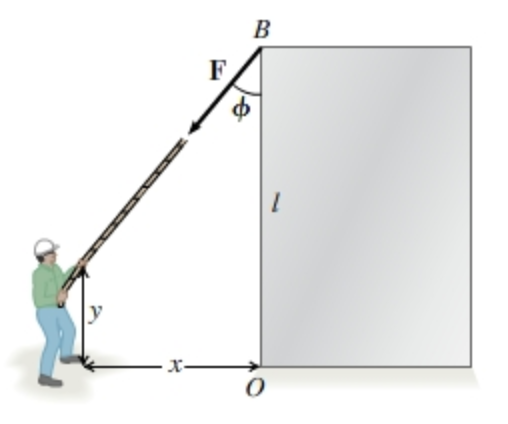
As shown, a rope is attached to a l=19.0 ft high shed that is to be relocated. A man pulls on the end of the rope at point A; the rope is attached to the shed at point B. (Intro 1 figure) As the man pulls on the rope, it creates an angle theta with the horizontal. The end of the rope is located at x=10.0 ft from the shed and y=4.50 ft off the ground. The man pulls on the rope with a force of magnitude F= 70 lbs.
Homework Answers
Free body diagram:
These diagrams are used to show all the external forces which are applied on the body. It is basically a vector representation of all the external forces. The dynamic analysis is done based on the free body diagram of any physical object.
Moment of a force:
Moment of a force refers to the propensity of the force to cause rotation on the body it acts upon. The moment’s magnitude can be determined from the product of force’s magnitude and the distance to the force measured perpendicularly.
The magnitude of the developed moment will be zero, if the line of action of the applied force is along the direction of the point about which the moment is to be determined.
The angle of inclination by the force can be determined using the inverse tangent relation. Then, resolve the force F into x and y components. Thus, calculate the moment at point O about x and y directions as the product of force and perpendicular distances using principle of transmissibility.
Resolution of force vector:
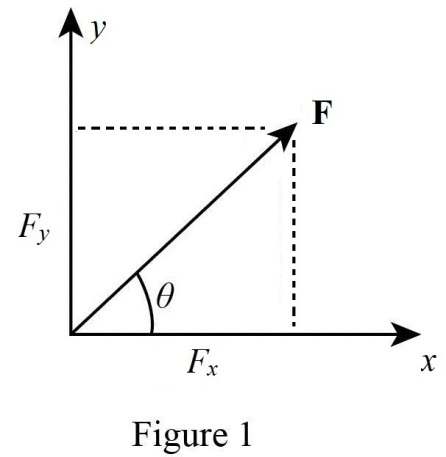
Here, the angle of inclination or the direction of force with horizontal is .
For a force vector acting as shown in the Figure (1), the components of force along the horizontal x and vertical y directions is given by,
In a right triangle, write the basic trigonometric relation for an inclination as follows:
The equation for the moment about any point is given as follows:
Here, the applied force is and the perpendicular distance between the force and reference point is .
The resultant moment for two mutually perpendicular moment components is given as follows:
Here, the moment component about axis is and the moment component about axis is .
General sign conventions:
Moment in clockwise direction is considered as negative and moment in counter clockwise direction is considered as positive.
Draw the free body diagram for the force action as shown in Figure (2).

Here, the horizontal distance of the man from point O is , the vertical distance of the man from point O is and the angle made by the force with the vertical axis is .
Calculate the angle of inclination by the force with vertical axis.
Substitute for , for and for .
Calculate the component of force at point B.
Here, the component of force at point B is .
Determine the contribution of the moment about point O made by the component of the force at point B .
Substitute for .
Substitute for , for and for .
Calculate the component of force at point B.
Here, the component of force at point B is .
Determine the contribution of the moment about point O made by the component of the force at point B.
Here, the perpendicular distance of the point of application of force from point O is .
Substitute for .
Substitute for , for and for .
Calculate the total moment due to the force about point O.
Substitute for and for .
Ans:
The contribution to the moment about point O made by the component of the force at point B is .
The contribution to the moment about point O made by the component of the force at point B is 0.
The total moment due to the force about point O is .
Fy = Fcos(phi)
MFx = Fx X l = Flsin(phi)
MFy = 0 since distance and force are in same direction
Total moment = Flsin(phi)
PartA Learning Goal: To apply the principle of moments and the principle of transmissibility What is...
 PartA Learning Goal: To apply the principle of moments and the principle of transmissibility What is M, the contribution to the moment about point O made by the x component of the force F at point A? What is ME, the contribution to the moment about point O made by the y component of the force F at point A? What is the total moment M due to the force F about point O? Assume that moments acting counterclockwise about...
A stool at a restaurant is anchored to the floor. When a customer is in the...
 A stool at a restaurant is anchored to the floor. When a customer
is in the process of sitting down, a horizontal force with
magnitude
F1
is exerted at the top of the stool support as shown in the figure.
(Figure
1) When the customer is seated, a vertical force with
magnitude
F2
is exerted on the stool support. If the maximum moment magnitude
that the stool support can sustain about point A is
MA
= 180lb?ft
, what is...
A stool at a restaurant is anchored to the floor. When a customer
is in the process of sitting down, a horizontal force with
magnitude
F1
is exerted at the top of the stool support as shown in the figure.
(Figure
1) When the customer is seated, a vertical force with
magnitude
F2
is exerted on the stool support. If the maximum moment magnitude
that the stool support can sustain about point A is
MA
= 180lb?ft
, what is...
2. There are two forces acting at C. What is the resultant from the two forces?...
 2. There are two forces acting at C. What is the resultant from the two forces? What is the moment about the point o generated from the resultant force? Find the component of the moment about point O which goes in the direction of OA. (20 pts.) 1 ft ft 3 ft F = {-20i + 10j + 30k) lb B 2 ft F = (-10i - 30j + 50k) ID
2. There are two forces acting at C. What is the resultant from the two forces?...
 2. There are two forces acting at C. What is the resultant from the two forces? What is the moment about the point o generated from the resultant force? Find the component of the moment about point which goes in the direction of OA. (20 pts.) 1 ft 3 ft F = (-20i + 10j + 30k) lb B 2 ft F. =-101 - 30j + 50k) lb
To understand the two most common procedures for finding torques when the forces and displacements are all in one plan...
 To understand the two most
common procedures for finding torques when the forces and
displacements are all in one plane: the moment arm method and the
tangential force method. The purpose of this problem is to give you
further practice finding torques in two-dimensional situations. In
this case it is overkill to use the full cross product definition
of the torque because the only nonzero component of the torque is
the component perpendicular to the plane containing the problem.
There...
To understand the two most
common procedures for finding torques when the forces and
displacements are all in one plane: the moment arm method and the
tangential force method. The purpose of this problem is to give you
further practice finding torques in two-dimensional situations. In
this case it is overkill to use the full cross product definition
of the torque because the only nonzero component of the torque is
the component perpendicular to the plane containing the problem.
There...
A man wishes to spin a merry-go-round in the x–y plane centered at the origin (0.000,0.000,0.000)....
A man wishes to spin a merry-go-round in the x–y plane centered at the origin (0.000,0.000,0.000). (Figure 1) Because he must pull upward and cannot stand on the merry-go-round, he must apply a force in the direction of the unit vector u=(?1/3)i+(2/3)j+(2/3)k. He pulls with a force F = 61.0 lb from point A [(3.00,4.00,0.000) ft]. What are the x, y, and z components of the resulting moment acting on the merry-go-round about the origin?
Please solve all the questions. 120 N Question No. 1: A 120-N force is applied to...
 Please solve all the questions.
120 N Question No. 1: A 120-N force is applied to the control rod AB as shown. Knowing that the length of the rod is 0.6 m: 1. Determine the moment of the force about point B by resolving the force into: a. components along AB and in a direction perpendicular to AB. b. horizontal and vertical components. 2. Determine the horizontal force at A which creates the same moment. Question No. 2: Knowing that...
Please solve all the questions.
120 N Question No. 1: A 120-N force is applied to the control rod AB as shown. Knowing that the length of the rod is 0.6 m: 1. Determine the moment of the force about point B by resolving the force into: a. components along AB and in a direction perpendicular to AB. b. horizontal and vertical components. 2. Determine the horizontal force at A which creates the same moment. Question No. 2: Knowing that...
The beam ABC has a mass of 78.0 kg and is supported by the rope BDC...
 The beam ABC has a mass of 78.0 kg and is supported by the rope
BDC that runs through the frictionless pulley at D. The winch at CC
has a mass of 44.5 kg. The tension in the rope acts on the beam at
points B and C and counteracts the moments due to the beam's weight
(acting vertically at the midpoint of its length) and the weight of
the winch (acting vertically at point C) such that the resultant...
The beam ABC has a mass of 78.0 kg and is supported by the rope
BDC that runs through the frictionless pulley at D. The winch at CC
has a mass of 44.5 kg. The tension in the rope acts on the beam at
points B and C and counteracts the moments due to the beam's weight
(acting vertically at the midpoint of its length) and the weight of
the winch (acting vertically at point C) such that the resultant...
only need to find axial, shear force, and bending moment Determine the general expressions for the moments of F about...
 only need to find axial, shear force, and bending moment
Determine the general expressions for the moments of F about point B and point O. Evaluate your expressions for F = 750 N, R = 2.4 m, theta = 30 degree, and phi = 15 degree.
only need to find axial, shear force, and bending moment
Determine the general expressions for the moments of F about point B and point O. Evaluate your expressions for F = 750 N, R = 2.4 m, theta = 30 degree, and phi = 15 degree.
#3-16, If the man at B exerts a force of P 30 lb on the rope,...
 #3-16, If the man at B exerts a force of P 30 lb on the rope, determine the magnitude of the force F the man at C must exert to prevent the pole from rotating, i.e., so the resultant moment about A of both forces is zero. of nt 6 ft 45° 12 ft Probs. 3-15/16
 PartA Learning Goal: To apply the principle of moments and the principle of transmissibility What is M, the contribution to the moment about point O made by the x component of the force F at point A? What is ME, the contribution to the moment about point O made by the y component of the force F at point A? What is the total moment M due to the force F about point O? Assume that moments acting counterclockwise about...
 A stool at a restaurant is anchored to the floor. When a customer
is in the process of sitting down, a horizontal force with
magnitude
F1
is exerted at the top of the stool support as shown in the figure.
(Figure
1) When the customer is seated, a vertical force with
magnitude
F2
is exerted on the stool support. If the maximum moment magnitude
that the stool support can sustain about point A is
MA
= 180lb?ft
, what is...
A stool at a restaurant is anchored to the floor. When a customer
is in the process of sitting down, a horizontal force with
magnitude
F1
is exerted at the top of the stool support as shown in the figure.
(Figure
1) When the customer is seated, a vertical force with
magnitude
F2
is exerted on the stool support. If the maximum moment magnitude
that the stool support can sustain about point A is
MA
= 180lb?ft
, what is...
 2. There are two forces acting at C. What is the resultant from the two forces? What is the moment about the point o generated from the resultant force? Find the component of the moment about point O which goes in the direction of OA. (20 pts.) 1 ft ft 3 ft F = {-20i + 10j + 30k) lb B 2 ft F = (-10i - 30j + 50k) ID
 2. There are two forces acting at C. What is the resultant from the two forces? What is the moment about the point o generated from the resultant force? Find the component of the moment about point which goes in the direction of OA. (20 pts.) 1 ft 3 ft F = (-20i + 10j + 30k) lb B 2 ft F. =-101 - 30j + 50k) lb
 To understand the two most
common procedures for finding torques when the forces and
displacements are all in one plane: the moment arm method and the
tangential force method. The purpose of this problem is to give you
further practice finding torques in two-dimensional situations. In
this case it is overkill to use the full cross product definition
of the torque because the only nonzero component of the torque is
the component perpendicular to the plane containing the problem.
There...
To understand the two most
common procedures for finding torques when the forces and
displacements are all in one plane: the moment arm method and the
tangential force method. The purpose of this problem is to give you
further practice finding torques in two-dimensional situations. In
this case it is overkill to use the full cross product definition
of the torque because the only nonzero component of the torque is
the component perpendicular to the plane containing the problem.
There...
 Please solve all the questions.
120 N Question No. 1: A 120-N force is applied to the control rod AB as shown. Knowing that the length of the rod is 0.6 m: 1. Determine the moment of the force about point B by resolving the force into: a. components along AB and in a direction perpendicular to AB. b. horizontal and vertical components. 2. Determine the horizontal force at A which creates the same moment. Question No. 2: Knowing that...
Please solve all the questions.
120 N Question No. 1: A 120-N force is applied to the control rod AB as shown. Knowing that the length of the rod is 0.6 m: 1. Determine the moment of the force about point B by resolving the force into: a. components along AB and in a direction perpendicular to AB. b. horizontal and vertical components. 2. Determine the horizontal force at A which creates the same moment. Question No. 2: Knowing that...
 The beam ABC has a mass of 78.0 kg and is supported by the rope
BDC that runs through the frictionless pulley at D. The winch at CC
has a mass of 44.5 kg. The tension in the rope acts on the beam at
points B and C and counteracts the moments due to the beam's weight
(acting vertically at the midpoint of its length) and the weight of
the winch (acting vertically at point C) such that the resultant...
The beam ABC has a mass of 78.0 kg and is supported by the rope
BDC that runs through the frictionless pulley at D. The winch at CC
has a mass of 44.5 kg. The tension in the rope acts on the beam at
points B and C and counteracts the moments due to the beam's weight
(acting vertically at the midpoint of its length) and the weight of
the winch (acting vertically at point C) such that the resultant...
 only need to find axial, shear force, and bending moment
Determine the general expressions for the moments of F about point B and point O. Evaluate your expressions for F = 750 N, R = 2.4 m, theta = 30 degree, and phi = 15 degree.
only need to find axial, shear force, and bending moment
Determine the general expressions for the moments of F about point B and point O. Evaluate your expressions for F = 750 N, R = 2.4 m, theta = 30 degree, and phi = 15 degree.
 #3-16, If the man at B exerts a force of P 30 lb on the rope, determine the magnitude of the force F the man at C must exert to prevent the pole from rotating, i.e., so the resultant moment about A of both forces is zero. of nt 6 ft 45° 12 ft Probs. 3-15/16
Most questions answered within 3 hours.
-
Where is the error in this code sequence?
String s1 = "Hello";
String s2 = "ello";...
asked 11 months ago -
Financial data for Joel de Paris, Inc., for last year
follow:
Joel de Paris, Inc.
Balance...
asked 11 months ago -
Consider this reaction:
Al2(SO4)3 (aq)+ BaCl3
(aq) Al2Cl6 (aq)- +
3BaSO4(s) . What is the...
asked 11 months ago -
Suppose that Savneet is considering increasing her
recent random sample from 20 car rentals to 40...
asked 11 months ago -
Trucks arrive at an unloading terminal at an average rate of 120
per hour.
Trucks arrive...
asked 11 months ago -
Why are methanol and ethanol completely soluble in water while
octanol is not very little soluble....
asked 11 months ago -
A facilities manager at a university reads in a research report
that the mean amount of...
asked 11 months ago -
When the CuSO4 is rehydrated by adding water to the anhydrous
compound, is this an endothermic...
asked 11 months ago -
A ray of sunlight is passing from diamond into crown glass; the
angle of incidence is...
asked 11 months ago -
A block of mass 0.249 kg is placed on top of a light, vertical
spring of...
asked 11 months ago -
how do the kidneys compensate in the presences of acidosis
a) trigger hyperventilate
b) reserve acid...
asked 11 months ago -
Question 501 pts
The rental rate of capital to the firm increases. Which of the
following...
asked 11 months ago