Let INFINITE PDA ={<M>|M is a PDA and L(M) is an infinite language} Show that INFINITE PDA is decidable
Homework Answers
Request Answer!
We need at least 10 more requests to produce the answer.
0 / 10 have requested this problem solution
The more requests, the faster the answer.
Add Answer to:
Let INFINITE PDA ={<M>|M is a PDA and L(M) is an infinite language} Show that INFINITE PDA is decidable
Let INFINITE PDA = {<M>|M is a PDA and L(M) is an infinite language}. Show that...
Let INFINITE PDA = {<M>|M is a PDA and L(M) is an infinite language}. Show that INFINITE PDA is decidable.
5. Let CONTAINPDA DFA L(M1) C (M2)}. Show that CONTAIN PDA DFA is decidable. {{M1, M2)...
 5. Let CONTAINPDA DFA L(M1) C (M2)}. Show that CONTAIN PDA DFA is decidable. {{M1, M2) M1 is a PDA and M2 is a DFA such that =
5. Let CONTAINPDA DFA L(M1) C (M2)}. Show that CONTAIN PDA DFA is decidable. {{M1, M2) M1 is a PDA and M2 is a DFA such that =
5. Let CONTAINPDA DFA L(M1) C (M2)}. Show that CONTAIN PDA DFA is decidable. {{M1, M2) M1 is a PDA and M2 is a DFA such that =
Show that the following language is decidable. L={〈A〉 | A is a DFA that recognizes Σ∗...
Show that the following language is decidable. L={〈A〉 | A is a DFA that recognizes Σ∗ } M =“On input 〈A〉 where A is a DFA:
(c) Let Sigma = {0, 1}. Consider the problem of determining whether a PDA accepts some...
(c) Let Sigma = {0, 1}. Consider the problem of determining whether a PDA accepts some string that contains substring �101� is decidable. Formulate it as a language, and then show that this language is decidable
I need to prove follow: Let be a semi-decidable language. Then the language (Kleene star) is...
 I need to prove follow:
Let
be a semi-decidable language. Then the language
(Kleene star) is semi-decidable.
We were unable to transcribe this imageWe were unable to transcribe this image
I need to prove follow:
Let
be a semi-decidable language. Then the language
(Kleene star) is semi-decidable.
We were unable to transcribe this imageWe were unable to transcribe this image
c) Determine the language, L, that is recognized by this PDA. q8 q7 c,b:A c) Determine the language, L, that is recognized by this PDA. q8 q7 c,b:A
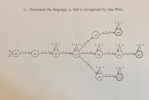 c) Determine the language, L, that is recognized by this PDA. q8 q7 c,b:A
c) Determine the language, L, that is recognized by this PDA. q8 q7 c,b:A
c) Determine the language, L, that is recognized by this PDA. q8 q7 c,b:A
9.) [30 points] Prove that, if a language L is decidable, then L can be enumerated...
 9.) [30 points] Prove that, if a language L is decidable, then L can be enumerated in canonical order by some machine.
. Show that a language is decidable if and only if some enumerator prints the strings...
. Show that a language is decidable if and only if some enumerator prints the strings in the language in lexicographical order.
Use a Turing Reduction to show that the following language is undecidable. L={ | L(M) is...
Use a Turing Reduction to show that the following language is undecidable. L={ | L(M) is infinite}.
 5. Let CONTAINPDA DFA L(M1) C (M2)}. Show that CONTAIN PDA DFA is decidable. {{M1, M2) M1 is a PDA and M2 is a DFA such that =
5. Let CONTAINPDA DFA L(M1) C (M2)}. Show that CONTAIN PDA DFA is decidable. {{M1, M2) M1 is a PDA and M2 is a DFA such that =
5. Let CONTAINPDA DFA L(M1) C (M2)}. Show that CONTAIN PDA DFA is decidable. {{M1, M2) M1 is a PDA and M2 is a DFA such that =
 I need to prove follow:
Let
be a semi-decidable language. Then the language
(Kleene star) is semi-decidable.
We were unable to transcribe this imageWe were unable to transcribe this image
I need to prove follow:
Let
be a semi-decidable language. Then the language
(Kleene star) is semi-decidable.
We were unable to transcribe this imageWe were unable to transcribe this image
 c) Determine the language, L, that is recognized by this PDA. q8 q7 c,b:A
c) Determine the language, L, that is recognized by this PDA. q8 q7 c,b:A
c) Determine the language, L, that is recognized by this PDA. q8 q7 c,b:A
 9.) [30 points] Prove that, if a language L is decidable, then L can be enumerated in canonical order by some machine.
Most questions answered within 3 hours.
-
Where is the error in this code sequence?
String s1 = "Hello";
String s2 = "ello";...
asked 10 months ago -
Financial data for Joel de Paris, Inc., for last year
follow:
Joel de Paris, Inc.
Balance...
asked 10 months ago -
Consider this reaction:
Al2(SO4)3 (aq)+ BaCl3
(aq) Al2Cl6 (aq)- +
3BaSO4(s) . What is the...
asked 10 months ago -
Suppose that Savneet is considering increasing her
recent random sample from 20 car rentals to 40...
asked 10 months ago -
Trucks arrive at an unloading terminal at an average rate of 120
per hour.
Trucks arrive...
asked 10 months ago -
Why are methanol and ethanol completely soluble in water while
octanol is not very little soluble....
asked 10 months ago -
A facilities manager at a university reads in a research report
that the mean amount of...
asked 10 months ago -
When the CuSO4 is rehydrated by adding water to the anhydrous
compound, is this an endothermic...
asked 10 months ago -
A ray of sunlight is passing from diamond into crown glass; the
angle of incidence is...
asked 10 months ago -
A block of mass 0.249 kg is placed on top of a light, vertical
spring of...
asked 10 months ago -
how do the kidneys compensate in the presences of acidosis
a) trigger hyperventilate
b) reserve acid...
asked 10 months ago -
Question 501 pts
The rental rate of capital to the firm increases. Which of the
following...
asked 10 months ago