Error analysis
a) According to theory, the period T of a simple pendulum is T = 2π√L/g, where L is the length of the pendulum. IfL is measured as L = 1.40 ± 0.01 m,what is the predicted value of T?
b) Would you say that a measured value of T = 2.39 ± 0.01 s is consistent with the theoretical prediction of part (a)?
Homework Answers


According to theory, the period T of a simple pendulum is T = 2π√(L/g). If L...
According to theory, the period T of a simple pendulum is T = 2π√(L/g). If L is measured as L = 1.40 ± 0.01 m ; what is the predicted value of T? b. Would you say that a measured value of T = 2.39 ± 0.01 s is consistent with the theoretical prediction of part (a)?
Calculating Uncertainty
The period T, of a simple pendulum is T=2π√(L/g),where L is the length of the pendulum.(a) If L is measuredas L=1.40 ± 0.01 m, what is the predicted valueof T? (b) would you say that a measured value of T = 2.39 ± 0.01 sis consistent with part (a)?Take g to be 9.80m/s2.How do I calculate the uncertainty when a square root isinvolved?
Pre-Lab Q2: Consider the equation you will use to calculate the period of your pendulum. For...
 Pre-Lab Q2: Consider the equation you will use to calculate the period of your pendulum. For each scenario below, determine how an error in your length measurement (L) would affect your predicted period value (T) SCENARIO 1: You measured the pendulum length (L) to be LARGER than the actual value. As a result your predicted period (T) will be a. i. ii. LARGER than the actual value. SMALLER than the actual value. b. SCENARIO 2: You measured the pendulum length...
Question: The period of a simple pendulum is T=2π√(L/g) with L = length of the pendulum...
Question: The period of a simple pendulum is T=2π√(L/g) with L = length of the pendulum and g = gravity of earth. a.Derive the scaling law for the pendulum. b.How much would the period of the pendulum change when you decrease the characteristic dimension by a factor of 10?
Find the error percentage using the general method shown for both 2 sigma and 3 sigma...
 Find the error percentage using the general method shown for
both 2 sigma and 3 sigma
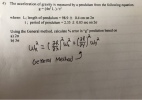
4) The acceleration of gravity is measured by a pendulum from the following equation. g=(4m2 L )/t2 where: L; length of pendulum = 98.9 ± t; period of pendulum-2.35 ± 0.03 sec on 2σ 0.4 cm on 2σ Using the General method, calculate % error in “g” prediction based on a) 2σ b) 3σ Ge Veral Melho
Find the error percentage using the general method shown for
both 2 sigma and 3 sigma
4) The acceleration of gravity is measured by a pendulum from the following equation. g=(4m2 L )/t2 where: L; length of pendulum = 98.9 ± t; period of pendulum-2.35 ± 0.03 sec on 2σ 0.4 cm on 2σ Using the General method, calculate % error in “g” prediction based on a) 2σ b) 3σ Ge Veral Melho
Pre-Lab Q2: Consider the equation you will use to calculate the period of your pendulum. For...
Pre-Lab Q2: Consider the equation you will use to calculate the period of your pendulum. For each scenario below, determine how an error in your length measurement (L) would affect your predicted period value (T). a. SCENARIO 1: You measured the pendulum length (L) to be LARGER than the actual value. As a result your predicted period (T) will be: i. LARGER than the actual value. ii. SMALLER than the actual value. b. SCENARIO 2: You measured the pendulum length...
Show that your resting pulse occurs at a time interval that corresponds to the period of...
 Show that your resting pulse occurs at a time interval that corresponds to the period of a pendulum whose length is somewhere in the ran = 0.1 to 0.25 meters. (The period of a simple pendulum is given br 2π(L/g)12, where L is the length of the pendulum and g is the accelera- tion due to gravity.)
The period T of a simple pendulum with small oscillations is calculated from the formula T=2pi sqrt(L/g) where L is the...
The period T of a simple pendulum with small oscillations is calculated from the formula T=2pi sqrt(L/g) where L is the length of the pendulum and g is the acceleration due to gravity. suppose that measured values of L and g have errors and are corrected with new values where L is increased from 4m to 4.5m and g is increased from 9 m/s2 to 9.8 m/s2. Use differentials to estimate the change in the period. Does the period increase...
THE SIMPLE PENDULUM Pre-Lab 1. State the objectives of this experiment. 2. How do you measure...
 THE SIMPLE PENDULUM Pre-Lab 1. State the objectives of this experiment. 2. How do you measure the length of a simple pendulum? 3. Define period of a simple pendulum in words. 4. The period of a simple pendulum is related to its length and the acceleration of gravity in an equation. Write down that equation. 5. What is the amplitude of a simple pendulum? 6. What does the period of a simple pendulum depend on? 7. True or false The...
The period T of a simple pendulum is given by T=2πLg−−√T=2πLg where L is the length of the...
The period T of a simple pendulum is given by T=2πLg−−√T=2πLg where L is the length of the pendulum and g is the acceleration due to gravity. Assume that g = 9.80 m/s2 exactly, and that L, in meters, is lognormal with parameters μL = 0.8 and σ2L=0.05.σL2=0.05. NOTE: This is a multi-part question. Once an answer is submitted, you will be unable to return to this part. Find P(T > 3).
 Pre-Lab Q2: Consider the equation you will use to calculate the period of your pendulum. For each scenario below, determine how an error in your length measurement (L) would affect your predicted period value (T) SCENARIO 1: You measured the pendulum length (L) to be LARGER than the actual value. As a result your predicted period (T) will be a. i. ii. LARGER than the actual value. SMALLER than the actual value. b. SCENARIO 2: You measured the pendulum length...
 Find the error percentage using the general method shown for
both 2 sigma and 3 sigma
4) The acceleration of gravity is measured by a pendulum from the following equation. g=(4m2 L )/t2 where: L; length of pendulum = 98.9 ± t; period of pendulum-2.35 ± 0.03 sec on 2σ 0.4 cm on 2σ Using the General method, calculate % error in “g” prediction based on a) 2σ b) 3σ Ge Veral Melho
Find the error percentage using the general method shown for
both 2 sigma and 3 sigma
4) The acceleration of gravity is measured by a pendulum from the following equation. g=(4m2 L )/t2 where: L; length of pendulum = 98.9 ± t; period of pendulum-2.35 ± 0.03 sec on 2σ 0.4 cm on 2σ Using the General method, calculate % error in “g” prediction based on a) 2σ b) 3σ Ge Veral Melho
 Show that your resting pulse occurs at a time interval that corresponds to the period of a pendulum whose length is somewhere in the ran = 0.1 to 0.25 meters. (The period of a simple pendulum is given br 2π(L/g)12, where L is the length of the pendulum and g is the accelera- tion due to gravity.)
 THE SIMPLE PENDULUM Pre-Lab 1. State the objectives of this experiment. 2. How do you measure the length of a simple pendulum? 3. Define period of a simple pendulum in words. 4. The period of a simple pendulum is related to its length and the acceleration of gravity in an equation. Write down that equation. 5. What is the amplitude of a simple pendulum? 6. What does the period of a simple pendulum depend on? 7. True or false The...
Most questions answered within 3 hours.
-
Where is the error in this code sequence?
String s1 = "Hello";
String s2 = "ello";...
asked 10 months ago -
Financial data for Joel de Paris, Inc., for last year
follow:
Joel de Paris, Inc.
Balance...
asked 10 months ago -
Consider this reaction:
Al2(SO4)3 (aq)+ BaCl3
(aq) Al2Cl6 (aq)- +
3BaSO4(s) . What is the...
asked 10 months ago -
Suppose that Savneet is considering increasing her
recent random sample from 20 car rentals to 40...
asked 10 months ago -
Trucks arrive at an unloading terminal at an average rate of 120
per hour.
Trucks arrive...
asked 10 months ago -
Why are methanol and ethanol completely soluble in water while
octanol is not very little soluble....
asked 10 months ago -
A facilities manager at a university reads in a research report
that the mean amount of...
asked 10 months ago -
When the CuSO4 is rehydrated by adding water to the anhydrous
compound, is this an endothermic...
asked 10 months ago -
A ray of sunlight is passing from diamond into crown glass; the
angle of incidence is...
asked 10 months ago -
A block of mass 0.249 kg is placed on top of a light, vertical
spring of...
asked 10 months ago -
how do the kidneys compensate in the presences of acidosis
a) trigger hyperventilate
b) reserve acid...
asked 10 months ago -
Question 501 pts
The rental rate of capital to the firm increases. Which of the
following...
asked 10 months ago