A spaceship ferrying workers to Moon Base I takes a straight-line path from the earthto the moon, a distance of 384,000 km
to the moon, a distance of 384,000 km. Suppose it accelerates at 20.0 m/s2 for the
first 15.0 min. of the trip, then travels at constant speed until the last 15.0 min. when
it accelerates at –20 m/s2, just coming to rest as it reaches the moon.
(a) What is the maximum speed attained?
(b) What fraction of the total distance is traveled at constant speed?
(c) What total time is required for the trip?
Homework Answers
We will divide the total journey in 3 parts :
The first part is:
$$ \begin{gathered} a_{1}=20 \frac{m}{s^{2}} \\ t_{1}=15 \mathrm{~min}=900 \mathrm{~s} \end{gathered} $$
\(U\) sing the equation:
$$ \begin{gathered} v_{f_{1}}=v_{i_{1}}+a_{1} t_{1} \quad \text { in this case } \rightarrow v_{i_{1}}=0 \\ v_{f_{1}}=20 \frac{m}{s^{2}}(900 s)=18,000 \frac{m}{s} \end{gathered} $$
This is the maximum speed of the spaceship.
The distance is:
$$ x_{f_{1}}=\frac{1}{2} a_{1} t^{2}=8.1 \times 10^{6} \mathrm{~m} $$
The second part is :
$$ \begin{gathered} a_{2}=-20 \frac{m}{s^{2}} \\ t_{2}=15 \min =900 s \\ v_{f_{2}}=v_{i_{3}}=-18,000 \frac{m}{s} \end{gathered} $$
The third part is when the velocity is constant:
To know the distance traveled on this part, we apply the next equation :
$$ x_{f_{3}}-x_{i_{3}}=\frac{1}{2}\left(v_{1_{3}}+v_{f_{3}}\right) t \quad \rightarrow t=\frac{x_{f_{3}}}{v_{f_{1}}} $$
since \(v_{f_{1}}=v_{i_{3}}=v_{i_{2}}\)
but, \(x_{3}=d-\left(x_{1}+x_{2}\right) \rightarrow x_{1}=x_{2} \quad x_{3}=d-2\left(x_{1}\right) \quad x_{3}=367,800,00 \mathrm{~m}\)
$$ t_{3}=20,433.33 \mathrm{~s} $$
The total time is :
$$ t_{t}=t_{1}+t_{2}+t_{3} \rightarrow t_{1}=t_{2} \quad \rightarrow \quad t_{t}=2 t_{1}+t_{3}=22,233.33 \mathrm{~s} $$
Add Answer to:
A spaceship ferrying workers to Moon Base I takes a straight-line path from the earthto the moon, a distance of 384,000 km
what is the maximum speed attained? what fraction of the total distance is traveled at constant...
 what is the maximum speed attained?
what fraction of the total distance is traveled at
constant speed?
what total time is required for the trip?
Constants Par A spaceship ferrying workers to Moon Base I takes a straight-line path from the earth to the moon, a distance of 384000 km. Suppose it accelerates at an acceleration 19.9 m/s for the first time interval 14.7 min of the trip, then travels at constant speed until the last time interval 14.7 min,...
what is the maximum speed attained?
what fraction of the total distance is traveled at
constant speed?
what total time is required for the trip?
Constants Par A spaceship ferrying workers to Moon Base I takes a straight-line path from the earth to the moon, a distance of 384000 km. Suppose it accelerates at an acceleration 19.9 m/s for the first time interval 14.7 min of the trip, then travels at constant speed until the last time interval 14.7 min,...
The Moon orbits the Earth every 665.7 hours at an average distance of 384,000 km from...
The Moon orbits the Earth every 665.7 hours at an average distance of 384,000 km from the center of the earth. Using Kepler's Third Law, what is the orbital radius of a satellite with a period of 0.910 hours? km What is the radius of the Earth? ___km. What is the orbital period of a satellite at the surface of the Earth? ___hours
A woman drives a car from one city to another with different constant speeds along the...
A woman drives a car from one city to another with different constant speeds along the trip. She drives at a speed of 85.0 km/h for 15.0 min, 80.0 km/h for 20.0 min, makes a stop for 50.0 min, then continues at 40.0 km/h for 35.0 min, at which point she reaches her destination. a) What is the total distance between her starting point and destination (in km)? b) What is the average speed for the entire trip (in units...
6. Given that the distance to the Moon is 384000 km, and taking the Moon’s orbit...
6. Given that the distance to the Moon is 384000 km, and taking the Moon’s orbit around Earth to be circular, estimate the speed (in kilometers per second) at which the Moon orbits the Earth. 7. The baseline in Figure 0.19 in the textbook is 100 m and the angle at B is 60 degrees. Using the tangent function, calculate the distance from A to the tree Ch. 1 Discussion Questions 2. The benefit of our current knowledge lets us...
A record of travel along a straight path is as follows: 1. Start from rest with...
A record of travel along a straight path is as follows: 1. Start from rest with constant acceleration of 2.80 m/s2 for 20.0 s. 2. Maintain a constant velocity for the next 1.60 min. 3. Apply a constant negative acceleration of −9.08 m/s2 for 6.17 s. (a) What was the total displacement for the trip? m (b) What were the average speeds for legs 1, 2, and 3 of the trip, as well as for the complete trip? leg 1...
A car travels in a straight line a distance of 8.4 km at an average speed...
A car travels in a straight line a distance of 8.4 km at an average speed of 70 km / h before stopping due to lack of fuel. Following this stop, the driver of this car walks for 30 minutes over a distance of 2.0 km to get to the nearest gas station. at. What is the total distance the driver has traveled between the beginning of the journey of her car and until he arrives at the gas station?...
12-7. A bicyclist starts from rest and after traveling along a straight path a distance of...
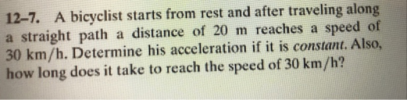 12-7. A bicyclist starts from rest and after traveling along a straight path a distance of 20 m reaches a speed of 30 km/h. Determine his acceleration if it is constant. Also, how long does it take to reach the speed of 30 km/h?
A woman drives a car from one city to another with different constant speeds along the...
A woman drives a car from one city to another with different constant speeds along the trip. She drives at a speed of 60.0 km/h for 20.0 min, 75.0 km/h for 25.0 min, makes a stop for 45.0 min, then continues at 45.0 km/h for 35.0 min, at which point she reaches her destination. (a) What is the total distance between her starting point and destination (in km)? __________km (b) What is the average speed for the entire trip (in...
A record of travel along a straight path is as follows: 1. Start from rest with...
A record of travel along a straight path is as follows: 1. Start from rest with constant acceleration of 3.00 m/s2 for 11.0 s. 2. Maintain a constant velocity for the next 1.50 min. 3. Apply a constant negative acceleration of −9.35 m/s2 for 3.53 s. (a) What was the total displacement for the trip? m (b) What were the average speeds for legs 1, 2, and 3 of the trip, as well as for the complete trip? leg 1 ...
record of travel along a straight path is as follows: 1. Start from rest with constant...
record of travel along a straight path is as follows: 1. Start from rest with constant acceleration of 2.25 m/s2 for 14.0 s. 2. Maintain a constant velocity for the next 1.10 min. 3. Apply a constant negative acceleration of −9.33 m/s2 for 3.38 s. (a) What was the total displacement for the trip? (b) What were the average speeds for legs 1, 2, and 3 of the trip, as well as for the complete trip? leg 1 m/s leg...
 what is the maximum speed attained?
what fraction of the total distance is traveled at
constant speed?
what total time is required for the trip?
Constants Par A spaceship ferrying workers to Moon Base I takes a straight-line path from the earth to the moon, a distance of 384000 km. Suppose it accelerates at an acceleration 19.9 m/s for the first time interval 14.7 min of the trip, then travels at constant speed until the last time interval 14.7 min,...
what is the maximum speed attained?
what fraction of the total distance is traveled at
constant speed?
what total time is required for the trip?
Constants Par A spaceship ferrying workers to Moon Base I takes a straight-line path from the earth to the moon, a distance of 384000 km. Suppose it accelerates at an acceleration 19.9 m/s for the first time interval 14.7 min of the trip, then travels at constant speed until the last time interval 14.7 min,...
 12-7. A bicyclist starts from rest and after traveling along a straight path a distance of 20 m reaches a speed of 30 km/h. Determine his acceleration if it is constant. Also, how long does it take to reach the speed of 30 km/h?
Most questions answered within 3 hours.
-
Where is the error in this code sequence?
String s1 = "Hello";
String s2 = "ello";...
asked 10 months ago -
Financial data for Joel de Paris, Inc., for last year
follow:
Joel de Paris, Inc.
Balance...
asked 10 months ago -
Consider this reaction:
Al2(SO4)3 (aq)+ BaCl3
(aq) Al2Cl6 (aq)- +
3BaSO4(s) . What is the...
asked 10 months ago -
Suppose that Savneet is considering increasing her
recent random sample from 20 car rentals to 40...
asked 10 months ago -
Trucks arrive at an unloading terminal at an average rate of 120
per hour.
Trucks arrive...
asked 10 months ago -
Why are methanol and ethanol completely soluble in water while
octanol is not very little soluble....
asked 10 months ago -
A facilities manager at a university reads in a research report
that the mean amount of...
asked 10 months ago -
When the CuSO4 is rehydrated by adding water to the anhydrous
compound, is this an endothermic...
asked 10 months ago -
A ray of sunlight is passing from diamond into crown glass; the
angle of incidence is...
asked 10 months ago -
A block of mass 0.249 kg is placed on top of a light, vertical
spring of...
asked 10 months ago -
how do the kidneys compensate in the presences of acidosis
a) trigger hyperventilate
b) reserve acid...
asked 10 months ago -
Question 501 pts
The rental rate of capital to the firm increases. Which of the
following...
asked 10 months ago