Given the eqm constant for the following reactions, Cu2+ + NH3 --> CuNH3 2+ (Ka = 630957) Cu(N...
Given the eqm constant for the following reactions,
Cu2+ + NH3 --> CuNH3 2+ (Ka = 630957)
Cu(NH3)2+ + NH3 --> Cu(NH3)2 2+ (aq)
The solubility of copper (II) hydroxide in water is 1.77x10^(-7) M.
Question: calc. the solubility of Cu(OH)2 in 5M NH3.
Please provide clear steps, thanks.
Homework Answers
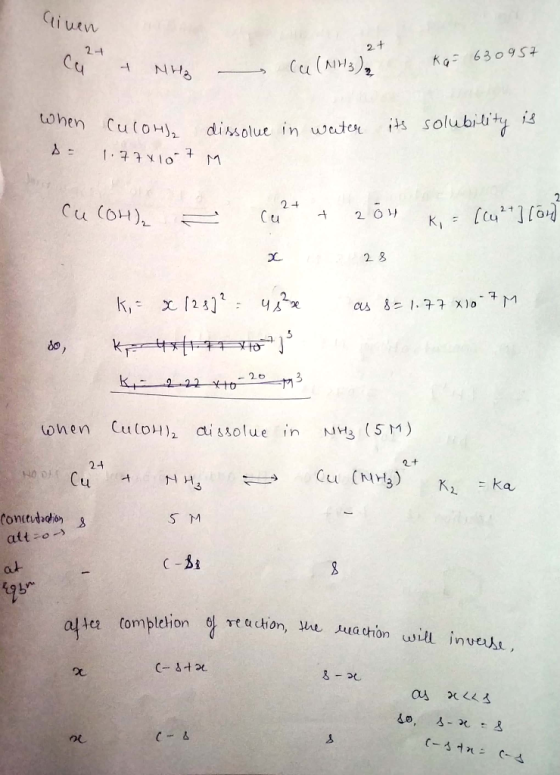
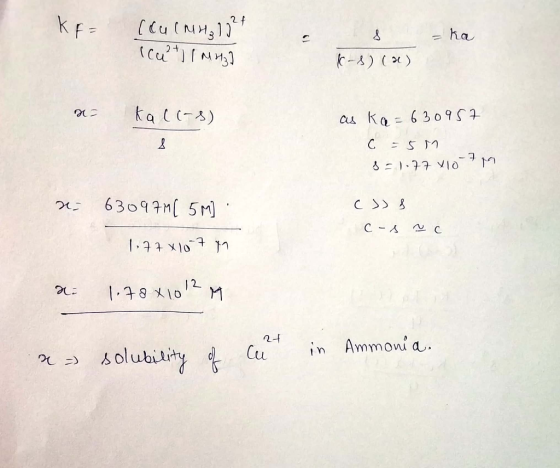
Add Answer to:
Given the eqm constant for the following reactions, Cu2+ + NH3 --> CuNH3 2+ (Ka = 630957) Cu(N...
Consider the insoluble compound copper(II) hydroxide , Cu(OH)2 . The copper(II) ion also forms a complex...
 Consider the insoluble compound copper(II) hydroxide , Cu(OH)2 .
The copper(II) ion also forms a complex with ammonia . Write a
balanced net ionic equation to show why the solubility of Cu(OH)2
(s) increases in the presence of ammonia and calculate the
equilibrium constant for this reaction. For Cu(NH3)42+ , Kf =
6.8×10¹² . Use the pull-down boxes to specify states such as (aq)
or (s). + + K = Submit Answer
Voit needed for this question. Consider the insoluble...
Consider the insoluble compound copper(II) hydroxide , Cu(OH)2 .
The copper(II) ion also forms a complex with ammonia . Write a
balanced net ionic equation to show why the solubility of Cu(OH)2
(s) increases in the presence of ammonia and calculate the
equilibrium constant for this reaction. For Cu(NH3)42+ , Kf =
6.8×10¹² . Use the pull-down boxes to specify states such as (aq)
or (s). + + K = Submit Answer
Voit needed for this question. Consider the insoluble...
I am sort of confused on what these are asking? An explination of the concepts would really help, I will give thumbs up...
 I am sort of confused on what these are asking? An explination
of the concepts would really help, I will give thumbs up :)
3. Consider the following reactions: a) The formation of tetraaqua copper (Il) ion in solution Cu2+ + 4H2O(l) = [Cu(H2O)4](aq) b) The reaction of ammonia with water. NH3(aq) + H2O(l) = NH4+ (aq) + OH(aq) c) The self ionization of water 2H2O(0) — H3O*(aq) + OH(aq) d) The formation of copper (II) hydroxide [Cu(H20)4]2+ (aq) +...
I am sort of confused on what these are asking? An explination
of the concepts would really help, I will give thumbs up :)
3. Consider the following reactions: a) The formation of tetraaqua copper (Il) ion in solution Cu2+ + 4H2O(l) = [Cu(H2O)4](aq) b) The reaction of ammonia with water. NH3(aq) + H2O(l) = NH4+ (aq) + OH(aq) c) The self ionization of water 2H2O(0) — H3O*(aq) + OH(aq) d) The formation of copper (II) hydroxide [Cu(H20)4]2+ (aq) +...
Copper hydroxide dissolves in water according to the following equation. It is only very slightly soluble....
Copper hydroxide dissolves in water according to the following equation. It is only very slightly soluble. Cu(OH)2(s) Cu2+(aq) + 2OH- (aq) a. Explain how the solubility can be increased by adding HCl to the solution. b. Explain how the concentration of copper (II) ion or of hydroxide ion can be reduced in the solution so that more of the solid copper hydroxide can be dissolved
Cu(s) + 4HNO3 --> Cu(NO3)2(aq) + 2NO2(g) + 2H2O(l) Cu2+(aq) + 4NH3(aq) --> [Cu(NH3)4]2+(aq) a. For...
Cu(s) + 4HNO3 --> Cu(NO3)2(aq) + 2NO2(g) + 2H2O(l) Cu2+(aq) + 4NH3(aq) --> [Cu(NH3)4]2+(aq) a. For each reaction, identify the oxidation number for each of the elements on both sides of the equation. b. Which of the reactions above is a redox reaction? Explain. c. Identify the element that is being reduced and the one that is being oxidized in the redox reaction. d. Identify the strong oxidizing agent and strong reducing agent in the redox reaction.
a. Using the Ksp value for Cu(OH)2 (1.6 x 10⁻¹⁹) and the overall formation constant for...
a. Using the Ksp value for Cu(OH)2 (1.6 x 10⁻¹⁹) and the overall formation constant for Cu(NH3)42+ (1.0 x 10¹³), calculate the value for the equilibrium constant for the following reaction: Cu(OH)2 (s) + 4NH3 (aq) ⇌ Cu(NH3)42+(aq) + 2OH -(aq) b. Use the value of the equilibrium constant you calculated in part a to calculate the solubility (in mol/L) of Cu(OH)2 in 5.0 M NH3. In 5.0 M NH3 the concentration of OH - is 0.0095 M.
*A copper, Cu(s), electrode is immersed in a solution that is 1.00 M in ammonia, NH3, and 1.00 M in tetraamminecopper(II), [Cu(NH3)4]2+. If a standard hydrogen electrode is used as the cathode, the ce...
 *A copper, Cu(s), electrode is immersed in a solution that is
1.00 M in ammonia, NH3, and 1.00 M in tetraamminecopper(II),
[Cu(NH3)4]2+. If a standard hydrogen electrode is used as the
cathode, the cell potential, Ecell, is found to be 0.070 V at 298
K.
A copper, Cu(s), electrode is immersed in a solution that is 1.00 M in ammonia, NH3, and 1.00 M in tetraamminecopper(II), [NH. If a standard hydrogen electrode is used as the cathode, the cell potential,...
*A copper, Cu(s), electrode is immersed in a solution that is
1.00 M in ammonia, NH3, and 1.00 M in tetraamminecopper(II),
[Cu(NH3)4]2+. If a standard hydrogen electrode is used as the
cathode, the cell potential, Ecell, is found to be 0.070 V at 298
K.
A copper, Cu(s), electrode is immersed in a solution that is 1.00 M in ammonia, NH3, and 1.00 M in tetraamminecopper(II), [NH. If a standard hydrogen electrode is used as the cathode, the cell potential,...
2. Consider the following equilibrium: Cu2+(aq) pale blue + 4NH3(aq) +[Cu(NH3)4]2+ (aq) colorless deep purple Would...
 2. Consider the following equilibrium: Cu2+(aq) pale blue + 4NH3(aq) +[Cu(NH3)4]2+ (aq) colorless deep purple Would you expect to see an increase, no change, or a decrease in the purple color when: (a) the temperature of the system is increased (the reaction is endothermic). (b) a catalyst is added. (c) more aqueous NH3 is added to the equilibrium. (d) the pressure is increased. NaOH(aq) is added to the system, resulting in the precipitation of Cu(OH)2(s). _(1) (f) the volume of...
1. Balance the three copper reactions: + H20 (1) Cu(NO3)2 (aq) + NO2(g) i) Cu (s)...
 1. Balance the three copper reactions: + H20 (1) Cu(NO3)2 (aq) + NO2(g) i) Cu (s) + HNO3 (aq) ii) Cu(NO3)2 (aq) + NaOH(aq) Cu(OH)2 (s) + NaNO3(aq) (aq) - iii) Cu(OH)2 (S) Cuo(s) + H2O (1) 2. In reaction (i), suppose you add 4.0 mL of 6 M nitric acid to a sphere of copper metal that weighs 0.65 grams. Which reactant is the limiting reagent? (Show your work)
1. Balance the three copper reactions: +H20 (1) +NO2 (g) Cu(NO3)2 (aq) i) Cu (s) HNO3...
 1. Balance the three copper reactions: +H20 (1) +NO2 (g) Cu(NO3)2 (aq) i) Cu (s) HNO3 (aq) NANO3 (aq) NaOH (aq) Cu(OH)2 (s) + ii) Cu(NOs)2 (aq) + H2O (1I) CuO (s) iii) Cu(OH)2 (s) 2. In reaction (i), suppose you add 4.0 mL of 6M nitric acid to a sphere of copper metal that weighs 0.65 grams. Which reactant is the limiting reagent? (Show your work)
Consider the 2 half-reactions: Cu2+(aq) + 2e- --> Cu(s) Eo= 0.34V Ag+(aq) + e- --> Ag(s)...
Consider the 2 half-reactions: Cu2+(aq) + 2e- --> Cu(s) Eo= 0.34V Ag+(aq) + e- --> Ag(s) Eo= 0.8V If you increase the concentration of Cu2+(aq), which of the following would be true about the cell potential E? It would remain constant It would increase It would decrease This cannot be determined
 Consider the insoluble compound copper(II) hydroxide , Cu(OH)2 .
The copper(II) ion also forms a complex with ammonia . Write a
balanced net ionic equation to show why the solubility of Cu(OH)2
(s) increases in the presence of ammonia and calculate the
equilibrium constant for this reaction. For Cu(NH3)42+ , Kf =
6.8×10¹² . Use the pull-down boxes to specify states such as (aq)
or (s). + + K = Submit Answer
Voit needed for this question. Consider the insoluble...
Consider the insoluble compound copper(II) hydroxide , Cu(OH)2 .
The copper(II) ion also forms a complex with ammonia . Write a
balanced net ionic equation to show why the solubility of Cu(OH)2
(s) increases in the presence of ammonia and calculate the
equilibrium constant for this reaction. For Cu(NH3)42+ , Kf =
6.8×10¹² . Use the pull-down boxes to specify states such as (aq)
or (s). + + K = Submit Answer
Voit needed for this question. Consider the insoluble...
 I am sort of confused on what these are asking? An explination
of the concepts would really help, I will give thumbs up :)
3. Consider the following reactions: a) The formation of tetraaqua copper (Il) ion in solution Cu2+ + 4H2O(l) = [Cu(H2O)4](aq) b) The reaction of ammonia with water. NH3(aq) + H2O(l) = NH4+ (aq) + OH(aq) c) The self ionization of water 2H2O(0) — H3O*(aq) + OH(aq) d) The formation of copper (II) hydroxide [Cu(H20)4]2+ (aq) +...
I am sort of confused on what these are asking? An explination
of the concepts would really help, I will give thumbs up :)
3. Consider the following reactions: a) The formation of tetraaqua copper (Il) ion in solution Cu2+ + 4H2O(l) = [Cu(H2O)4](aq) b) The reaction of ammonia with water. NH3(aq) + H2O(l) = NH4+ (aq) + OH(aq) c) The self ionization of water 2H2O(0) — H3O*(aq) + OH(aq) d) The formation of copper (II) hydroxide [Cu(H20)4]2+ (aq) +...
 *A copper, Cu(s), electrode is immersed in a solution that is
1.00 M in ammonia, NH3, and 1.00 M in tetraamminecopper(II),
[Cu(NH3)4]2+. If a standard hydrogen electrode is used as the
cathode, the cell potential, Ecell, is found to be 0.070 V at 298
K.
A copper, Cu(s), electrode is immersed in a solution that is 1.00 M in ammonia, NH3, and 1.00 M in tetraamminecopper(II), [NH. If a standard hydrogen electrode is used as the cathode, the cell potential,...
*A copper, Cu(s), electrode is immersed in a solution that is
1.00 M in ammonia, NH3, and 1.00 M in tetraamminecopper(II),
[Cu(NH3)4]2+. If a standard hydrogen electrode is used as the
cathode, the cell potential, Ecell, is found to be 0.070 V at 298
K.
A copper, Cu(s), electrode is immersed in a solution that is 1.00 M in ammonia, NH3, and 1.00 M in tetraamminecopper(II), [NH. If a standard hydrogen electrode is used as the cathode, the cell potential,...
 2. Consider the following equilibrium: Cu2+(aq) pale blue + 4NH3(aq) +[Cu(NH3)4]2+ (aq) colorless deep purple Would you expect to see an increase, no change, or a decrease in the purple color when: (a) the temperature of the system is increased (the reaction is endothermic). (b) a catalyst is added. (c) more aqueous NH3 is added to the equilibrium. (d) the pressure is increased. NaOH(aq) is added to the system, resulting in the precipitation of Cu(OH)2(s). _(1) (f) the volume of...
 1. Balance the three copper reactions: + H20 (1) Cu(NO3)2 (aq) + NO2(g) i) Cu (s) + HNO3 (aq) ii) Cu(NO3)2 (aq) + NaOH(aq) Cu(OH)2 (s) + NaNO3(aq) (aq) - iii) Cu(OH)2 (S) Cuo(s) + H2O (1) 2. In reaction (i), suppose you add 4.0 mL of 6 M nitric acid to a sphere of copper metal that weighs 0.65 grams. Which reactant is the limiting reagent? (Show your work)
 1. Balance the three copper reactions: +H20 (1) +NO2 (g) Cu(NO3)2 (aq) i) Cu (s) HNO3 (aq) NANO3 (aq) NaOH (aq) Cu(OH)2 (s) + ii) Cu(NOs)2 (aq) + H2O (1I) CuO (s) iii) Cu(OH)2 (s) 2. In reaction (i), suppose you add 4.0 mL of 6M nitric acid to a sphere of copper metal that weighs 0.65 grams. Which reactant is the limiting reagent? (Show your work)
Most questions answered within 3 hours.
-
Where is the error in this code sequence?
String s1 = "Hello";
String s2 = "ello";...
asked 10 months ago -
Financial data for Joel de Paris, Inc., for last year
follow:
Joel de Paris, Inc.
Balance...
asked 10 months ago -
Consider this reaction:
Al2(SO4)3 (aq)+ BaCl3
(aq) Al2Cl6 (aq)- +
3BaSO4(s) . What is the...
asked 10 months ago -
Suppose that Savneet is considering increasing her
recent random sample from 20 car rentals to 40...
asked 10 months ago -
Trucks arrive at an unloading terminal at an average rate of 120
per hour.
Trucks arrive...
asked 10 months ago -
Why are methanol and ethanol completely soluble in water while
octanol is not very little soluble....
asked 10 months ago -
A facilities manager at a university reads in a research report
that the mean amount of...
asked 10 months ago -
When the CuSO4 is rehydrated by adding water to the anhydrous
compound, is this an endothermic...
asked 10 months ago -
A ray of sunlight is passing from diamond into crown glass; the
angle of incidence is...
asked 10 months ago -
A block of mass 0.249 kg is placed on top of a light, vertical
spring of...
asked 10 months ago -
how do the kidneys compensate in the presences of acidosis
a) trigger hyperventilate
b) reserve acid...
asked 10 months ago -
Question 501 pts
The rental rate of capital to the firm increases. Which of the
following...
asked 10 months ago