Please be neat and show all work. thank you.

Homework Answers

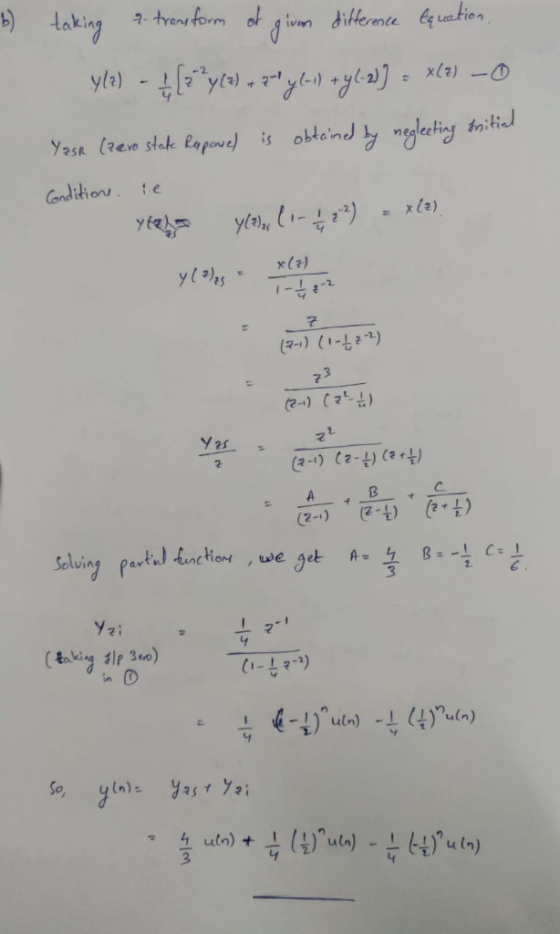
Add Answer to:
Given the difference equation, y(n) -y(n-2)-x(n);n 2 y(-1) 1, y(-2)0, and the input x(n) a) yh (n...
Styles Paragraph 6. Given the difference equation y(n)-x(n-1)-0.75y(n-1)-0.125(n-2) a. Use MATLAB function filterl) and filticl) to...
 Styles Paragraph 6. Given the difference equation y(n)-x(n-1)-0.75y(n-1)-0.125(n-2) a. Use MATLAB function filterl) and filticl) to calculate the system response y(n)for n 0, 1, 2, 3, 4 with the input of x(n (0.5) u(n)and initial conditions x(-1)--1, y(-2) -2, and y(-1)-1 b. Use MATLAB function filter!) to calculate the system response y(n) for n-0, 1, 2, 3,4 with the input of x(n) (0.5)"u(n)and zero initial conditions x(-1)-0, (-2)-0, and y(-1)-0 Design a 5-tap FIR low pass filter with a cutoff...
If the input to the system described by the difference equation y(n+1) (1/2)x(n+) -x(n) is a)...
 If the input to the system described by the difference equation y(n+1) (1/2)x(n+) -x(n) is a) Does it matter what are the initial conditions for nc0 in order to find y(n) for n20? Explain your b) x(n) -u(n) answer. (3 points). Determine the transfer function H(z) and the Frequency Response (H(est) (10 points). Find the amplitude lH(epT)I and the phase He*') as a function of co. Evaluate both for normalized frequency ω T=z/4. ( 10 points) c) Find the steady...
(20 pts.) Determine the response of the system described by the difference equation 7. 1 1 y(n) yn 1)n2)x(n) n for inpu...
 (20 pts.) Determine the response of the system described by the difference equation 7. 1 1 y(n) yn 1)n2)x(n) n for input signal x(n) = (;) u(n) under the following initial conditions y(-1) 1, y-2) 0.5
(20 pts.) Determine the response of the system described by the difference equation 7. 1 1 y(n) yn 1)n2)x(n) n for input signal x(n) = (;) u(n) under the following initial conditions y(-1) 1, y-2) 0.5
(20 pts.) Determine the response of the system described by the difference equation 7. 1 1 y(n) yn 1)n2)x(n) n for input signal x(n) = (;) u(n) under the following initial conditions y(-1) 1, y-2) 0.5
2) An LTI DT system is defined by the difference equation: y[n] = -0.4yIn - 1]...
 2) An LTI DT system is defined by the difference equation: y[n] = -0.4yIn - 1] + x[n]. a) Derive the impulse response of the system. (2 pt) b) Determine if the system is BIBO stable. (1 pt) c) Assuming initial conditions yl-1) = 1, derive the complete system response to an input x[n] = u[n] - u[n-2), for n > 0.(2 pt) d) Derive the zero-state system response to an input z[n] = u[n] - 2u[n - 2] +...
1. Determine y(n) of the given LTI Difference equation y(n)=1.2 y(n-1) -0.32 y(n-2)+10x(n) +6x(n-1) a. x(n)...
 1. Determine y(n) of the given LTI Difference equation y(n)=1.2 y(n-1) -0.32 y(n-2)+10x(n) +6x(n-1) a. x(n) = 0.4"u(n) b. x(n)= 8(n) (Impulse response) c. Draw the network structure in direct form I and II of the given LTI Difference equation
1. Given the impulse response, h[n duration 50 samples. (-0.9)"u[n, find the step response for a step input of h-(0...
 1. Given the impulse response, h[n duration 50 samples. (-0.9)"u[n, find the step response for a step input of h-(0.9)-10:491 -ones (1,50) s- conv(u,h) 2. Plot h and u using stem function for 50 samples only stem(10:491, s(1:50) 1. Given a system described by the following difference equation: yIn] 1143yn 1 0.4128y[n -2 0.0675x[n0.1349xn 0.675x[n-2] Determine the output y in response to zero input and the initial conditionsy-11 and yl-2] 2 for 50 samples using the following commands: a -,-1.143,...
1 point) An equation in the form y + p(x)y -(x)y with n 0, 1 is...
 1 point) An equation in the form y + p(x)y -(x)y with n 0, 1 is called a Bernoulli equation and it can be solved using the substitution wich transforms the Bernoulli equation into the following first order linear equation for v: Given the Bernoulli equation we have n- We obtain the equation u' Solving the resulting first order linear equation for v we obtain the general solution (with arbitrary constant C) given by Then transforming back into the variables...
Let a DT system described by the following difference equation: y[n]-5/6y[n-1]-1/6y[n-2]=1/6x[n-1] Find the zero input and...
Let a DT system described by the following difference equation: y[n]-5/6y[n-1]-1/6y[n-2]=1/6x[n-1] Find the zero input and zero state responses of this system for n≥0 assuming that the input s x[n]=2^nu[n] and the initial conditions y[-1]=1 and y[-2]=2.
Q1(b). Given the following difference equation: y(n) + y(n-1) + 0.25y(n-2) = x(n)-0.4x(n-1). (1) Determine the...
 Q1(b). Given the following difference equation: y(n) + y(n-1) + 0.25y(n-2) = x(n)-0.4x(n-1). (1) Determine the transfer function representing the LTID system. (2) Determine the output of the LTID system for the input x (n) (0.4)nu(n).
Solve y[n+2]−5 6y[n+1]+1 6y[n]=5x[n+1]−x[n] if the initial conditions are y[−1]=2, y[−2]=0, and the input x[n]=u[n]. Separate...
Solve y[n+2]−5 6y[n+1]+1 6y[n]=5x[n+1]−x[n] if the initial conditions are y[−1]=2, y[−2]=0, and the input x[n]=u[n]. Separate the response into zero-input and zero-state responses.
 Styles Paragraph 6. Given the difference equation y(n)-x(n-1)-0.75y(n-1)-0.125(n-2) a. Use MATLAB function filterl) and filticl) to calculate the system response y(n)for n 0, 1, 2, 3, 4 with the input of x(n (0.5) u(n)and initial conditions x(-1)--1, y(-2) -2, and y(-1)-1 b. Use MATLAB function filter!) to calculate the system response y(n) for n-0, 1, 2, 3,4 with the input of x(n) (0.5)"u(n)and zero initial conditions x(-1)-0, (-2)-0, and y(-1)-0 Design a 5-tap FIR low pass filter with a cutoff...
 If the input to the system described by the difference equation y(n+1) (1/2)x(n+) -x(n) is a) Does it matter what are the initial conditions for nc0 in order to find y(n) for n20? Explain your b) x(n) -u(n) answer. (3 points). Determine the transfer function H(z) and the Frequency Response (H(est) (10 points). Find the amplitude lH(epT)I and the phase He*') as a function of co. Evaluate both for normalized frequency ω T=z/4. ( 10 points) c) Find the steady...
 (20 pts.) Determine the response of the system described by the difference equation 7. 1 1 y(n) yn 1)n2)x(n) n for input signal x(n) = (;) u(n) under the following initial conditions y(-1) 1, y-2) 0.5
(20 pts.) Determine the response of the system described by the difference equation 7. 1 1 y(n) yn 1)n2)x(n) n for input signal x(n) = (;) u(n) under the following initial conditions y(-1) 1, y-2) 0.5
(20 pts.) Determine the response of the system described by the difference equation 7. 1 1 y(n) yn 1)n2)x(n) n for input signal x(n) = (;) u(n) under the following initial conditions y(-1) 1, y-2) 0.5
 2) An LTI DT system is defined by the difference equation: y[n] = -0.4yIn - 1] + x[n]. a) Derive the impulse response of the system. (2 pt) b) Determine if the system is BIBO stable. (1 pt) c) Assuming initial conditions yl-1) = 1, derive the complete system response to an input x[n] = u[n] - u[n-2), for n > 0.(2 pt) d) Derive the zero-state system response to an input z[n] = u[n] - 2u[n - 2] +...
 1. Determine y(n) of the given LTI Difference equation y(n)=1.2 y(n-1) -0.32 y(n-2)+10x(n) +6x(n-1) a. x(n) = 0.4"u(n) b. x(n)= 8(n) (Impulse response) c. Draw the network structure in direct form I and II of the given LTI Difference equation
 1. Given the impulse response, h[n duration 50 samples. (-0.9)"u[n, find the step response for a step input of h-(0.9)-10:491 -ones (1,50) s- conv(u,h) 2. Plot h and u using stem function for 50 samples only stem(10:491, s(1:50) 1. Given a system described by the following difference equation: yIn] 1143yn 1 0.4128y[n -2 0.0675x[n0.1349xn 0.675x[n-2] Determine the output y in response to zero input and the initial conditionsy-11 and yl-2] 2 for 50 samples using the following commands: a -,-1.143,...
 1 point) An equation in the form y + p(x)y -(x)y with n 0, 1 is called a Bernoulli equation and it can be solved using the substitution wich transforms the Bernoulli equation into the following first order linear equation for v: Given the Bernoulli equation we have n- We obtain the equation u' Solving the resulting first order linear equation for v we obtain the general solution (with arbitrary constant C) given by Then transforming back into the variables...
 Q1(b). Given the following difference equation: y(n) + y(n-1) + 0.25y(n-2) = x(n)-0.4x(n-1). (1) Determine the transfer function representing the LTID system. (2) Determine the output of the LTID system for the input x (n) (0.4)nu(n).
Most questions answered within 3 hours.
-
Where is the error in this code sequence?
String s1 = "Hello";
String s2 = "ello";...
asked 10 months ago -
Financial data for Joel de Paris, Inc., for last year
follow:
Joel de Paris, Inc.
Balance...
asked 10 months ago -
Consider this reaction:
Al2(SO4)3 (aq)+ BaCl3
(aq) Al2Cl6 (aq)- +
3BaSO4(s) . What is the...
asked 10 months ago -
Suppose that Savneet is considering increasing her
recent random sample from 20 car rentals to 40...
asked 10 months ago -
Trucks arrive at an unloading terminal at an average rate of 120
per hour.
Trucks arrive...
asked 10 months ago -
Why are methanol and ethanol completely soluble in water while
octanol is not very little soluble....
asked 10 months ago -
A facilities manager at a university reads in a research report
that the mean amount of...
asked 10 months ago -
When the CuSO4 is rehydrated by adding water to the anhydrous
compound, is this an endothermic...
asked 10 months ago -
A ray of sunlight is passing from diamond into crown glass; the
angle of incidence is...
asked 10 months ago -
A block of mass 0.249 kg is placed on top of a light, vertical
spring of...
asked 10 months ago -
how do the kidneys compensate in the presences of acidosis
a) trigger hyperventilate
b) reserve acid...
asked 10 months ago -
Question 501 pts
The rental rate of capital to the firm increases. Which of the
following...
asked 10 months ago