
Homework Answers
Add Answer to:
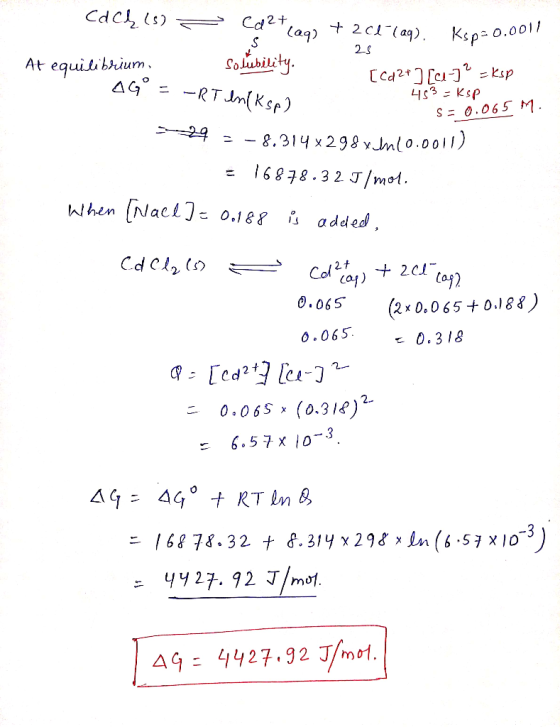
Consider the solubility of this salt in water at a temperature of 298. K. The equilibrium constan...
The "insoluble" salt, silver sulfide, has a solubility product, Ksp=6.3*10^-51 at 298 K. Ag2S(s)=2Ag+ (aq)+ S2-(aq)...
The "insoluble" salt, silver sulfide, has a solubility product, Ksp=6.3*10^-51 at 298 K. Ag2S(s)=2Ag+ (aq)+ S2-(aq) What is the concentration of Ag+ at equilibrium, at this temperature?
NaCl(s) ⇌ Na+(aq) + Cl-(aq) ΔHo = 3.9 kJ/mol At 298 K, a saturated solution of NaCl has [Na+] = 7.0 M and [Cl-] = 5.4 M....
 NaCl(s) ⇌ Na+(aq) + Cl-(aq)
ΔHo = 3.9 kJ/mol At 298 K, a saturated solution of NaCl has [Na+] =
7.0 M and [Cl-] = 5.4 M. If the temperature of the mixture is
increased to 323 K, what will be the equilibrium concentration (M)
of Na+? (Assume no ion pairing.) Enter your answer to 2 decimal
places.
NaCl(s) Na (aq) + CI'(aq) AH- 3.9 kJ/mol At 298 K, a saturated solution of NaCI has [Na"] 7.0M and [CI] -...
NaCl(s) ⇌ Na+(aq) + Cl-(aq)
ΔHo = 3.9 kJ/mol At 298 K, a saturated solution of NaCl has [Na+] =
7.0 M and [Cl-] = 5.4 M. If the temperature of the mixture is
increased to 323 K, what will be the equilibrium concentration (M)
of Na+? (Assume no ion pairing.) Enter your answer to 2 decimal
places.
NaCl(s) Na (aq) + CI'(aq) AH- 3.9 kJ/mol At 298 K, a saturated solution of NaCI has [Na"] 7.0M and [CI] -...
#9 and #10 Thank you solubility of the slightly soluble salt The solubility of AgCl is...
 #9
and #10 Thank you
solubility of the slightly soluble salt The solubility of AgCl is the same in a 1.0 M NH, solution vs. in pure water because the Ksp of AgCl is a constant at 25°C. D) 9. Calculate the molar solubity of AgBrts) in 0.500 M NH, at 25°C. Kup of AgBr is 1.8 x 10⁻⁵, K of Ag(NHs)2" is 1.7 x 10 A) 8.7 x 10⁴ M B) 1.2x 10⁻³ M C) 4.2 x 10⁻⁷ M...
#9
and #10 Thank you
solubility of the slightly soluble salt The solubility of AgCl is the same in a 1.0 M NH, solution vs. in pure water because the Ksp of AgCl is a constant at 25°C. D) 9. Calculate the molar solubity of AgBrts) in 0.500 M NH, at 25°C. Kup of AgBr is 1.8 x 10⁻⁵, K of Ag(NHs)2" is 1.7 x 10 A) 8.7 x 10⁴ M B) 1.2x 10⁻³ M C) 4.2 x 10⁻⁷ M...
Learning Goal: To learn how to calculate the solubility from Kspand vice versa. Consider the following equilibrium be...
Learning Goal: To learn how to calculate the solubility from Kspand vice versa. Consider the following equilibrium between a solid salt and its dissolved form (ions) in a saturated solution: CaF2(s)⇌Ca2+(aq)+2F−(aq) At equilibrium, the ion concentrations remain constant because the rate of dissolution of solid CaF2 equals the rate of the ion crystallization. The equilibrium constant for the dissolution reaction is Ksp=[Ca2+][F−]2 Ksp is called the solubility product and can be determined experimentally by measuring thesolubility, which is the amount...
Part B please. Part A Silver chloride is only slightly soluble in pure water at 25...
 Part B please.
Part A Silver chloride is only slightly soluble in pure water at 25 C AgCI(s) Ag (ag)+CI (aq) K-1.8 x 10 1 Calculate the concentration of Ag and Cl in a solution that is saturated with AgCl e, the system is at equilibrium and there is still solid AgCl visible). Express your answers using two significant figures, separate your answers by a comma. [Ag+],[Cl-)- 1.3×10⁻⁵ 1.3×10⁻⁵ mol Li Previous An Correct Part B The addition of ammonia...
Part B please.
Part A Silver chloride is only slightly soluble in pure water at 25 C AgCI(s) Ag (ag)+CI (aq) K-1.8 x 10 1 Calculate the concentration of Ag and Cl in a solution that is saturated with AgCl e, the system is at equilibrium and there is still solid AgCl visible). Express your answers using two significant figures, separate your answers by a comma. [Ag+],[Cl-)- 1.3×10⁻⁵ 1.3×10⁻⁵ mol Li Previous An Correct Part B The addition of ammonia...
help please? this was the only other information given REPORT SHEET Determination of the Solubility-Product Constant...
 help please?
this was the only other information given
REPORT SHEET Determination of the Solubility-Product Constant for a Sparingly Soluble Salt EXPERIMENT 8 A. Preparation of a Calibration Curve Initial (Cro121 0.0024 M Absorbance 5 mL Volume of 0.0024 M K Cro Total volume 1. I mL 100 mL 2. 100ML 3. 10 mL 100ml 4. 15 mL 100 ML Molar extinction coefficient for [CrO2) [Cro,2) 2.4x100M 12x1044 2.4810M 3.6810M 0.04) 2037.37 0.85 1.13 2. 3. Average molar extinction coefficient...
help please?
this was the only other information given
REPORT SHEET Determination of the Solubility-Product Constant for a Sparingly Soluble Salt EXPERIMENT 8 A. Preparation of a Calibration Curve Initial (Cro121 0.0024 M Absorbance 5 mL Volume of 0.0024 M K Cro Total volume 1. I mL 100 mL 2. 100ML 3. 10 mL 100ml 4. 15 mL 100 ML Molar extinction coefficient for [CrO2) [Cro,2) 2.4x100M 12x1044 2.4810M 3.6810M 0.04) 2037.37 0.85 1.13 2. 3. Average molar extinction coefficient...
Help please! Show work xercise 14.16 thodynamic 2. The equilibrium constant for the following reaction is called the...
 Help please! Show work
xercise 14.16 thodynamic 2. The equilibrium constant for the following reaction is called the fluoride: constant for the following reaction is called the "solubility product of calcium CaF2(s) - Ca2+(aq) + 2F (aq) K = K = 3.2 x 10⁻¹¹ a write an expression for the equilibrium constant of this reaction in terms of concentrations. why do you suppose we call this a solubility product instead of a solubility quotient or ratio (b) Calculate the equilibrium...
Help please! Show work
xercise 14.16 thodynamic 2. The equilibrium constant for the following reaction is called the fluoride: constant for the following reaction is called the "solubility product of calcium CaF2(s) - Ca2+(aq) + 2F (aq) K = K = 3.2 x 10⁻¹¹ a write an expression for the equilibrium constant of this reaction in terms of concentrations. why do you suppose we call this a solubility product instead of a solubility quotient or ratio (b) Calculate the equilibrium...
Table 1 Factors Affecting Solubility le 1. Identity general trends. Exceptions do sometimes occur, we will leam a...
 Table 1 Factors Affecting Solubility le 1. Identity general trends. Exceptions do sometimes occur, we will leam about exceptions and the reasons behind them later. Condition Nonbonding Interaction (if applicable) Dipol-dipole polar solute/polar solvent Effect on Solubility The solute dissolves. nonpolar solute/nonpolar solvent polar soluto/nonpolar solvent nonpolar solute/polar solvent increasing the pressure of a gas over a liquid solvent increasing the temperature of a dissolving solid increasing the temperature of a dissolving gas Table 2 Measures of Solution Concentration Quantity...
Experiment 8 Solubility of lonic Precipitates Lead chloride is a slightly soluble salt. When lead chloride...
 Experiment 8 Solubility of lonic Precipitates Lead chloride is a slightly soluble salt. When lead chloride dissolves in pure water or an aqueous solution, the small quantity that dissolves completely ionizes and reaches equilibrium in a saturated solution, PbCl(s) ® Pb (aq) + 2Cl(aq) Kp = [Pb (C) (1) Lets be the molar solubility of lead chloride. In pure water, s = [Pb ) = (CH) / 2. In a solution containing Cl, a common ion to lead chloride, s...
15) Determine the molar solubility of FeCl, in pure water. K A) 0.228 M B ) 0.0301 M C) 0.311 M for FeCl, -2.45 x 1...
 15) Determine the molar solubility of FeCl, in pure water. K A) 0.228 M B ) 0.0301 M C) 0.311 M for FeCl, -2.45 x 10 D ) 0.174 M 15 E) 2.45 * 10M 16) 16) Which of the following statements is true? A) Kris related to the formation of complexes B) K is related to acid dissociation C) K, is related to the solubility of a solid ionic species D) Khis related to base dissociation E) K is...
 NaCl(s) ⇌ Na+(aq) + Cl-(aq)
ΔHo = 3.9 kJ/mol At 298 K, a saturated solution of NaCl has [Na+] =
7.0 M and [Cl-] = 5.4 M. If the temperature of the mixture is
increased to 323 K, what will be the equilibrium concentration (M)
of Na+? (Assume no ion pairing.) Enter your answer to 2 decimal
places.
NaCl(s) Na (aq) + CI'(aq) AH- 3.9 kJ/mol At 298 K, a saturated solution of NaCI has [Na"] 7.0M and [CI] -...
NaCl(s) ⇌ Na+(aq) + Cl-(aq)
ΔHo = 3.9 kJ/mol At 298 K, a saturated solution of NaCl has [Na+] =
7.0 M and [Cl-] = 5.4 M. If the temperature of the mixture is
increased to 323 K, what will be the equilibrium concentration (M)
of Na+? (Assume no ion pairing.) Enter your answer to 2 decimal
places.
NaCl(s) Na (aq) + CI'(aq) AH- 3.9 kJ/mol At 298 K, a saturated solution of NaCI has [Na"] 7.0M and [CI] -...
 #9
and #10 Thank you
solubility of the slightly soluble salt The solubility of AgCl is the same in a 1.0 M NH, solution vs. in pure water because the Ksp of AgCl is a constant at 25°C. D) 9. Calculate the molar solubity of AgBrts) in 0.500 M NH, at 25°C. Kup of AgBr is 1.8 x 10⁻⁵, K of Ag(NHs)2" is 1.7 x 10 A) 8.7 x 10⁴ M B) 1.2x 10⁻³ M C) 4.2 x 10⁻⁷ M...
#9
and #10 Thank you
solubility of the slightly soluble salt The solubility of AgCl is the same in a 1.0 M NH, solution vs. in pure water because the Ksp of AgCl is a constant at 25°C. D) 9. Calculate the molar solubity of AgBrts) in 0.500 M NH, at 25°C. Kup of AgBr is 1.8 x 10⁻⁵, K of Ag(NHs)2" is 1.7 x 10 A) 8.7 x 10⁴ M B) 1.2x 10⁻³ M C) 4.2 x 10⁻⁷ M...
 Part B please.
Part A Silver chloride is only slightly soluble in pure water at 25 C AgCI(s) Ag (ag)+CI (aq) K-1.8 x 10 1 Calculate the concentration of Ag and Cl in a solution that is saturated with AgCl e, the system is at equilibrium and there is still solid AgCl visible). Express your answers using two significant figures, separate your answers by a comma. [Ag+],[Cl-)- 1.3×10⁻⁵ 1.3×10⁻⁵ mol Li Previous An Correct Part B The addition of ammonia...
Part B please.
Part A Silver chloride is only slightly soluble in pure water at 25 C AgCI(s) Ag (ag)+CI (aq) K-1.8 x 10 1 Calculate the concentration of Ag and Cl in a solution that is saturated with AgCl e, the system is at equilibrium and there is still solid AgCl visible). Express your answers using two significant figures, separate your answers by a comma. [Ag+],[Cl-)- 1.3×10⁻⁵ 1.3×10⁻⁵ mol Li Previous An Correct Part B The addition of ammonia...
 help please?
this was the only other information given
REPORT SHEET Determination of the Solubility-Product Constant for a Sparingly Soluble Salt EXPERIMENT 8 A. Preparation of a Calibration Curve Initial (Cro121 0.0024 M Absorbance 5 mL Volume of 0.0024 M K Cro Total volume 1. I mL 100 mL 2. 100ML 3. 10 mL 100ml 4. 15 mL 100 ML Molar extinction coefficient for [CrO2) [Cro,2) 2.4x100M 12x1044 2.4810M 3.6810M 0.04) 2037.37 0.85 1.13 2. 3. Average molar extinction coefficient...
help please?
this was the only other information given
REPORT SHEET Determination of the Solubility-Product Constant for a Sparingly Soluble Salt EXPERIMENT 8 A. Preparation of a Calibration Curve Initial (Cro121 0.0024 M Absorbance 5 mL Volume of 0.0024 M K Cro Total volume 1. I mL 100 mL 2. 100ML 3. 10 mL 100ml 4. 15 mL 100 ML Molar extinction coefficient for [CrO2) [Cro,2) 2.4x100M 12x1044 2.4810M 3.6810M 0.04) 2037.37 0.85 1.13 2. 3. Average molar extinction coefficient...
 Help please! Show work
xercise 14.16 thodynamic 2. The equilibrium constant for the following reaction is called the fluoride: constant for the following reaction is called the "solubility product of calcium CaF2(s) - Ca2+(aq) + 2F (aq) K = K = 3.2 x 10⁻¹¹ a write an expression for the equilibrium constant of this reaction in terms of concentrations. why do you suppose we call this a solubility product instead of a solubility quotient or ratio (b) Calculate the equilibrium...
Help please! Show work
xercise 14.16 thodynamic 2. The equilibrium constant for the following reaction is called the fluoride: constant for the following reaction is called the "solubility product of calcium CaF2(s) - Ca2+(aq) + 2F (aq) K = K = 3.2 x 10⁻¹¹ a write an expression for the equilibrium constant of this reaction in terms of concentrations. why do you suppose we call this a solubility product instead of a solubility quotient or ratio (b) Calculate the equilibrium...
 Table 1 Factors Affecting Solubility le 1. Identity general trends. Exceptions do sometimes occur, we will leam about exceptions and the reasons behind them later. Condition Nonbonding Interaction (if applicable) Dipol-dipole polar solute/polar solvent Effect on Solubility The solute dissolves. nonpolar solute/nonpolar solvent polar soluto/nonpolar solvent nonpolar solute/polar solvent increasing the pressure of a gas over a liquid solvent increasing the temperature of a dissolving solid increasing the temperature of a dissolving gas Table 2 Measures of Solution Concentration Quantity...
 Experiment 8 Solubility of lonic Precipitates Lead chloride is a slightly soluble salt. When lead chloride dissolves in pure water or an aqueous solution, the small quantity that dissolves completely ionizes and reaches equilibrium in a saturated solution, PbCl(s) ® Pb (aq) + 2Cl(aq) Kp = [Pb (C) (1) Lets be the molar solubility of lead chloride. In pure water, s = [Pb ) = (CH) / 2. In a solution containing Cl, a common ion to lead chloride, s...
 15) Determine the molar solubility of FeCl, in pure water. K A) 0.228 M B ) 0.0301 M C) 0.311 M for FeCl, -2.45 x 10 D ) 0.174 M 15 E) 2.45 * 10M 16) 16) Which of the following statements is true? A) Kris related to the formation of complexes B) K is related to acid dissociation C) K, is related to the solubility of a solid ionic species D) Khis related to base dissociation E) K is...
Most questions answered within 3 hours.
-
Where is the error in this code sequence?
String s1 = "Hello";
String s2 = "ello";...
asked 11 months ago -
Financial data for Joel de Paris, Inc., for last year
follow:
Joel de Paris, Inc.
Balance...
asked 11 months ago -
Consider this reaction:
Al2(SO4)3 (aq)+ BaCl3
(aq) Al2Cl6 (aq)- +
3BaSO4(s) . What is the...
asked 11 months ago -
Suppose that Savneet is considering increasing her
recent random sample from 20 car rentals to 40...
asked 11 months ago -
Trucks arrive at an unloading terminal at an average rate of 120
per hour.
Trucks arrive...
asked 11 months ago -
Why are methanol and ethanol completely soluble in water while
octanol is not very little soluble....
asked 11 months ago -
A facilities manager at a university reads in a research report
that the mean amount of...
asked 11 months ago -
When the CuSO4 is rehydrated by adding water to the anhydrous
compound, is this an endothermic...
asked 11 months ago -
A ray of sunlight is passing from diamond into crown glass; the
angle of incidence is...
asked 11 months ago -
A block of mass 0.249 kg is placed on top of a light, vertical
spring of...
asked 11 months ago -
how do the kidneys compensate in the presences of acidosis
a) trigger hyperventilate
b) reserve acid...
asked 11 months ago -
Question 501 pts
The rental rate of capital to the firm increases. Which of the
following...
asked 11 months ago