
Homework Answers

Add Answer to:
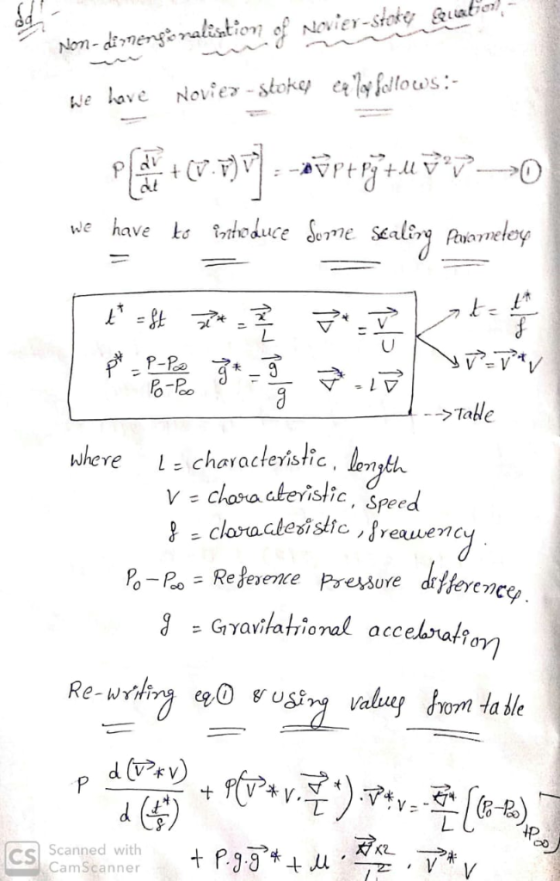
1. Consider the flow of a biological fluid to be described by the general dimensional version of ...
can you solve the last question (e) Q1. Consider a steady, two-dimensional, incompressible flow field has...
 can you solve the last question
(e)
Q1. Consider a steady, two-dimensional, incompressible flow field has the velocity potential a) b) c) 2 (x-7)(x+y) Determine the velocity components and verify that continuity is satisfied. [4 marks] Verify that the flow is irrotational. [2 marks] Determine the corresponding stream function. [4 marks) Now, consider a steady, two-dimensional, incompressible flow defined by velocity components u = ax + b&v=-ay + cx, where a, b and care constants. Neglect gravity. d) e) Show...
can you solve the last question
(e)
Q1. Consider a steady, two-dimensional, incompressible flow field has the velocity potential a) b) c) 2 (x-7)(x+y) Determine the velocity components and verify that continuity is satisfied. [4 marks] Verify that the flow is irrotational. [2 marks] Determine the corresponding stream function. [4 marks) Now, consider a steady, two-dimensional, incompressible flow defined by velocity components u = ax + b&v=-ay + cx, where a, b and care constants. Neglect gravity. d) e) Show...
Fluid Mechanics QUESTION 3 State 2 applications of dimensional analysis. (a) (2 marks) (b) The drag force, Fo acting...
 Fluid Mechanics
QUESTION 3 State 2 applications of dimensional analysis. (a) (2 marks) (b) The drag force, Fo acting on a ship is considered to be a function of the fluid density (p) viscosity (H). exavitlg). ship velocity (V), and characteristic length (). Using Buckingham П theorem, determine a set ofsuitable dimensionless numbers to describe the relationship.Fo f(p.H.g.V (4 marks) A 1:60 scale model of a ship is used in a water tank to simulate a ship speed of 10...
Fluid Mechanics
QUESTION 3 State 2 applications of dimensional analysis. (a) (2 marks) (b) The drag force, Fo acting on a ship is considered to be a function of the fluid density (p) viscosity (H). exavitlg). ship velocity (V), and characteristic length (). Using Buckingham П theorem, determine a set ofsuitable dimensionless numbers to describe the relationship.Fo f(p.H.g.V (4 marks) A 1:60 scale model of a ship is used in a water tank to simulate a ship speed of 10...
Tutorial 2. Incompressible Navier-Stokes equations 18 September, 4-5 pm in FN2 In Lecture Notes 1 the Navier-Stokes equ...
 Tutorial 2. Incompressible Navier-Stokes equations 18 September, 4-5 pm in FN2 In Lecture Notes 1 the Navier-Stokes equations (momentum balance) for incompressible flow were derived. They were eventually written in the following form dr In this equation, the viscosity μ and the density ρ are constants. We now consider two simple flow configurations. Config. 1. The steady state flow of a liquid in the space between two very large static parallel plates at distance H of each other in the...
Consider a two-dimensional, fully-developed, steady viscous flow of water through a duct of constant one-centimeter width...
 Consider a two-dimensional, fully-developed, steady viscous flow of water through a duct of constant one-centimeter width in the y-direction. There is no pressure variation through the flow but the water flows in the positive x-direction, which is the direction of the gravity force. $y = 0 and gx = g. (a) Using the continuity and momentum equations, determine the magnitude of the v component of velocity and develop the ordinary differential equation that governs the u component of velocity. (b)...
Consider the two dimensional Control Volume (CV) shown below in Fig. 1.1 for the special case...
 Consider the two dimensional Control Volume (CV) shown below in Fig. 1.1 for the special case of steady-state flow with v = 0 and a uniform pressure gradient vp = dp/axi = Ci everywhere C is a non-zero constant. These assumptions mean that both viscous shear stresses t = and compressive stresses due to pressure act on the fluid in the CV. You can also assume that there is no momentum source. - at itayº .. (x + 8x,y +...
Problem 3. Consider a pipe containing a steadily flowing inviscid fluid. It has one inlet and branches into two arms so...
 Problem 3. Consider a pipe containing a steadily flowing inviscid fluid. It has one inlet and branches into two arms so that there are two outlets (see Fig. 1). Flow can be considered uniform and parallel to the walls when entering and exiting the pipe Inlet Pi Outlet ρ2 A2 p, Outlet Figure 1: Flow of fluid through a "T" -junction in a pipe, shown from above (not to scale) Part A (a) The Continuity equation, as given on the...
Consider the steady, laminar flow of two liquids, A and B, with viscosities HA-μ and μΒ...
 Consider the steady, laminar flow of two liquids, A and B, with viscosities HA-μ and μΒ 21, respectively, between infinite parallel plates at 2- a, as shown in the diagram below. The plate at 2 a is fixed, while the plate at 2a moves with constant velocity -Vi, where V0. The liquids do not mix, and each forms a layer of depth a. There is an applied pressure gradient acting on both liquids, given by ▽p--Ci (where C > 0...
Consider the steady, incompressible flow of depth h of a liquid of known density ρ and...
 Consider the steady, incompressible flow of depth h of a liquid
of known density ρ and unknown viscosity µ down a flat plate as
shown in Figure 1. Air is the fluid above the liquid layer. The
force of gravity is in the vertical direction with acceleration g,
and the plate is at an angle θ with respect to the horizontal.
Assuming the coordinate system as shown, with x aligned with the
flow direction, and y normal to the plate,...
Consider the steady, incompressible flow of depth h of a liquid
of known density ρ and unknown viscosity µ down a flat plate as
shown in Figure 1. Air is the fluid above the liquid layer. The
force of gravity is in the vertical direction with acceleration g,
and the plate is at an angle θ with respect to the horizontal.
Assuming the coordinate system as shown, with x aligned with the
flow direction, and y normal to the plate,...
A bridge is supported by two types of rectangular cross-section piles located in a river as shown in Figure 1. The widt...
 A bridge is supported by two types of rectangular cross-section piles located in a river as shown in Figure 1. The width of the piles is w 0.5 m and their lengths are eitherl 2 m or 12 2.5 m. The river of depth of about 20 m runs at 2 m/s. Water density is ρ-1000 kg/m' and its absolute viscosityH-1 .00 x 103 N.s/m2 You are asked to perform dimensional analysis to find the drag force on the piles,...
A bridge is supported by two types of rectangular cross-section piles located in a river as shown in Figure 1. The wid...
 A bridge is supported by two types of rectangular cross-section piles located in a river as shown in Figure 1. The width of the piles is w -0.5 m and their lengths are either lı- 2 m or l2-2.5 m. The river of depth of about 20 m runs at 2 m/s. Water density is p 1000 kg/m3 and its absolute viscosityH 1.00 x 10⁻³ N.s/m2. You are asked to perform dimensional analysis to find the drag force on the...
 can you solve the last question
(e)
Q1. Consider a steady, two-dimensional, incompressible flow field has the velocity potential a) b) c) 2 (x-7)(x+y) Determine the velocity components and verify that continuity is satisfied. [4 marks] Verify that the flow is irrotational. [2 marks] Determine the corresponding stream function. [4 marks) Now, consider a steady, two-dimensional, incompressible flow defined by velocity components u = ax + b&v=-ay + cx, where a, b and care constants. Neglect gravity. d) e) Show...
can you solve the last question
(e)
Q1. Consider a steady, two-dimensional, incompressible flow field has the velocity potential a) b) c) 2 (x-7)(x+y) Determine the velocity components and verify that continuity is satisfied. [4 marks] Verify that the flow is irrotational. [2 marks] Determine the corresponding stream function. [4 marks) Now, consider a steady, two-dimensional, incompressible flow defined by velocity components u = ax + b&v=-ay + cx, where a, b and care constants. Neglect gravity. d) e) Show...
 Fluid Mechanics
QUESTION 3 State 2 applications of dimensional analysis. (a) (2 marks) (b) The drag force, Fo acting on a ship is considered to be a function of the fluid density (p) viscosity (H). exavitlg). ship velocity (V), and characteristic length (). Using Buckingham П theorem, determine a set ofsuitable dimensionless numbers to describe the relationship.Fo f(p.H.g.V (4 marks) A 1:60 scale model of a ship is used in a water tank to simulate a ship speed of 10...
Fluid Mechanics
QUESTION 3 State 2 applications of dimensional analysis. (a) (2 marks) (b) The drag force, Fo acting on a ship is considered to be a function of the fluid density (p) viscosity (H). exavitlg). ship velocity (V), and characteristic length (). Using Buckingham П theorem, determine a set ofsuitable dimensionless numbers to describe the relationship.Fo f(p.H.g.V (4 marks) A 1:60 scale model of a ship is used in a water tank to simulate a ship speed of 10...
 Tutorial 2. Incompressible Navier-Stokes equations 18 September, 4-5 pm in FN2 In Lecture Notes 1 the Navier-Stokes equations (momentum balance) for incompressible flow were derived. They were eventually written in the following form dr In this equation, the viscosity μ and the density ρ are constants. We now consider two simple flow configurations. Config. 1. The steady state flow of a liquid in the space between two very large static parallel plates at distance H of each other in the...
 Consider a two-dimensional, fully-developed, steady viscous flow of water through a duct of constant one-centimeter width in the y-direction. There is no pressure variation through the flow but the water flows in the positive x-direction, which is the direction of the gravity force. $y = 0 and gx = g. (a) Using the continuity and momentum equations, determine the magnitude of the v component of velocity and develop the ordinary differential equation that governs the u component of velocity. (b)...
 Consider the two dimensional Control Volume (CV) shown below in Fig. 1.1 for the special case of steady-state flow with v = 0 and a uniform pressure gradient vp = dp/axi = Ci everywhere C is a non-zero constant. These assumptions mean that both viscous shear stresses t = and compressive stresses due to pressure act on the fluid in the CV. You can also assume that there is no momentum source. - at itayº .. (x + 8x,y +...
 Problem 3. Consider a pipe containing a steadily flowing inviscid fluid. It has one inlet and branches into two arms so that there are two outlets (see Fig. 1). Flow can be considered uniform and parallel to the walls when entering and exiting the pipe Inlet Pi Outlet ρ2 A2 p, Outlet Figure 1: Flow of fluid through a "T" -junction in a pipe, shown from above (not to scale) Part A (a) The Continuity equation, as given on the...
 Consider the steady, laminar flow of two liquids, A and B, with viscosities HA-μ and μΒ 21, respectively, between infinite parallel plates at 2- a, as shown in the diagram below. The plate at 2 a is fixed, while the plate at 2a moves with constant velocity -Vi, where V0. The liquids do not mix, and each forms a layer of depth a. There is an applied pressure gradient acting on both liquids, given by ▽p--Ci (where C > 0...
 Consider the steady, incompressible flow of depth h of a liquid
of known density ρ and unknown viscosity µ down a flat plate as
shown in Figure 1. Air is the fluid above the liquid layer. The
force of gravity is in the vertical direction with acceleration g,
and the plate is at an angle θ with respect to the horizontal.
Assuming the coordinate system as shown, with x aligned with the
flow direction, and y normal to the plate,...
Consider the steady, incompressible flow of depth h of a liquid
of known density ρ and unknown viscosity µ down a flat plate as
shown in Figure 1. Air is the fluid above the liquid layer. The
force of gravity is in the vertical direction with acceleration g,
and the plate is at an angle θ with respect to the horizontal.
Assuming the coordinate system as shown, with x aligned with the
flow direction, and y normal to the plate,...
 A bridge is supported by two types of rectangular cross-section piles located in a river as shown in Figure 1. The width of the piles is w 0.5 m and their lengths are eitherl 2 m or 12 2.5 m. The river of depth of about 20 m runs at 2 m/s. Water density is ρ-1000 kg/m' and its absolute viscosityH-1 .00 x 103 N.s/m2 You are asked to perform dimensional analysis to find the drag force on the piles,...
 A bridge is supported by two types of rectangular cross-section piles located in a river as shown in Figure 1. The width of the piles is w -0.5 m and their lengths are either lı- 2 m or l2-2.5 m. The river of depth of about 20 m runs at 2 m/s. Water density is p 1000 kg/m3 and its absolute viscosityH 1.00 x 10⁻³ N.s/m2. You are asked to perform dimensional analysis to find the drag force on the...
Most questions answered within 3 hours.
-
Where is the error in this code sequence?
String s1 = "Hello";
String s2 = "ello";...
asked 11 months ago -
Financial data for Joel de Paris, Inc., for last year
follow:
Joel de Paris, Inc.
Balance...
asked 11 months ago -
Consider this reaction:
Al2(SO4)3 (aq)+ BaCl3
(aq) Al2Cl6 (aq)- +
3BaSO4(s) . What is the...
asked 11 months ago -
Suppose that Savneet is considering increasing her
recent random sample from 20 car rentals to 40...
asked 11 months ago -
Trucks arrive at an unloading terminal at an average rate of 120
per hour.
Trucks arrive...
asked 11 months ago -
Why are methanol and ethanol completely soluble in water while
octanol is not very little soluble....
asked 11 months ago -
A facilities manager at a university reads in a research report
that the mean amount of...
asked 11 months ago -
When the CuSO4 is rehydrated by adding water to the anhydrous
compound, is this an endothermic...
asked 11 months ago -
A ray of sunlight is passing from diamond into crown glass; the
angle of incidence is...
asked 11 months ago -
A block of mass 0.249 kg is placed on top of a light, vertical
spring of...
asked 11 months ago -
how do the kidneys compensate in the presences of acidosis
a) trigger hyperventilate
b) reserve acid...
asked 11 months ago -
Question 501 pts
The rental rate of capital to the firm increases. Which of the
following...
asked 11 months ago