
Please don't use the divergence theorem
Homework Answers
we cant find as you said
since F(x,y,z) = del f where f is also a function of 3 variables
but you mentioned f(x,y) in 2 variables which is not possible with your function
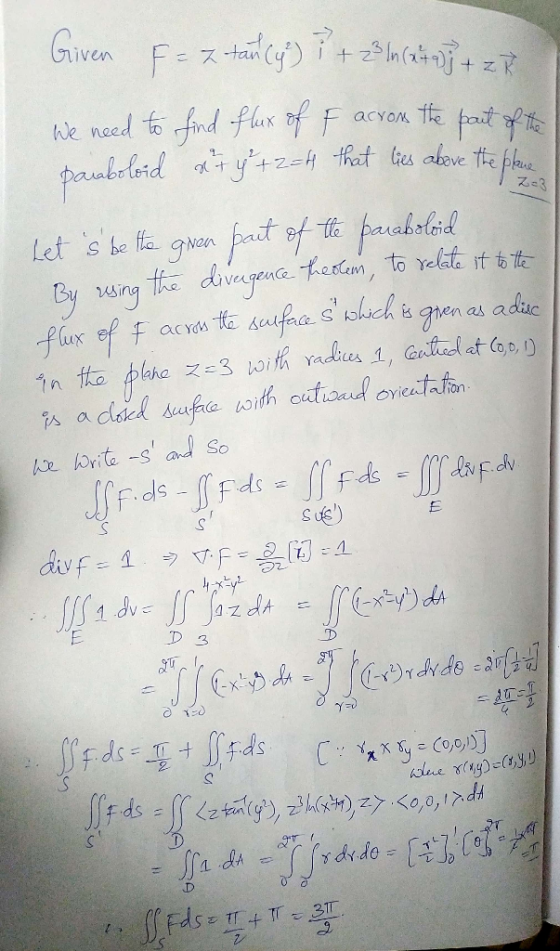
we have to use divergence theorem and get the solution as follows.
I hope you understand if u have any more doubts comment below or discuss with your professor.
Add Answer to:
Very very urgent Ill need a detailed explanation of solving this problem. Let F(z, y, z)--z tan 1...
Very very urgent !!! need a detailed explanation of solving this problem. we need to solve using...
 Very very urgent !!! need a detailed explanation of solving this
problem.
we need to solve using the formula like integral of f(x,y) .
r_x* r_y.
Let F(z, y, z)-z tan 1 (уг) i + z3ln(z2 + 9) j + z k. Find the flux of F across the part of the paraboloid z2 + y2 + z = 4 that lies above the plane z = 3 and is oriented upward.
Let F(z, y, z)-z tan 1 (уг) i...
Very very urgent !!! need a detailed explanation of solving this
problem.
we need to solve using the formula like integral of f(x,y) .
r_x* r_y.
Let F(z, y, z)-z tan 1 (уг) i + z3ln(z2 + 9) j + z k. Find the flux of F across the part of the paraboloid z2 + y2 + z = 4 that lies above the plane z = 3 and is oriented upward.
Let F(z, y, z)-z tan 1 (уг) i...
pi over 2 is not correct either Let F(x, y, z) = z tan-(y2)i + z3...
 pi over 2 is not correct either
Let F(x, y, z) = z tan-(y2)i + z3 In(x2 + 2)j + zk. Find the flux of F across S, the part of the paraboloid x2 + y2 + z = 5 that lies above the plane z = 4 and is oriented upward.
pi over 2 is not correct either
Let F(x, y, z) = z tan-(y2)i + z3 In(x2 + 2)j + zk. Find the flux of F across S, the part of the paraboloid x2 + y2 + z = 5 that lies above the plane z = 4 and is oriented upward.
Let F(x,y,z) = ztan-1(y2) i + z3ln(x2 + 2) j + z k. Find the flux...
Let F(x,y,z) = ztan-1(y2) i + z3ln(x2 + 2) j + z k. Find the flux of F across the part of the paraboloid x2 + y2 + z = 8 that lies above the plane z = 4 and is oriented upward.
ie Use Stokes' Theorem to evaluate curl F. ds. F(x, y, z) = x2 sin(z)i +...
 ie Use Stokes' Theorem to evaluate curl F. ds. F(x, y, z) = x2 sin(z)i + y2 + xyk, S is the part of the paraboloid z = upward. - x2 - y2 that lies above the xy-plane, oriented
(1 point) Let S be the part of the plane z 4 y which lies in the first octant, oriented upward. Evaluate the flux integral of the vector field F 2i + j + 3k across the surface S (with N being the uni...
 (1 point) Let S be the part of the plane z 4 y which lies in the first octant, oriented upward. Evaluate the flux integral of the vector field F 2i + j + 3k across the surface S (with N being the unit upward vector normal to the plane). B.I 48 C. I 72 E. 1 24
(1 point) Let S be the part of the plane z 4 y which lies in the first octant, oriented upward. Evaluate...
(1 point) Let S be the part of the plane z 4 y which lies in the first octant, oriented upward. Evaluate the flux integral of the vector field F 2i + j + 3k across the surface S (with N being the unit upward vector normal to the plane). B.I 48 C. I 72 E. 1 24
(1 point) Let S be the part of the plane z 4 y which lies in the first octant, oriented upward. Evaluate...
7. Let S be surface, oriented upward, given by the graph of f(x, y) 2 - z2 -y2 which lies over th...
 7. Let S be surface, oriented upward, given by the graph of f(x, y) 2 - z2 -y2 which lies over the unit disk in the ry-plane. If F(, y,z (-4x+ 1 + 3y2 1 +3y2
7. Let S be surface, oriented upward, given by the graph of f(x, y) 2 - z2 -y2 which lies over the unit disk in the ry-plane. If F(, y,z (-4x+ 1 + 3y2 1 +3y2
7. Let S be surface, oriented upward, given by the graph of f(x, y) 2 - z2 -y2 which lies over the unit disk in the ry-plane. If F(, y,z (-4x+ 1 + 3y2 1 +3y2
Consider the vector field F(x, y, z) = (z arctan(y2), 22 In(22 +1), 32) Let the...
 Consider the vector field F(x, y, z) = (z arctan(y2), 22 In(22 +1), 32) Let the surface S be the part of the sphere x2 + y2 + x2 = 4 that lies above the plane 2=1 and be oriented downwards. (a) Find the divergence of F. (b) Compute the flux integral SS. F . ñ ds.
21 Problem 20. Let S be the surface bounded by the graph of f(x,y)-2+y2 . the plane z 5; Os1; and .0sys1. In addition, let F be the vector field defined by F(x, y,z):i+ k. (1) By converting the r...
 21 Problem 20. Let S be the surface bounded by the graph of f(x,y)-2+y2 . the plane z 5; Os1; and .0sys1. In addition, let F be the vector field defined by F(x, y,z):i+ k. (1) By converting the resulting triple integral into cylindrical coordinates, find the exact value of the flux integral F.n do, assuming that S is oriented in the positive z-direction. (Recall that since the surface is oriented upwardly, you should use the vector -fx, -fy, 1)...
10. Let F(x, y, z) = 〈y,-z, 10) per half of x2 +y2 + z2 = 1, oriented upward, and C the circle 2 y 1 in the z - y plane, oriented counter-clockwise. Find Jscurl(F) ndS directly and by using Stokes&#...
 10. Let F(x, y, z) = 〈y,-z, 10) per half of x2 +y2 + z2 = 1, oriented upward, and C the circle 2 y 1 in the z - y plane, oriented counter-clockwise. Find Jscurl(F) ndS directly and by using Stokes' Theorem. , where S is the up
10. Let F(x, y, z) = 〈y,-z, 10) per half of x2 +y2 + z2 = 1, oriented upward, and C the circle 2 y 1 in the z - y...
10. Let F(x, y, z) = 〈y,-z, 10) per half of x2 +y2 + z2 = 1, oriented upward, and C the circle 2 y 1 in the z - y plane, oriented counter-clockwise. Find Jscurl(F) ndS directly and by using Stokes' Theorem. , where S is the up
10. Let F(x, y, z) = 〈y,-z, 10) per half of x2 +y2 + z2 = 1, oriented upward, and C the circle 2 y 1 in the z - y...
(1 point) Suppose F(x, y, z) = (x, y, 4z). Let W be the solid bounded...
 (1 point) Suppose F(x, y, z) = (x, y, 4z). Let W be the solid bounded by the paraboloid z = x2 + y2 and the plane z = 4. Let S be the closed boundary of W oriented outward. (a) Use the divergence theorem to find the flux of F through S. ſ FdA = 48pi S (b) Find the flux of F out the bottom of S (the truncated paraboloid) and the top of S (the disk). Flux...
 Very very urgent !!! need a detailed explanation of solving this
problem.
we need to solve using the formula like integral of f(x,y) .
r_x* r_y.
Let F(z, y, z)-z tan 1 (уг) i + z3ln(z2 + 9) j + z k. Find the flux of F across the part of the paraboloid z2 + y2 + z = 4 that lies above the plane z = 3 and is oriented upward.
Let F(z, y, z)-z tan 1 (уг) i...
Very very urgent !!! need a detailed explanation of solving this
problem.
we need to solve using the formula like integral of f(x,y) .
r_x* r_y.
Let F(z, y, z)-z tan 1 (уг) i + z3ln(z2 + 9) j + z k. Find the flux of F across the part of the paraboloid z2 + y2 + z = 4 that lies above the plane z = 3 and is oriented upward.
Let F(z, y, z)-z tan 1 (уг) i...
 pi over 2 is not correct either
Let F(x, y, z) = z tan-(y2)i + z3 In(x2 + 2)j + zk. Find the flux of F across S, the part of the paraboloid x2 + y2 + z = 5 that lies above the plane z = 4 and is oriented upward.
pi over 2 is not correct either
Let F(x, y, z) = z tan-(y2)i + z3 In(x2 + 2)j + zk. Find the flux of F across S, the part of the paraboloid x2 + y2 + z = 5 that lies above the plane z = 4 and is oriented upward.
 ie Use Stokes' Theorem to evaluate curl F. ds. F(x, y, z) = x2 sin(z)i + y2 + xyk, S is the part of the paraboloid z = upward. - x2 - y2 that lies above the xy-plane, oriented
 (1 point) Let S be the part of the plane z 4 y which lies in the first octant, oriented upward. Evaluate the flux integral of the vector field F 2i + j + 3k across the surface S (with N being the unit upward vector normal to the plane). B.I 48 C. I 72 E. 1 24
(1 point) Let S be the part of the plane z 4 y which lies in the first octant, oriented upward. Evaluate...
(1 point) Let S be the part of the plane z 4 y which lies in the first octant, oriented upward. Evaluate the flux integral of the vector field F 2i + j + 3k across the surface S (with N being the unit upward vector normal to the plane). B.I 48 C. I 72 E. 1 24
(1 point) Let S be the part of the plane z 4 y which lies in the first octant, oriented upward. Evaluate...
 7. Let S be surface, oriented upward, given by the graph of f(x, y) 2 - z2 -y2 which lies over the unit disk in the ry-plane. If F(, y,z (-4x+ 1 + 3y2 1 +3y2
7. Let S be surface, oriented upward, given by the graph of f(x, y) 2 - z2 -y2 which lies over the unit disk in the ry-plane. If F(, y,z (-4x+ 1 + 3y2 1 +3y2
7. Let S be surface, oriented upward, given by the graph of f(x, y) 2 - z2 -y2 which lies over the unit disk in the ry-plane. If F(, y,z (-4x+ 1 + 3y2 1 +3y2
 Consider the vector field F(x, y, z) = (z arctan(y2), 22 In(22 +1), 32) Let the surface S be the part of the sphere x2 + y2 + x2 = 4 that lies above the plane 2=1 and be oriented downwards. (a) Find the divergence of F. (b) Compute the flux integral SS. F . ñ ds.
 21 Problem 20. Let S be the surface bounded by the graph of f(x,y)-2+y2 . the plane z 5; Os1; and .0sys1. In addition, let F be the vector field defined by F(x, y,z):i+ k. (1) By converting the resulting triple integral into cylindrical coordinates, find the exact value of the flux integral F.n do, assuming that S is oriented in the positive z-direction. (Recall that since the surface is oriented upwardly, you should use the vector -fx, -fy, 1)...
 10. Let F(x, y, z) = 〈y,-z, 10) per half of x2 +y2 + z2 = 1, oriented upward, and C the circle 2 y 1 in the z - y plane, oriented counter-clockwise. Find Jscurl(F) ndS directly and by using Stokes' Theorem. , where S is the up
10. Let F(x, y, z) = 〈y,-z, 10) per half of x2 +y2 + z2 = 1, oriented upward, and C the circle 2 y 1 in the z - y...
10. Let F(x, y, z) = 〈y,-z, 10) per half of x2 +y2 + z2 = 1, oriented upward, and C the circle 2 y 1 in the z - y plane, oriented counter-clockwise. Find Jscurl(F) ndS directly and by using Stokes' Theorem. , where S is the up
10. Let F(x, y, z) = 〈y,-z, 10) per half of x2 +y2 + z2 = 1, oriented upward, and C the circle 2 y 1 in the z - y...
 (1 point) Suppose F(x, y, z) = (x, y, 4z). Let W be the solid bounded by the paraboloid z = x2 + y2 and the plane z = 4. Let S be the closed boundary of W oriented outward. (a) Use the divergence theorem to find the flux of F through S. ſ FdA = 48pi S (b) Find the flux of F out the bottom of S (the truncated paraboloid) and the top of S (the disk). Flux...
Most questions answered within 3 hours.
-
Where is the error in this code sequence?
String s1 = "Hello";
String s2 = "ello";...
asked 11 months ago -
Financial data for Joel de Paris, Inc., for last year
follow:
Joel de Paris, Inc.
Balance...
asked 11 months ago -
Consider this reaction:
Al2(SO4)3 (aq)+ BaCl3
(aq) Al2Cl6 (aq)- +
3BaSO4(s) . What is the...
asked 11 months ago -
Suppose that Savneet is considering increasing her
recent random sample from 20 car rentals to 40...
asked 11 months ago -
Trucks arrive at an unloading terminal at an average rate of 120
per hour.
Trucks arrive...
asked 11 months ago -
Why are methanol and ethanol completely soluble in water while
octanol is not very little soluble....
asked 11 months ago -
A facilities manager at a university reads in a research report
that the mean amount of...
asked 11 months ago -
When the CuSO4 is rehydrated by adding water to the anhydrous
compound, is this an endothermic...
asked 11 months ago -
A ray of sunlight is passing from diamond into crown glass; the
angle of incidence is...
asked 11 months ago -
A block of mass 0.249 kg is placed on top of a light, vertical
spring of...
asked 11 months ago -
how do the kidneys compensate in the presences of acidosis
a) trigger hyperventilate
b) reserve acid...
asked 11 months ago -
Question 501 pts
The rental rate of capital to the firm increases. Which of the
following...
asked 11 months ago