Write a recurrence relation describing the worst-case
running time of each of the following algorithms and determine the
asymptotic complexity of the function defined by the recurrence
relation. Justify your solution by using substitution or a
recursion tree. You may NOT use the Master Theorem.
![上午1:46 3月21日周四 令52%. 5. endfor 6. return (r); function func4(A, n) *Aarray of n integers */ 1. if n s 20 then return (A[n])](http://img.homeworklib.com/images/695322fd-f22a-49e7-825e-1612341098d3.png?x-oss-process=image/resize,w_560)
Homework Answers
if n <= 20 it is constant function
Otherwise recurrence relation of above algorithm is
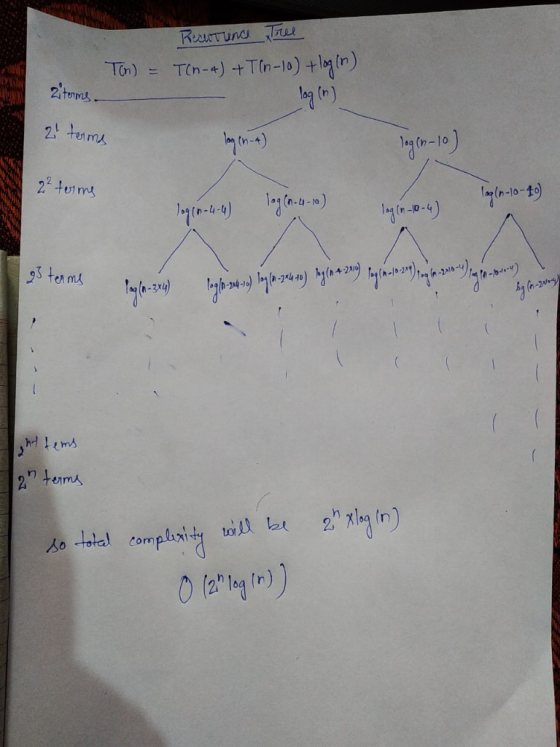
T(n) = T(n-4) + T(n-10) +

So recurrence relation is
T(n) = T(n-4) + T(n-10) + log(n)
As shown in recurrence tree of this algorithm the worst case time complexity will be

//If you have any doubt.Please feel free to ask.Thanks.
Add Answer to:
Write a recurrence relation describing the worst-case running time of each of the following algor...
Write a recurrence relation describing the worst case running time of each of the following algorithms,...
 Write a recurrence relation describing the worst case running time of each of the following algorithms, and determine the asymptotic complexity of the function defined by the recurrence relation. Justify your solution by using substitution or a recursion tree. You may NOT use the Master Theorem. Simplify your answers, expressing them in a form such as O(nk) or (nklog n) whenever possible. If the algorithm takes exponential time, then just give an exponential lower bound using the 2 notation. function...
For each of the following problems write a recurrence relation describing the running time of eac...
 For each of the following problems write a recurrence relation
describing the running time of each of the following algorithms and
determine the asymptotic complexity of the function defined by the
recurrence relation. Justify your solution using substitution and
carefully computing lower and upper bounds for the sums. Simplify
and express your answer as Θ(n k ) or Θ(n k (log n)) wherever
possible. If the algorithm takes exponential time, then just give
exponential lower bounds.
5. func5 (A,n) /*...
For each of the following problems write a recurrence relation
describing the running time of each of the following algorithms and
determine the asymptotic complexity of the function defined by the
recurrence relation. Justify your solution using substitution and
carefully computing lower and upper bounds for the sums. Simplify
and express your answer as Θ(n k ) or Θ(n k (log n)) wherever
possible. If the algorithm takes exponential time, then just give
exponential lower bounds.
5. func5 (A,n) /*...
7. What is the worst-case running time complexity of an algorithm with the recurrence relation T(N)...
7. What is the worst-case running time complexity of an algorithm with the recurrence relation T(N) = 2T(N/4) + O(N2)? Hint: Use the Master Theorem.
For each of the following recursive methods available on the class handout, derive a worst-case recurrence...
For each of the following recursive methods available on the class handout, derive a worst-case recurrence relation along with initial condition(s) and solve the relation to analyze the time complexity of the method. The time complexity must be given in a big-O notation. 1. digitSum(int n) - summing the digits of integer: int digitSum(int n) { if (n < 10) return n; return (digitSum(n/10) + n%10); } 2. void reverseA(int l, int r) - reversing array: void...
2. Give the asymptotic running time of each the following functions in e notation. That is,...
 2. Give the asymptotic running time of each the following functions in e notation. That is, write down a recurrence relation for each recursive function below and solve it. Show your work def Pow(x, n): 2 if n-0: 3 return 1 end 5 e f Pow(x, [n/2]) 1 # n is even if n % 2-0: 9 return f f 10 end #nis odd 12return r*f*.f 13 end
Compute the recurrence relation, T(n), for the following function, solve it, and give a e bound....
 Compute the recurrence relation, T(n), for the following function, solve it, and give a e bound. Justify your answer public static double myPower(double r, int n) if (n1){ return 1 } else if (n % 2 == 0) { double tmp myPower (r, n/2); return tmp tmp; } else{ myPower (r, (n 1)/2); return }
MATLAB 1. The Fibonacci sequence is defined by the recurrence relation Fn = Fn-1+Fn-2 where Fo...
 MATLAB
1. The Fibonacci sequence is defined by the recurrence relation Fn = Fn-1+Fn-2 where Fo = 0 and F1 = 1. Hence F2 = 1, F3 = 2, F4 = 3, etc. In this problem you will use three different methods to compute the n-th element of the sequence. Then, you will compare the time complexity of these methods. (a) Write a recursive function called fibRec with the following declaration line begin code function nElem = fibrec (n) end...
MATLAB
1. The Fibonacci sequence is defined by the recurrence relation Fn = Fn-1+Fn-2 where Fo = 0 and F1 = 1. Hence F2 = 1, F3 = 2, F4 = 3, etc. In this problem you will use three different methods to compute the n-th element of the sequence. Then, you will compare the time complexity of these methods. (a) Write a recursive function called fibRec with the following declaration line begin code function nElem = fibrec (n) end...
What is the worst-case asymptotic time complexity of the following divide-andconquer algorithm (give a Θ-bound). The...
What is the worst-case asymptotic time complexity of the following divide-andconquer algorithm (give a Θ-bound). The input is an array A of size n. You may assume that n is a power of 2. (NOTE: It doesn’t matter what the algorithm does, just analyze its complexity). Assume that the non-recursive function call, bar(A1,A2,A3,n) has cost 3n. Show your work! Next to each statement show its cost when the algorithm is executed on an imput of size n abd give the...
What is the worst-case asymptotic time complexity of the following divide-andconquer algorithm (give a Θ-bound). The...
What is the worst-case asymptotic time complexity of the following divide-andconquer algorithm (give a Θ-bound). The input is an array A of size n. You may assume that n is a power of 2. (NOTE: It doesn’t matter what the algorithm does, just analyze its complexity). Assume that the non-recursive function call, bar(A1,A2,A3,n) has cost 3n. Show your work! Next to each statement show its cost when the algorithm is executed on an imput of size n abd give the...
Consider the following: Algorithm 1 Smallest (A,q,r) Precondition: A[ q, ... , r] is an array...
Consider the following: Algorithm 1 Smallest (A,q,r) Precondition: A[ q, ... , r] is an array of integers q ≤ r and q,r ∈ N. Postcondition: Returns the smallest element of A[q, ... , r]. 1: function Smallest (A , q , r) 2: if q = r then 3: return A[q] 4: else 5: mid <--- [q+r/2] 6: return min (Smallest(A, q, mid), Smallest (A, mid + 1, r)) 7: end if 8: end function (a) Write a recurrence...
 Write a recurrence relation describing the worst case running time of each of the following algorithms, and determine the asymptotic complexity of the function defined by the recurrence relation. Justify your solution by using substitution or a recursion tree. You may NOT use the Master Theorem. Simplify your answers, expressing them in a form such as O(nk) or (nklog n) whenever possible. If the algorithm takes exponential time, then just give an exponential lower bound using the 2 notation. function...
 For each of the following problems write a recurrence relation
describing the running time of each of the following algorithms and
determine the asymptotic complexity of the function defined by the
recurrence relation. Justify your solution using substitution and
carefully computing lower and upper bounds for the sums. Simplify
and express your answer as Θ(n k ) or Θ(n k (log n)) wherever
possible. If the algorithm takes exponential time, then just give
exponential lower bounds.
5. func5 (A,n) /*...
For each of the following problems write a recurrence relation
describing the running time of each of the following algorithms and
determine the asymptotic complexity of the function defined by the
recurrence relation. Justify your solution using substitution and
carefully computing lower and upper bounds for the sums. Simplify
and express your answer as Θ(n k ) or Θ(n k (log n)) wherever
possible. If the algorithm takes exponential time, then just give
exponential lower bounds.
5. func5 (A,n) /*...
 2. Give the asymptotic running time of each the following functions in e notation. That is, write down a recurrence relation for each recursive function below and solve it. Show your work def Pow(x, n): 2 if n-0: 3 return 1 end 5 e f Pow(x, [n/2]) 1 # n is even if n % 2-0: 9 return f f 10 end #nis odd 12return r*f*.f 13 end
 Compute the recurrence relation, T(n), for the following function, solve it, and give a e bound. Justify your answer public static double myPower(double r, int n) if (n1){ return 1 } else if (n % 2 == 0) { double tmp myPower (r, n/2); return tmp tmp; } else{ myPower (r, (n 1)/2); return }
 MATLAB
1. The Fibonacci sequence is defined by the recurrence relation Fn = Fn-1+Fn-2 where Fo = 0 and F1 = 1. Hence F2 = 1, F3 = 2, F4 = 3, etc. In this problem you will use three different methods to compute the n-th element of the sequence. Then, you will compare the time complexity of these methods. (a) Write a recursive function called fibRec with the following declaration line begin code function nElem = fibrec (n) end...
MATLAB
1. The Fibonacci sequence is defined by the recurrence relation Fn = Fn-1+Fn-2 where Fo = 0 and F1 = 1. Hence F2 = 1, F3 = 2, F4 = 3, etc. In this problem you will use three different methods to compute the n-th element of the sequence. Then, you will compare the time complexity of these methods. (a) Write a recursive function called fibRec with the following declaration line begin code function nElem = fibrec (n) end...
Most questions answered within 3 hours.
-
Where is the error in this code sequence?
String s1 = "Hello";
String s2 = "ello";...
asked 11 months ago -
Financial data for Joel de Paris, Inc., for last year
follow:
Joel de Paris, Inc.
Balance...
asked 11 months ago -
Consider this reaction:
Al2(SO4)3 (aq)+ BaCl3
(aq) Al2Cl6 (aq)- +
3BaSO4(s) . What is the...
asked 11 months ago -
Suppose that Savneet is considering increasing her
recent random sample from 20 car rentals to 40...
asked 11 months ago -
Trucks arrive at an unloading terminal at an average rate of 120
per hour.
Trucks arrive...
asked 11 months ago -
Why are methanol and ethanol completely soluble in water while
octanol is not very little soluble....
asked 11 months ago -
A facilities manager at a university reads in a research report
that the mean amount of...
asked 11 months ago -
When the CuSO4 is rehydrated by adding water to the anhydrous
compound, is this an endothermic...
asked 11 months ago -
A ray of sunlight is passing from diamond into crown glass; the
angle of incidence is...
asked 11 months ago -
A block of mass 0.249 kg is placed on top of a light, vertical
spring of...
asked 11 months ago -
how do the kidneys compensate in the presences of acidosis
a) trigger hyperventilate
b) reserve acid...
asked 11 months ago -
Question 501 pts
The rental rate of capital to the firm increases. Which of the
following...
asked 11 months ago