
Write this code using x86 assembly language using the irvine32 library
Homework Answers
ANSWER:

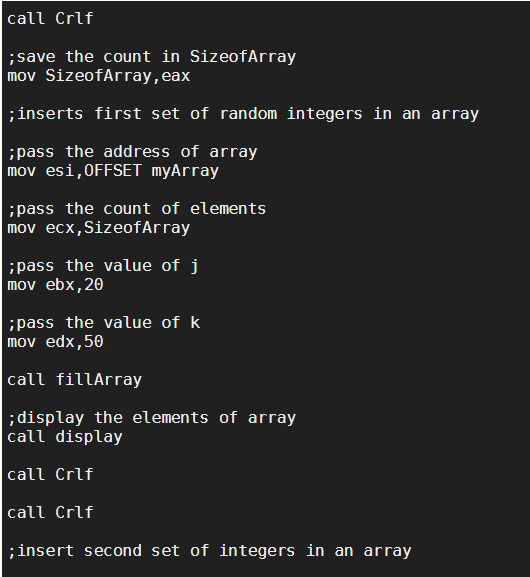
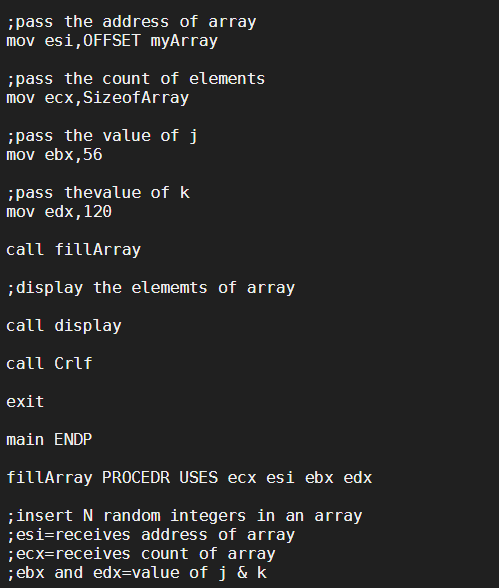

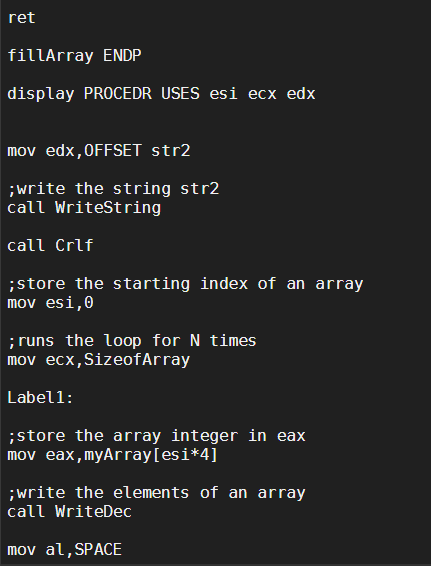

THANKS.
I hope this helps if you find any problem. Please comment below.
Don't forget to give a thumbs up if you liked it. :)
Add Answer to:
Write this code using x86 assembly language using the irvine32 library
computer organization Write this code using x86 assembly language using the irvine32 library 10) In write a procedure that swaps to different values (Do NOT use the XCHG instruction). (7pts )...
 computer organization Write this code using x86 assembly
language using the irvine32 library
10) In write a procedure that swaps to different values (Do NOT use the XCHG instruction). (7pts )
10) In write a procedure that swaps to different values (Do NOT use the XCHG instruction). (7pts )
computer organization Write this code using x86 assembly
language using the irvine32 library
10) In write a procedure that swaps to different values (Do NOT use the XCHG instruction). (7pts )
10) In write a procedure that swaps to different values (Do NOT use the XCHG instruction). (7pts )
Programming Problem: SUMMING ARRAY ELEMENTS - Use Assembly Language x86 (MASM) Write an assembly code...
Programming Problem: SUMMING ARRAY ELEMENTS - Use Assembly Language x86 (MASM) Write an assembly code calculates the sum of all array elements. Save the sum in the EAX register. ------------------------------------------------------------------------------- This is my code so far: INCLUDE Irvine32.inc N=10 .data array SDWORD N DUP(0,1,2,3,4,5,6,7,8,9) j DWORD ? k DWORD ? .code main PROC ; not complete exit main ENDP END main
Assembly Language For x86 Processors 7th edition When you write programs to solve the programming exercises,...
Assembly Language For x86 Processors 7th edition When you write programs to solve the programming exercises, use multiple procedures when possible. Follow the style and naming conventions used in this book. Use explanatory comments in your programs at the beginning of each procedure and next to nontrivial statements. Random Strings Create a procedure that generates a random string of length L, containing all capital letters. When calling the procedure, pass the value of L in EAX, and pass a pointer...
Use Assembly (Masm and Irvine32 library) to write a complete program that: 1. Asks the user...
Use Assembly (Masm and Irvine32 library) to write a complete program that: 1. Asks the user to enter 2 numbers. Assume that the user enters unsigned 32-bit integers only. 2. Displays the product of the two numbers. Assume that the result will never be larger than 32 bits. 3. This process will continue till the user enters 0 for both inputs. You can’t use mul instruction in your program: You need to use shifting and addition only. Your program must...
this is assembly language for x-86 processors using microsoft visual studio Create a procedure named FindThrees...
this is assembly language for x-86 processors using microsoft visual studio Create a procedure named FindThrees that returns 1 if an array has three consecutive values of 3 somewhere in the array. Otherwise, return 0. The procedure’s input parameter list contains a pointer to the array and the array’s size. Use the PROC directive with a parameter list when declaring the procedure. Preserve all registers (except EAX) that are modified by the procedure. Write a test program that calls FindThrees...
Validating a PIN
1. Validating a PINBanks use a Personal Identification Number to uniquely identify each customer. Let us assume that our bank has a specified range of acceptable values for each digit in its customer’s 5-digit PINs. The table shown below contains the acceptable ranges, where the digits are numbered from left to right in the PIN. Then we can see that the PIN 52413 is valid. But the PIN 43534 is invalid because the first digit is out of range. Similarly,...
Validating a PIN
1. Validating a PINBanks use a Personal Identification Number to uniquely identify each customer. Let us assume that our bank has a specified range of acceptable values for each digit in its customer’s 5-digit PINs. The table shown below contains the acceptable ranges, where the digits are numbered from left to right in the PIN. Then we can see that the PIN 52413 is valid. But the PIN 43534 is invalid because the first digit is out of range. Similarly,...
Assembly Language Program Help Write a procedure named CountNearMatches that receives pointers to two arrays of...
Assembly Language Program Help Write a procedure named CountNearMatches that receives pointers to two arrays of signed doublewords, a parameter that indicates the length of the two arrays, and a parameter that indicates the maximum allowed difference (called diff) between any two matching elements. For each element x(i) in the first array, if the difference between it and the corresponding y(i) in the second array is less than or equal to diff, increment a count. At the end, return a...
Create the following two programs in assembly language: 1. Write a program that will call a...
Create the following two programs in assembly language: 1. Write a program that will call a procedure to push the following Decimal value into eax - 31000 and then clear the register using pop. 2. Write a program that will call a procedure to use minMax to push an array values into eax register.
Code written in NASM Function called findLargest Write a function called findLargest that receives two parameters:...
Code written in NASM Function called findLargest Write a function called findLargest that receives two parameters: an unsigned doubleword array and the length of the array. The function must return the value of the largest array member in eax. Preserve all registers (except eax) that are modified by the function. Write a test program in main that calls findLargest three times, each call using a different array with different lengths. Function called countHits Write a function called named countHits that...
 computer organization Write this code using x86 assembly
language using the irvine32 library
10) In write a procedure that swaps to different values (Do NOT use the XCHG instruction). (7pts )
10) In write a procedure that swaps to different values (Do NOT use the XCHG instruction). (7pts )
computer organization Write this code using x86 assembly
language using the irvine32 library
10) In write a procedure that swaps to different values (Do NOT use the XCHG instruction). (7pts )
10) In write a procedure that swaps to different values (Do NOT use the XCHG instruction). (7pts )
Most questions answered within 3 hours.
-
Where is the error in this code sequence?
String s1 = "Hello";
String s2 = "ello";...
asked 11 months ago -
Financial data for Joel de Paris, Inc., for last year
follow:
Joel de Paris, Inc.
Balance...
asked 11 months ago -
Consider this reaction:
Al2(SO4)3 (aq)+ BaCl3
(aq) Al2Cl6 (aq)- +
3BaSO4(s) . What is the...
asked 11 months ago -
Suppose that Savneet is considering increasing her
recent random sample from 20 car rentals to 40...
asked 11 months ago -
Trucks arrive at an unloading terminal at an average rate of 120
per hour.
Trucks arrive...
asked 11 months ago -
Why are methanol and ethanol completely soluble in water while
octanol is not very little soluble....
asked 11 months ago -
A facilities manager at a university reads in a research report
that the mean amount of...
asked 11 months ago -
When the CuSO4 is rehydrated by adding water to the anhydrous
compound, is this an endothermic...
asked 11 months ago -
A ray of sunlight is passing from diamond into crown glass; the
angle of incidence is...
asked 11 months ago -
A block of mass 0.249 kg is placed on top of a light, vertical
spring of...
asked 11 months ago -
how do the kidneys compensate in the presences of acidosis
a) trigger hyperventilate
b) reserve acid...
asked 11 months ago -
Question 501 pts
The rental rate of capital to the firm increases. Which of the
following...
asked 11 months ago