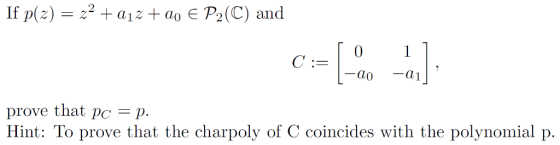
Prove pc=p (the charpoly of C coincides with the polynomial p)
Homework Answers

(3) Suppose that f E C'((0, 1]). Given e > 0, prove that there exists a polynomial p such that lf-plloo -p'|...
 (3) Suppose that f E C'((0, 1]). Given e > 0, prove that there exists a polynomial p such that lf-plloo -p'| <E
(3) Suppose that f E C'((0, 1]). Given e > 0, prove that there exists a polynomial p such that lf-plloo -p'|
(3) Suppose that f E C'((0, 1]). Given e > 0, prove that there exists a polynomial p such that lf-plloo -p'| <E
(3) Suppose that f E C'((0, 1]). Given e > 0, prove that there exists a polynomial p such that lf-plloo -p'|
Let k be a field of positive characteristic p, and let f(x)be an irreducible polynomial. Prove...
 Let k be a field of positive characteristic p, and let f(x)be an irreducible polynomial. Prove that there exist an integer d and a separable irreducible polynomial fsep (2) such that f(0) = fsep (2P). The number p is called the inseparable degree of f(c). If f(1) is the minimal polynomial of an algebraic element a, the inseparable degree of a is defined to be the inseparable degree of f(1). Prove that a is inseparable if and only if its...
11. Prove that ifp is a polynomial of degree n , and ifp(a)-0, then p(z) =...
 11. Prove that ifp is a polynomial of degree n , and ifp(a)-0, then p(z) = (z-a)q(z), where q is a polynomial of degree
5. Prove the Rational Roots Theorem: Let p(x)=ataiェ+ +anz" be a polynomial with integer coefficients (that...
 5. Prove the Rational Roots Theorem: Let p(x)=ataiェ+ +anz" be a polynomial with integer coefficients (that is, each aj is an integer). If t rls (oherer and s are nonzero integers and t is written in lowest terms, that is, gcd(Irl'ls!) = 1) is a non-zero Tational root orp(r), that is, if tメ0 and p(t) 0, then rao and slan. (Hint: Plug in t a t in the polynomial equation p(t) - o. Clear the fractions, then use a combination...
X 1 1 11 (C). The polynomial p() = 4 - 2 + 2? - +1...
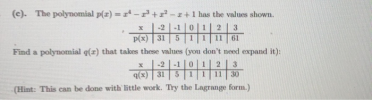 X 1 1 11 (C). The polynomial p() = 4 - 2 + 2? - +1 has the values shown. -2-1 01 | 2 3 p(x) 31 5 61 Find a polynomial (2) that takes these values (you don't need expand it): -2 -1 0 1 2 3 9(x) 31 5 11 30 (Hint: This can be done with little work. Try the Lagrange form.) 1 1
previous problem Problem 5 Let p.) be a polynomial satisfying the same constraints as in the...
 previous problem
Problem 5 Let p.) be a polynomial satisfying the same constraints as in the previous problem and let (2) be given as in the preceding problem. Show that p.) = r(c)(c) for some polynomial r(c). Hint: you can use the fundamental theorem of linear algebra and the generalized product rule for derivatives Problem 4 Prove that the polynomial q(x) given by g(x) = II (2 – x;) satisfies the linear constraints 9(wo) = 0, d'(x0) = 0, ......
previous problem
Problem 5 Let p.) be a polynomial satisfying the same constraints as in the previous problem and let (2) be given as in the preceding problem. Show that p.) = r(c)(c) for some polynomial r(c). Hint: you can use the fundamental theorem of linear algebra and the generalized product rule for derivatives Problem 4 Prove that the polynomial q(x) given by g(x) = II (2 – x;) satisfies the linear constraints 9(wo) = 0, d'(x0) = 0, ......
Prove that any polynomial p(z) with real coefficients can be decomposed into a product of polynomials...
Prove that any polynomial p(z) with real coefficients can be decomposed into a product of polynomials of the form az2 + bz + c, where a, b, c ∈ R.
Using FTLM. a) Let . Use linear algebra to prove that there is a polynomial such...
Using FTLM. a) Let . Use linear algebra to prove that there is a polynomial such that p + p' - 3p'' = q. Hint: consider the map defined by Tp: p + p' - 3p'', and use FTLM. b) Let be distinct elements of . Let be any elements of . Use linear algebra to prove that there is a such that Hint: consider the map defined by . You can use any facts from algebra about the solution...
Please help with this proof. Thank you Problem 3 Prove that a polynomial anz" + an-121-1...
 Please help with this proof.
Thank you
Problem 3 Prove that a polynomial anz" + an-121-1 +...+ajz+ao is a continuous function on the entire complex plane.
Please help with this proof.
Thank you
Problem 3 Prove that a polynomial anz" + an-121-1 +...+ajz+ao is a continuous function on the entire complex plane.
11. (adapted from 1.6 8) Prove the characteristic polynomial of matrix A - is p(x) =...
 11. (adapted from 1.6 8) Prove the characteristic polynomial of matrix A - is p(x) = 12 - (a+d)X + ad-bc = 0. Show that p(A) = A - (a + d) A+ (ad - bc)1 = 0. 12. (adapted from 1.6 14) Suppose A has eigenvalues 0,0,3 with independent eigenvectors u, v,w. (a) Give the vectors span the nullspace and the column space. (b) Find a particular solution to Ax=w. Find all solutions. (c) Does w + u in...
 (3) Suppose that f E C'((0, 1]). Given e > 0, prove that there exists a polynomial p such that lf-plloo -p'| <E
(3) Suppose that f E C'((0, 1]). Given e > 0, prove that there exists a polynomial p such that lf-plloo -p'|
(3) Suppose that f E C'((0, 1]). Given e > 0, prove that there exists a polynomial p such that lf-plloo -p'| <E
(3) Suppose that f E C'((0, 1]). Given e > 0, prove that there exists a polynomial p such that lf-plloo -p'|
 Let k be a field of positive characteristic p, and let f(x)be an irreducible polynomial. Prove that there exist an integer d and a separable irreducible polynomial fsep (2) such that f(0) = fsep (2P). The number p is called the inseparable degree of f(c). If f(1) is the minimal polynomial of an algebraic element a, the inseparable degree of a is defined to be the inseparable degree of f(1). Prove that a is inseparable if and only if its...
 11. Prove that ifp is a polynomial of degree n , and ifp(a)-0, then p(z) = (z-a)q(z), where q is a polynomial of degree
 5. Prove the Rational Roots Theorem: Let p(x)=ataiェ+ +anz" be a polynomial with integer coefficients (that is, each aj is an integer). If t rls (oherer and s are nonzero integers and t is written in lowest terms, that is, gcd(Irl'ls!) = 1) is a non-zero Tational root orp(r), that is, if tメ0 and p(t) 0, then rao and slan. (Hint: Plug in t a t in the polynomial equation p(t) - o. Clear the fractions, then use a combination...
 X 1 1 11 (C). The polynomial p() = 4 - 2 + 2? - +1 has the values shown. -2-1 01 | 2 3 p(x) 31 5 61 Find a polynomial (2) that takes these values (you don't need expand it): -2 -1 0 1 2 3 9(x) 31 5 11 30 (Hint: This can be done with little work. Try the Lagrange form.) 1 1
 previous problem
Problem 5 Let p.) be a polynomial satisfying the same constraints as in the previous problem and let (2) be given as in the preceding problem. Show that p.) = r(c)(c) for some polynomial r(c). Hint: you can use the fundamental theorem of linear algebra and the generalized product rule for derivatives Problem 4 Prove that the polynomial q(x) given by g(x) = II (2 – x;) satisfies the linear constraints 9(wo) = 0, d'(x0) = 0, ......
previous problem
Problem 5 Let p.) be a polynomial satisfying the same constraints as in the previous problem and let (2) be given as in the preceding problem. Show that p.) = r(c)(c) for some polynomial r(c). Hint: you can use the fundamental theorem of linear algebra and the generalized product rule for derivatives Problem 4 Prove that the polynomial q(x) given by g(x) = II (2 – x;) satisfies the linear constraints 9(wo) = 0, d'(x0) = 0, ......
 Please help with this proof.
Thank you
Problem 3 Prove that a polynomial anz" + an-121-1 +...+ajz+ao is a continuous function on the entire complex plane.
Please help with this proof.
Thank you
Problem 3 Prove that a polynomial anz" + an-121-1 +...+ajz+ao is a continuous function on the entire complex plane.
 11. (adapted from 1.6 8) Prove the characteristic polynomial of matrix A - is p(x) = 12 - (a+d)X + ad-bc = 0. Show that p(A) = A - (a + d) A+ (ad - bc)1 = 0. 12. (adapted from 1.6 14) Suppose A has eigenvalues 0,0,3 with independent eigenvectors u, v,w. (a) Give the vectors span the nullspace and the column space. (b) Find a particular solution to Ax=w. Find all solutions. (c) Does w + u in...
Most questions answered within 3 hours.
-
Where is the error in this code sequence?
String s1 = "Hello";
String s2 = "ello";...
asked 11 months ago -
Financial data for Joel de Paris, Inc., for last year
follow:
Joel de Paris, Inc.
Balance...
asked 11 months ago -
Consider this reaction:
Al2(SO4)3 (aq)+ BaCl3
(aq) Al2Cl6 (aq)- +
3BaSO4(s) . What is the...
asked 11 months ago -
Suppose that Savneet is considering increasing her
recent random sample from 20 car rentals to 40...
asked 11 months ago -
Trucks arrive at an unloading terminal at an average rate of 120
per hour.
Trucks arrive...
asked 11 months ago -
Why are methanol and ethanol completely soluble in water while
octanol is not very little soluble....
asked 11 months ago -
A facilities manager at a university reads in a research report
that the mean amount of...
asked 11 months ago -
When the CuSO4 is rehydrated by adding water to the anhydrous
compound, is this an endothermic...
asked 11 months ago -
A ray of sunlight is passing from diamond into crown glass; the
angle of incidence is...
asked 11 months ago -
A block of mass 0.249 kg is placed on top of a light, vertical
spring of...
asked 11 months ago -
how do the kidneys compensate in the presences of acidosis
a) trigger hyperventilate
b) reserve acid...
asked 11 months ago -
Question 501 pts
The rental rate of capital to the firm increases. Which of the
following...
asked 11 months ago