This equation from problem 2 is needed to solve problem 3.

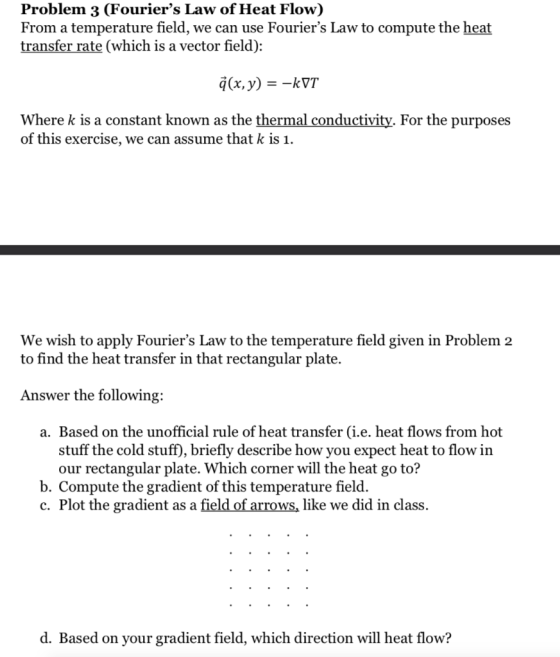
Problem 3 (Fourier's Law of Heat Flow) From a temperature field, we can use Fourier's Law to compute the heat transfer rate (which is a vector field): Where k is a constant known as the thermal conductivity. For the purposes of this exercise, we can assume that k is 1. We wish to apply Fourier's Law to the temperature field given in Problem 2 to find the heat transfer in that rectangular plate. Answer the following: a. Based on the unofficial rule of heat transfer (i.e. heat flows from hot stuff the cold stuff), briefly describe how you expect heat to flow in our rectangular plate. Which corner will the heat go to? b. Compute the gradient of this temperature field. c. Plot the gradient as a field of arrows, like we did in class. d. Based on your gradient field, which direction will heat flow?
Homework Answers
Qa
Assuming cartesian coordinates,
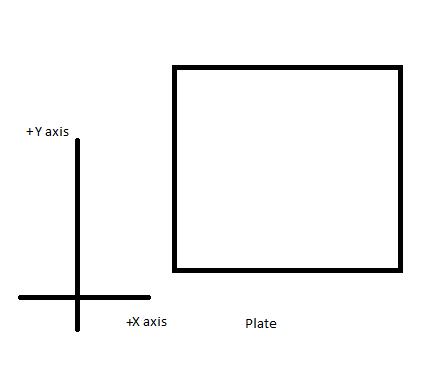
Based on the given vector field,


where 

and Temperature field

we get

where 

Therefore this shows that, heat is transferred in negative x direction along the x axis, and in positive y axis along the Y axis.
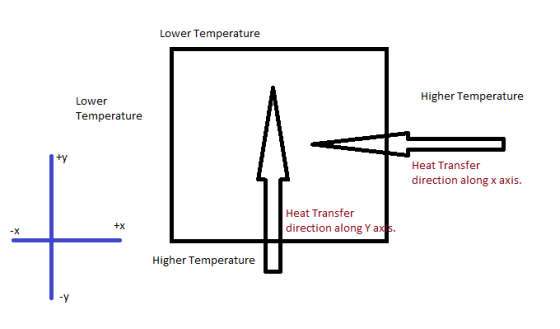
As depicted above using a schematic diagram.
Heat will go to the top and the left edges of the plate. Since no temperature variation along the z axis.
Qb
Gradient of temperature is given by

this operation on

gives,

where 

Qd
Since Heat transfer rate as a vector field is a vector quantity we can take Cartesian components of this vector along x and y axes.
Along x axis,
Based on the gradient field, Temperature is increasing along the positive x direction with respect to the x coordinates as

This means heat is transferred from positive x end of the plate to the negative x end of the plate along x axis.
Similarly
Along y axis,

Temperature is decreasing in the +y direction, this implies heat transfer is from negative y direction to the positive y direction.
Add Answer to:
Problem 2 temperature field. Problem 3 (Fourier's Law of Heat Flow) From a temperature field, w...
The wall of a heat exchanger separates hot water at Tin 90 C with h." 80 w/m2.K from cold water a...
 The wall of a heat exchanger separates hot water at Tin 90 C with h." 80 w/m2.K from cold water at Tout 10 C with h,ut 60 W/m2.K. The thermal conductivity of the heat exchanger is 180 W/m.K To extend the heat transfer area, two-dimensional ridges are machined on the cold side of the wall. This geometry causes non-uniform thermal stresses, which may become critical for crack initiation along the lines between two ridges. To predict thermal stresses, the temperature...
please provide the complete code for python Problem 2 (11 pts) From heat transfer, you should...
 please provide the complete code for python
Problem 2 (11 pts) From heat transfer, you should recall that Fourier's law of conduction states where λ is the thermal conductivity and q is the heat flux (a vector. Recall that can be written in Cartesian coordinates as v- + is the gradient operator, which In addition, for constant λ. aT where is the thermal diffusivity and V2 is the Laplacian, which in Cartesian coordinates is ▽2 + 하륜 Recall that V...
please provide the complete code for python
Problem 2 (11 pts) From heat transfer, you should recall that Fourier's law of conduction states where λ is the thermal conductivity and q is the heat flux (a vector. Recall that can be written in Cartesian coordinates as v- + is the gradient operator, which In addition, for constant λ. aT where is the thermal diffusivity and V2 is the Laplacian, which in Cartesian coordinates is ▽2 + 하륜 Recall that V...
(2 pts) Heat is transferred from a hot fluid (temperature T1 and heat transfer coefficient h2)...
 (2 pts) Heat is transferred from a hot fluid (temperature T1 and heat transfer coefficient h2) through a plane wall of thickness 8, surface area A and the thermal conductivity k. The thermal resistance for the set up is + (a) AC ) (b) A (i + + ) (c) 2 (na + + n2) (d) A (na + b +h2) (2 pts) An increase in convective heat transfer coefficient over a fin will (a) increase effectiveness (b) decrease effectiveness...
[10] Design Problem As shown in the figure below, a double-pipe parallel-flow heat exchanger is used...
 [10] Design Problem As shown in the figure below, a double-pipe parallel-flow heat exchanger is used to heat cold fluid which is water (Cp = 4180 J/(kg.K), p = 1000 kg/m) from 20°C to 80°C at a rate of 0.15 kg/s. The heating is to be accomplished by hot fluid, which is geothermal water (Cp = 4310 J/(kg.K), p = 1050 kg/m²) available at 130°C at a mass flow rate of 0.25 kg/s. The inner tube has an inner diameter...
A3. (a) According to Fourier's Law of thermal conduction, the heat flux through a solid is...
 A3. (a) According to Fourier's Law of thermal conduction, the heat flux through a solid is given by the solid's thermal conductivity k multiplied by the negative of the local temperature gradient. If the temperature in the solid is given by the function T(x, y, z)= 30e **(y2 + z), determine an expression for the heat flux through an internal surface with normal n=2i+j+2k [7 marks) (b) If f(t)=3sin ox and g(t)= 2 cos(@t++), determine the amplitude of the function...
PROBLEM 3 (45 points) The condenser of a large steam power plant is a heat exchanger...
 PROBLEM 3 (45 points) The condenser of a large steam power plant is a heat exchanger in which steam is condensed to liquid water. Assume the condenser to be a parallel flow shell-and-tube heat exchanger consisting of a single shell and 1x10 tubes, each executing two passes. The inner diameter of tubes is D = 50 mm and its thickness is 5 mm (Do not ignore the thickness). The steam condenses on their outer surface. Thermal conductivity of the tube...
, A tite ditèrence analysis vestir coeficient is h. sis has been performed on the fin of diameter D using a uniform spacing o perfi at each node has been obtained. The thermal conducti has been obtai...
 , A tite ditèrence analysis vestir coeficient is h. sis has been performed on the fin of diameter D using a uniform spacing o perfi at each node has been obtained. The thermal conducti has been obtained. The thermal conductivity of the fin is & and the ambient flow hich discretized equation for node T, is correct? f Ax and the equatio s A hole is drilled through the center of a solid block of square cross section. The hole...
Problem 4: Consider the heat exchanger design illustrated. Hot air flows at speed of r0.6 m/s thr...
 Problem 4: Consider the heat exchanger design illustrated. Hot air flows at speed of r0.6 m/s through the center pipe. The center pipe has an outer diameter of D=7 cm and length 4-2 m Cold water flows at 20-25 cm3/s through a smaller helical pipe having an outer diameter d = 1 cm and wall thickness of mm. The helical pipe is wrapped around the center pipe to form a heat exchanger. The center pipe has a thermal conductivity of...
Consider a rectangular bar of thermal conductivity k W/m-K and total length 2L, as shown in...
 Consider a rectangular bar of thermal conductivity k W/m-K and
total length 2L, as shown in the figure, is connected to a hot
surface that is at a temperature T1. The connection between the bar
and the surface is imperfect and results in a thermal contact
resistance of R’’ m2-K/W. The width of the rod into the depth of
the paper is W meters and the thickness of the rod is t meters. The
first section of the rod of...
Consider a rectangular bar of thermal conductivity k W/m-K and
total length 2L, as shown in the figure, is connected to a hot
surface that is at a temperature T1. The connection between the bar
and the surface is imperfect and results in a thermal contact
resistance of R’’ m2-K/W. The width of the rod into the depth of
the paper is W meters and the thickness of the rod is t meters. The
first section of the rod of...
Problem 3 (20 points) A cross-flow heat exchanger consists of a bundle of 32 tubes in a long duct. Hot water at 150°C and a mean velocity of 0.5 m/s enters the tubes having inner and outer diameters...
 Problem 3 (20 points) A cross-flow heat exchanger consists of a bundle of 32 tubes in a long duct. Hot water at 150°C and a mean velocity of 0.5 m/s enters the tubes having inner and outer diameters of 10.2mm and 12.5mm and has to be cooled to 136°C. The tubes are made of steel of thermal conductivity k-40 W/m.K. Air at 10°c enters the exchanger (unfinned) with a volumetric flow rate of 1.0 m3/s. The convective heat transfer coefficient...
 The wall of a heat exchanger separates hot water at Tin 90 C with h." 80 w/m2.K from cold water at Tout 10 C with h,ut 60 W/m2.K. The thermal conductivity of the heat exchanger is 180 W/m.K To extend the heat transfer area, two-dimensional ridges are machined on the cold side of the wall. This geometry causes non-uniform thermal stresses, which may become critical for crack initiation along the lines between two ridges. To predict thermal stresses, the temperature...
 please provide the complete code for python
Problem 2 (11 pts) From heat transfer, you should recall that Fourier's law of conduction states where λ is the thermal conductivity and q is the heat flux (a vector. Recall that can be written in Cartesian coordinates as v- + is the gradient operator, which In addition, for constant λ. aT where is the thermal diffusivity and V2 is the Laplacian, which in Cartesian coordinates is ▽2 + 하륜 Recall that V...
please provide the complete code for python
Problem 2 (11 pts) From heat transfer, you should recall that Fourier's law of conduction states where λ is the thermal conductivity and q is the heat flux (a vector. Recall that can be written in Cartesian coordinates as v- + is the gradient operator, which In addition, for constant λ. aT where is the thermal diffusivity and V2 is the Laplacian, which in Cartesian coordinates is ▽2 + 하륜 Recall that V...
 (2 pts) Heat is transferred from a hot fluid (temperature T1 and heat transfer coefficient h2) through a plane wall of thickness 8, surface area A and the thermal conductivity k. The thermal resistance for the set up is + (a) AC ) (b) A (i + + ) (c) 2 (na + + n2) (d) A (na + b +h2) (2 pts) An increase in convective heat transfer coefficient over a fin will (a) increase effectiveness (b) decrease effectiveness...
 [10] Design Problem As shown in the figure below, a double-pipe parallel-flow heat exchanger is used to heat cold fluid which is water (Cp = 4180 J/(kg.K), p = 1000 kg/m) from 20°C to 80°C at a rate of 0.15 kg/s. The heating is to be accomplished by hot fluid, which is geothermal water (Cp = 4310 J/(kg.K), p = 1050 kg/m²) available at 130°C at a mass flow rate of 0.25 kg/s. The inner tube has an inner diameter...
 A3. (a) According to Fourier's Law of thermal conduction, the heat flux through a solid is given by the solid's thermal conductivity k multiplied by the negative of the local temperature gradient. If the temperature in the solid is given by the function T(x, y, z)= 30e **(y2 + z), determine an expression for the heat flux through an internal surface with normal n=2i+j+2k [7 marks) (b) If f(t)=3sin ox and g(t)= 2 cos(@t++), determine the amplitude of the function...
 PROBLEM 3 (45 points) The condenser of a large steam power plant is a heat exchanger in which steam is condensed to liquid water. Assume the condenser to be a parallel flow shell-and-tube heat exchanger consisting of a single shell and 1x10 tubes, each executing two passes. The inner diameter of tubes is D = 50 mm and its thickness is 5 mm (Do not ignore the thickness). The steam condenses on their outer surface. Thermal conductivity of the tube...
 , A tite ditèrence analysis vestir coeficient is h. sis has been performed on the fin of diameter D using a uniform spacing o perfi at each node has been obtained. The thermal conducti has been obtained. The thermal conductivity of the fin is & and the ambient flow hich discretized equation for node T, is correct? f Ax and the equatio s A hole is drilled through the center of a solid block of square cross section. The hole...
 Problem 4: Consider the heat exchanger design illustrated. Hot air flows at speed of r0.6 m/s through the center pipe. The center pipe has an outer diameter of D=7 cm and length 4-2 m Cold water flows at 20-25 cm3/s through a smaller helical pipe having an outer diameter d = 1 cm and wall thickness of mm. The helical pipe is wrapped around the center pipe to form a heat exchanger. The center pipe has a thermal conductivity of...
 Consider a rectangular bar of thermal conductivity k W/m-K and
total length 2L, as shown in the figure, is connected to a hot
surface that is at a temperature T1. The connection between the bar
and the surface is imperfect and results in a thermal contact
resistance of R’’ m2-K/W. The width of the rod into the depth of
the paper is W meters and the thickness of the rod is t meters. The
first section of the rod of...
Consider a rectangular bar of thermal conductivity k W/m-K and
total length 2L, as shown in the figure, is connected to a hot
surface that is at a temperature T1. The connection between the bar
and the surface is imperfect and results in a thermal contact
resistance of R’’ m2-K/W. The width of the rod into the depth of
the paper is W meters and the thickness of the rod is t meters. The
first section of the rod of...
 Problem 3 (20 points) A cross-flow heat exchanger consists of a bundle of 32 tubes in a long duct. Hot water at 150°C and a mean velocity of 0.5 m/s enters the tubes having inner and outer diameters of 10.2mm and 12.5mm and has to be cooled to 136°C. The tubes are made of steel of thermal conductivity k-40 W/m.K. Air at 10°c enters the exchanger (unfinned) with a volumetric flow rate of 1.0 m3/s. The convective heat transfer coefficient...
Most questions answered within 3 hours.
-
Where is the error in this code sequence?
String s1 = "Hello";
String s2 = "ello";...
asked 11 months ago -
Financial data for Joel de Paris, Inc., for last year
follow:
Joel de Paris, Inc.
Balance...
asked 11 months ago -
Consider this reaction:
Al2(SO4)3 (aq)+ BaCl3
(aq) Al2Cl6 (aq)- +
3BaSO4(s) . What is the...
asked 11 months ago -
Suppose that Savneet is considering increasing her
recent random sample from 20 car rentals to 40...
asked 11 months ago -
Trucks arrive at an unloading terminal at an average rate of 120
per hour.
Trucks arrive...
asked 11 months ago -
Why are methanol and ethanol completely soluble in water while
octanol is not very little soluble....
asked 11 months ago -
A facilities manager at a university reads in a research report
that the mean amount of...
asked 11 months ago -
When the CuSO4 is rehydrated by adding water to the anhydrous
compound, is this an endothermic...
asked 11 months ago -
A ray of sunlight is passing from diamond into crown glass; the
angle of incidence is...
asked 11 months ago -
A block of mass 0.249 kg is placed on top of a light, vertical
spring of...
asked 11 months ago -
how do the kidneys compensate in the presences of acidosis
a) trigger hyperventilate
b) reserve acid...
asked 11 months ago -
Question 501 pts
The rental rate of capital to the firm increases. Which of the
following...
asked 11 months ago