TIPAMT – Tip Amount (coded as 1, 2, 3, 4, or 5) where 1 = <10%; 2 = 10-12%; 3 = 12-14%; 4 = 15...
- TIPAMT – Tip Amount (coded as 1, 2, 3, 4, or 5) where 1 =
<10%; 2 = 10-12%; 3 = 12-14%; 4 = 15-16%; 5 = >18%.
(TIPAMT was directly measured from customers’ payments for the checks). - MLTSRV – Multiple Servers in Attendance (0=No; 1=Yes).
(For customers on Tuesday, this variable was coded as 1. For customers on Wednesday, this variable was coded as 0). - #PRTY - # of Individuals in the Party.
(The primary server noted the number of individuals on the meal check). - #EYECNT - # of Eye Contacts made with any one individual in the party.
(This variable was harder to measure because on Tuesday multiple servers could have made eye-contact. It was the primary servers responsibility to check with the other servers how many times they looked into any one customer’s eyes in the party. The primary server then noted that number on the meal check).
- MFPAY – Male or Female Making the Payment (1 = Male; 2 =
Female).
(Again it was the primary server’s responsibility to note the gender of the individual making the payment). - #TRPS - # of Trips in the last Month to BurgerHut by the person making the payment.
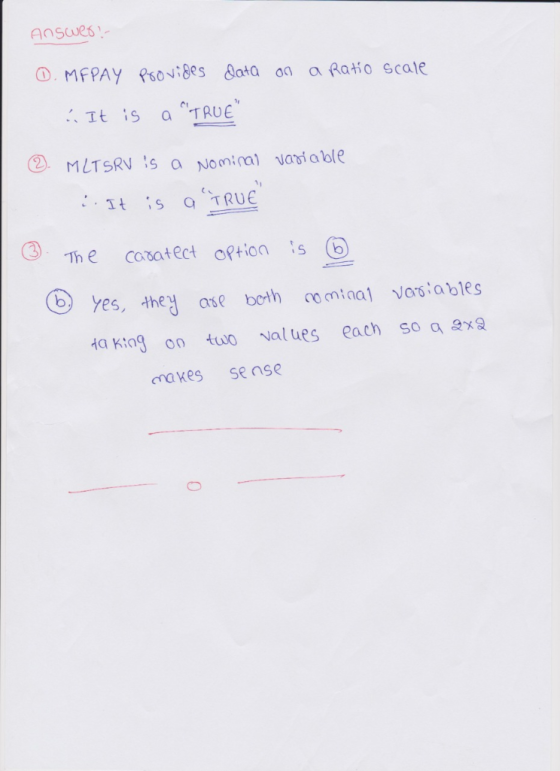
1. You conducted a 2-group independent t-test with MFPAY as the grouping (independent) variable and TIPAMT as the dependent variable. The mean tip amount for males, the mean tip value for females and the t-statistic were 3.46, 2.21, 3.68. Given the t-statistic value you would conclude
Select one:
a. Females leave more tip than males
b. Males leave more tip than females
c. They both leave same amount statistically speaking
d. Even though this test is interesting, it does not shed light on the main hypothesis
e. b and c
2. You conducted a 2-group independent t-test with MLTSRV as the grouping (independent) variable and TIPAMT as the dependent variable. The mean tip amount with single server, the mean tip value with multiple servers and the t-statistic were 2.06, 4.06 and -8.53. Given the t-statistic and the two means you would conclude
Select one:
a. TIPAMT was statistically higher when multiple servers were present
b. Having multiple servers had no effect on the tip amount
c. This is not a right test to conduct
3.Would you consider conducting an analysis using #TRPS and MFPAY?
Select one:
a. Yes, a 2-group t-test with MFPAY as the independent grouping variable and #TRPS as the dependent variable makes sense.
b. No, it doesn’t make any sense trying to establish a relationship between these two variables
Homework Answers
Add Answer to:
TIPAMT – Tip Amount (coded as 1, 2, 3, 4, or 5) where 1 = <10%; 2 = 10-12%; 3 = 12-14%; 4 = 15...
TIPAMT – Tip Amount (coded as 1, 2, 3, 4, or 5) where 1 = <10%; 2 = 10-12%; 3 = 12-14%; 4 = 15...
TIPAMT – Tip Amount (coded as 1, 2, 3, 4, or 5) where 1 = <10%; 2 = 10-12%; 3 = 12-14%; 4 = 15-16%; 5 = >18%. (TIPAMT was directly measured from customers’ payments for the checks). MLTSRV – Multiple Servers in Attendance (0=No; 1=Yes). (For customers on Tuesday, this variable was coded as 1. For customers on Wednesday, this variable was coded as 0). #PRTY - # of Individuals in the Party. (The primary server noted the number...
TIPAMT – Tip Amount (coded as 1, 2, 3, 4, or 5) where 1 = <10%;...
TIPAMT – Tip Amount (coded as 1, 2, 3, 4, or 5) where 1 = <10%; 2 = 10-12%; 3 = 12-14%; 4 = 15-16%; 5 = >18%. (TIPAMT was directly measured from customers’ payments for the checks). MLTSRV – Multiple Servers in Attendance (0=No; 1=Yes). (For customers on Tuesday, this variable was coded as 1. For customers on Wednesday, this variable was coded as 0). #PRTY - # of Individuals in the Party. (The primary server noted the number...
TIPAMT – Tip Amount (coded as 1, 2, 3, 4, or 5) where 1 = <10%;...
TIPAMT – Tip Amount (coded as 1, 2, 3, 4, or 5) where 1 = <10%; 2 = 10-12%; 3 = 12-14%; 4 = 15-16%; 5 = >18%. (TIPAMT was directly measured from customers’ payments for the checks). MLTSRV – Multiple Servers in Attendance (0=No; 1=Yes). (For customers on Tuesday, this variable was coded as 1. For customers on Wednesday, this variable was coded as 0). #PRTY - # of Individuals in the Party. (The primary server noted the number...
Q2) Independent-Samples t-Test (15 points total) Help with H, I, J, K, L please! In a...
Q2) Independent-Samples t-Test (15 points total) Help with H, I, J, K, L please! In a research project, researchers collected demographic and health data from a sample of elderly residents in the community. To examine any possible gender differences in their sample, they want to see if the females and the males differ significantly on the education level (number of years of formal schooling). The researchers are not predicting any direction in the possible gender differences so the hypotheses should...
Treatment 1 Treatment 2 Treatment 3 0 1 6 1 4 5 0 1 6 3...
Treatment 1 Treatment 2 Treatment 3 0 1 6 1 4 5 0 1 6 3 2 3 T = 4 T = 8 T = 20 SS = 6 SS = 6 SS = 6 N = 12 G = 32 ƩX2= 138 1a. Conduct a single-factor independent-measures ANOVA to test the hypothesis that there are significant differences in the mean scores among the three treatment conditions. Use α = .01. The alternative hypothesis is Group of answer choices...
GAGE MINDTAP 6 Homework Video eBook Given are five observations for two variables, a and y. 5 1 2 3 4 12 14 3 6 Th...
 GAGE MINDTAP 6 Homework Video eBook Given are five observations for two variables, a and y. 5 1 2 3 4 12 14 3 6 The estimated regression equation is ý= 0.8+ 2.6z - using the following equation (to 3 decimals). a. Compute the mean square error SSE = MSE= n-2 b. Compute the standard error of the estimate using the following equation (to 3 decimals). SSE s=VMSE n-2 c. Compute the estimated standard deviation b using the following equation...
Q2) Independent-Samples t-Test (15 points total) In a research project, researchers collected demographic and health data...
Q2) Independent-Samples t-Test (15 points total) In a research project, researchers collected demographic and health data from a sample of elderly residents in the community. To examine any possible gender differences in their sample, they want to see if the females and the males differ significantly on the education level (number of years of formal schooling). The researchers are not predicting any direction in the possible gender differences so the hypotheses should be non-directional. They would like to run a...
City code %drivers21 fatal accidents/1000 1 12 1.309 2 5 0 3 12 2.539 4 9 2...
 city code
%drivers21
fatal accidents/1000
1
12
1.309
2
5
0
3
12
2.539
4
9
2.003
5
11
2.034
6
14
4.08
7
13
2.639
8
9
0.124
9
6
0
10
10
1.145
11
13
2.719
12
18
3.128
13
10
1.676
14
17
3.769
15
14
2.639
16
13
1.449
17
12
3.121
18
10
2.616
19
9
0.788
20
14
2.631
21
10
1.887
22
12
1
23
9
0.652
24
12
1.209
25
15
0.775...
city code
%drivers21
fatal accidents/1000
1
12
1.309
2
5
0
3
12
2.539
4
9
2.003
5
11
2.034
6
14
4.08
7
13
2.639
8
9
0.124
9
6
0
10
10
1.145
11
13
2.719
12
18
3.128
13
10
1.676
14
17
3.769
15
14
2.639
16
13
1.449
17
12
3.121
18
10
2.616
19
9
0.788
20
14
2.631
21
10
1.887
22
12
1
23
9
0.652
24
12
1.209
25
15
0.775...
1 pts Question 1 Question 1: Death Penalty. Exercise 14-4. The chi-square for Table 14-3 on...
 1 pts Question 1 Question 1: Death Penalty. Exercise 14-4. The chi-square for Table 14-3 on page 138 (see Exercise 14-4 /'a 'in your Exercise Book on page 138) is Table 14-3.PNG [Exercise 14-4 on page 138 is here: exercise 14-4.PNG Exercise 14-4. A speaker at a lecture declares that no statistical evidence whatsoever demonstrates that the death penalty discriminates against minorities. When pressed on the point, she shows a slide that looks like table 14-3.9 The subjects were 326...
5-1 -2 -4 545. Multiple Choice Questions Select the best answer for each of the following...
 5-1 -2 -4 545. Multiple Choice Questions Select the best answer for each of the following questions. Explain the reasons for your selection a. Which of the following is not a financial statement assertion made by management? (1) Existence of recorded assets and liabilities. (2) Completeness of recorded assets and liabilities. (3) Valuation of assets and liabilities. (4) Effectiveness of internal control b. Which of the following business characteristics is not indicative of high inherent risk? (1) Operating results that...
 GAGE MINDTAP 6 Homework Video eBook Given are five observations for two variables, a and y. 5 1 2 3 4 12 14 3 6 The estimated regression equation is ý= 0.8+ 2.6z - using the following equation (to 3 decimals). a. Compute the mean square error SSE = MSE= n-2 b. Compute the standard error of the estimate using the following equation (to 3 decimals). SSE s=VMSE n-2 c. Compute the estimated standard deviation b using the following equation...
 city code
%drivers21
fatal accidents/1000
1
12
1.309
2
5
0
3
12
2.539
4
9
2.003
5
11
2.034
6
14
4.08
7
13
2.639
8
9
0.124
9
6
0
10
10
1.145
11
13
2.719
12
18
3.128
13
10
1.676
14
17
3.769
15
14
2.639
16
13
1.449
17
12
3.121
18
10
2.616
19
9
0.788
20
14
2.631
21
10
1.887
22
12
1
23
9
0.652
24
12
1.209
25
15
0.775...
city code
%drivers21
fatal accidents/1000
1
12
1.309
2
5
0
3
12
2.539
4
9
2.003
5
11
2.034
6
14
4.08
7
13
2.639
8
9
0.124
9
6
0
10
10
1.145
11
13
2.719
12
18
3.128
13
10
1.676
14
17
3.769
15
14
2.639
16
13
1.449
17
12
3.121
18
10
2.616
19
9
0.788
20
14
2.631
21
10
1.887
22
12
1
23
9
0.652
24
12
1.209
25
15
0.775...
 1 pts Question 1 Question 1: Death Penalty. Exercise 14-4. The chi-square for Table 14-3 on page 138 (see Exercise 14-4 /'a 'in your Exercise Book on page 138) is Table 14-3.PNG [Exercise 14-4 on page 138 is here: exercise 14-4.PNG Exercise 14-4. A speaker at a lecture declares that no statistical evidence whatsoever demonstrates that the death penalty discriminates against minorities. When pressed on the point, she shows a slide that looks like table 14-3.9 The subjects were 326...
 5-1 -2 -4 545. Multiple Choice Questions Select the best answer for each of the following questions. Explain the reasons for your selection a. Which of the following is not a financial statement assertion made by management? (1) Existence of recorded assets and liabilities. (2) Completeness of recorded assets and liabilities. (3) Valuation of assets and liabilities. (4) Effectiveness of internal control b. Which of the following business characteristics is not indicative of high inherent risk? (1) Operating results that...
Most questions answered within 3 hours.
-
Where is the error in this code sequence?
String s1 = "Hello";
String s2 = "ello";...
asked 10 months ago -
Financial data for Joel de Paris, Inc., for last year
follow:
Joel de Paris, Inc.
Balance...
asked 10 months ago -
Consider this reaction:
Al2(SO4)3 (aq)+ BaCl3
(aq) Al2Cl6 (aq)- +
3BaSO4(s) . What is the...
asked 10 months ago -
Suppose that Savneet is considering increasing her
recent random sample from 20 car rentals to 40...
asked 10 months ago -
Trucks arrive at an unloading terminal at an average rate of 120
per hour.
Trucks arrive...
asked 10 months ago -
Why are methanol and ethanol completely soluble in water while
octanol is not very little soluble....
asked 10 months ago -
A facilities manager at a university reads in a research report
that the mean amount of...
asked 10 months ago -
When the CuSO4 is rehydrated by adding water to the anhydrous
compound, is this an endothermic...
asked 10 months ago -
A ray of sunlight is passing from diamond into crown glass; the
angle of incidence is...
asked 10 months ago -
A block of mass 0.249 kg is placed on top of a light, vertical
spring of...
asked 10 months ago -
how do the kidneys compensate in the presences of acidosis
a) trigger hyperventilate
b) reserve acid...
asked 10 months ago -
Question 501 pts
The rental rate of capital to the firm increases. Which of the
following...
asked 10 months ago