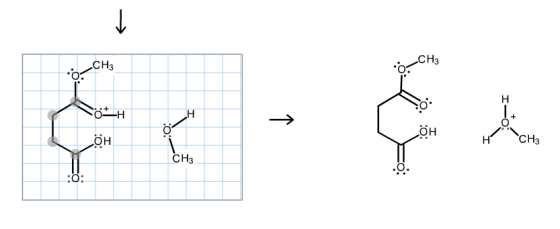
Draw the curved arrows to show the mechanism for the reaction of butanedioic (succinic) anhydride with methanol.
Draw the curved arrows to show the mechanism for the reaction of butanedioic (succinic) anhydride with methanol.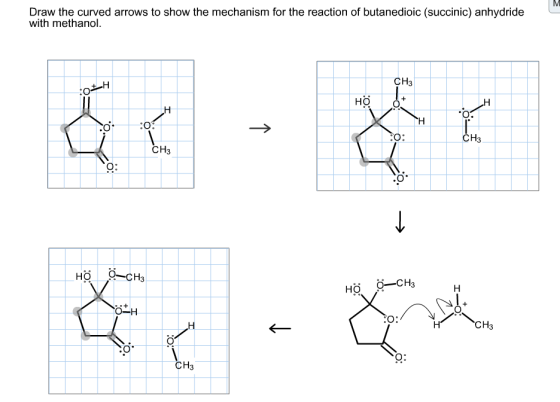
Homework Answers

Add Answer to:
Draw the curved arrows to show the mechanism for the reaction of butanedioic (succinic) anhydride with methanol.
Draw the curved arrows to show the mechanism for the reaction of butanedioic (succinic) anhydride with methanol.
 Draw the curved arrows to show the mechanism for the reaction of butanedioic (succinic) anhydride with methanol.
draw curved arrows to show the movement of electrons in this step of the reaction mechanism...
 draw curved arrows to show the movement of electrons in this step
of the reaction mechanism
HCI H2O NH,CI -CEN ОН Acid catalyzed hydrolysis of a nitrile to give a carboxylic acid occurs by initial protonation of the nitrogen atom, fo Draw curved arrows to show the movement of electrons in this step of the reaction mechanism Arrow-pushing Instructions O: x H -CI: -NH₂ SLIDE ty Another Mansion 1 terrattuttomat
draw curved arrows to show the movement of electrons in this step
of the reaction mechanism
HCI H2O NH,CI -CEN ОН Acid catalyzed hydrolysis of a nitrile to give a carboxylic acid occurs by initial protonation of the nitrogen atom, fo Draw curved arrows to show the movement of electrons in this step of the reaction mechanism Arrow-pushing Instructions O: x H -CI: -NH₂ SLIDE ty Another Mansion 1 terrattuttomat
4-hydroxypentanal reacts with one equivalent of methanol to form a cyclic acetal. Draw curved arrows to...
 4-hydroxypentanal reacts with one equivalent of methanol to form a cyclic acetal. Draw curved arrows to show the movement of electrons in this step of the reaction mechanism.
draw curved arrows Draw curved arrows to complete the Diels-Alder mechanism for the two reactants shown....
 draw curved arrows
Draw curved arrows to complete the Diels-Alder mechanism for the two reactants shown. Then draw the product of the reaction in the box to the right. Do not show stereochemistry.
draw curved arrows
Draw curved arrows to complete the Diels-Alder mechanism for the two reactants shown. Then draw the product of the reaction in the box to the right. Do not show stereochemistry.
The Friedel Crafts Acylation Reaction Reaction of Anisole With Succinic Anhydride 1. Write a stepwise mechanism...
The Friedel Crafts Acylation Reaction Reaction of Anisole With Succinic Anhydride 1. Write a stepwise mechanism for this reaction. 2.(a) Starting from toluene, show how you could prepare 4-(p-tolyl) butanoic acid in two steps. (b) What would be the product of treating this acid with concentrated H2SO4? 3. What would be the main product formed in this experiment (a) if anisole were replaced with naphthalene? (b) if succinic anhydride were replaced with phthalic anhydride?
(a) Draw a stepwise, detailed mechanism for the following reaction. Used curved arrows to show the...
 (a) Draw a stepwise, detailed mechanism for the following reaction. Used curved arrows to show the movement of electrons. Br CN NaCN DMF NaBr (b) Assign the configuration (Ror S) of the chiral centre in the substrate and product (c) List the bonds broken and formed in this reaction (d) Assume that this is an endothermic reaction. Draw an energy diagram for this reaction. Label the axes, reactants, products, E, and AH. Draw the structure for both transition states.
Write a mechanism for the reaction using curved arrows to show electron reorganization.
 Write a mechanism for the reaction using curved arrows to show electron reorganization. Write a mechanism for the reaction using curved arrows to show electron reorganization. Consult the arrow-pushing instructions for the convention on regiospecific electrophilic attack on a double bond.
Draw curved arrows to show the movement of electrons in this step of the mechanism. Draw...
 Draw curved arrows to show the movement of electrons in this
step of the mechanism.
Draw curved arrows to show the movement of electrons in this step of the mechanism. Arrow-pushing Instructions nga XT :00 Ph H3c-tö- PhẳNH H₃C N" H₃co CHỊ next Ph-NH2 H3Co PhNH - Ph—ŃHz CHỊ H3c-töl Ph–NH CH3 nggam '0 ' with the H₃C/ Ph Нsc H3COOH | Pháo: CH
Draw curved arrows to show the movement of electrons in this
step of the mechanism.
Draw curved arrows to show the movement of electrons in this step of the mechanism. Arrow-pushing Instructions nga XT :00 Ph H3c-tö- PhẳNH H₃C N" H₃co CHỊ next Ph-NH2 H3Co PhNH - Ph—ŃHz CHỊ H3c-töl Ph–NH CH3 nggam '0 ' with the H₃C/ Ph Нsc H3COOH | Pháo: CH
Draw curved arrows to show the movement of electrons in this step of the mechanism.
 Electrophilic addition of bromine, Br-, to alkenes yields a 1,2-dibromoalkane. The reaction proceeds through a cyclic intermediate known as a bromonium ion. The reaction occurs in an anhydrous solvent such as CH2Cl2 In the second step of the reaction, bromide is the nucleophile and attacks at one of the carbons of the bromonium ion to yield the product. Due to steric clashes, the bromide ion always attacks the carbon from the opposite face of the bromonium ion so that a product...
Draw curved arrows to show the movement of electrons in this step of the mechanism.
 Electrophilic addition of bromine, Br2, to alkenes yields a 1,2-dibromoalkane. The reaction proceeds through a cyclic intermediate known as a bromonium ion. The reaction occurs in an anhydrous solvent such as CH2Cl2 In the second step of the reaction, bromide is the nucleophile and attacks at one of the carbons of the bromonium ion to yield the product. Due to steric clashes, the bromide ion always attacks the carbon from the opposite face of the bromonium ion so that a product...
 draw curved arrows to show the movement of electrons in this step
of the reaction mechanism
HCI H2O NH,CI -CEN ОН Acid catalyzed hydrolysis of a nitrile to give a carboxylic acid occurs by initial protonation of the nitrogen atom, fo Draw curved arrows to show the movement of electrons in this step of the reaction mechanism Arrow-pushing Instructions O: x H -CI: -NH₂ SLIDE ty Another Mansion 1 terrattuttomat
draw curved arrows to show the movement of electrons in this step
of the reaction mechanism
HCI H2O NH,CI -CEN ОН Acid catalyzed hydrolysis of a nitrile to give a carboxylic acid occurs by initial protonation of the nitrogen atom, fo Draw curved arrows to show the movement of electrons in this step of the reaction mechanism Arrow-pushing Instructions O: x H -CI: -NH₂ SLIDE ty Another Mansion 1 terrattuttomat
 4-hydroxypentanal reacts with one equivalent of methanol to form a cyclic acetal. Draw curved arrows to show the movement of electrons in this step of the reaction mechanism.
 draw curved arrows
Draw curved arrows to complete the Diels-Alder mechanism for the two reactants shown. Then draw the product of the reaction in the box to the right. Do not show stereochemistry.
draw curved arrows
Draw curved arrows to complete the Diels-Alder mechanism for the two reactants shown. Then draw the product of the reaction in the box to the right. Do not show stereochemistry.
 (a) Draw a stepwise, detailed mechanism for the following reaction. Used curved arrows to show the movement of electrons. Br CN NaCN DMF NaBr (b) Assign the configuration (Ror S) of the chiral centre in the substrate and product (c) List the bonds broken and formed in this reaction (d) Assume that this is an endothermic reaction. Draw an energy diagram for this reaction. Label the axes, reactants, products, E, and AH. Draw the structure for both transition states.
 Draw curved arrows to show the movement of electrons in this
step of the mechanism.
Draw curved arrows to show the movement of electrons in this step of the mechanism. Arrow-pushing Instructions nga XT :00 Ph H3c-tö- PhẳNH H₃C N" H₃co CHỊ next Ph-NH2 H3Co PhNH - Ph—ŃHz CHỊ H3c-töl Ph–NH CH3 nggam '0 ' with the H₃C/ Ph Нsc H3COOH | Pháo: CH
Draw curved arrows to show the movement of electrons in this
step of the mechanism.
Draw curved arrows to show the movement of electrons in this step of the mechanism. Arrow-pushing Instructions nga XT :00 Ph H3c-tö- PhẳNH H₃C N" H₃co CHỊ next Ph-NH2 H3Co PhNH - Ph—ŃHz CHỊ H3c-töl Ph–NH CH3 nggam '0 ' with the H₃C/ Ph Нsc H3COOH | Pháo: CH
Most questions answered within 3 hours.
-
Where is the error in this code sequence?
String s1 = "Hello";
String s2 = "ello";...
asked 11 months ago -
Financial data for Joel de Paris, Inc., for last year
follow:
Joel de Paris, Inc.
Balance...
asked 11 months ago -
Consider this reaction:
Al2(SO4)3 (aq)+ BaCl3
(aq) Al2Cl6 (aq)- +
3BaSO4(s) . What is the...
asked 11 months ago -
Suppose that Savneet is considering increasing her
recent random sample from 20 car rentals to 40...
asked 11 months ago -
Trucks arrive at an unloading terminal at an average rate of 120
per hour.
Trucks arrive...
asked 11 months ago -
Why are methanol and ethanol completely soluble in water while
octanol is not very little soluble....
asked 11 months ago -
A facilities manager at a university reads in a research report
that the mean amount of...
asked 11 months ago -
When the CuSO4 is rehydrated by adding water to the anhydrous
compound, is this an endothermic...
asked 11 months ago -
A ray of sunlight is passing from diamond into crown glass; the
angle of incidence is...
asked 11 months ago -
A block of mass 0.249 kg is placed on top of a light, vertical
spring of...
asked 11 months ago -
how do the kidneys compensate in the presences of acidosis
a) trigger hyperventilate
b) reserve acid...
asked 11 months ago -
Question 501 pts
The rental rate of capital to the firm increases. Which of the
following...
asked 11 months ago