
Homework Answers
1,6- dihydroionsine is the transition state analog and the inhibition is competitive inhibition.
During competitive inhibition, an inhibitor is competing with the substrate for access to the enzyme's active site.
Add Answer to:
TransitionState 7) Adenosine deaminase is an enzyme that catalyzes the conversion of adenosine su...
3. Cytidine deaminase is an enzyme which converts cytidine to uridine. NH, CHOH Cysdi deaminase Cytidine...
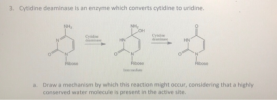 3. Cytidine deaminase is an enzyme which converts cytidine to uridine. NH, CHOH Cysdi deaminase Cytidine deminase HN HN Ribose Ribose Ribose teerediate Draw a mechanism by which this reaction might occur, considering that a highly conserved water molecule is present in the active site. a. b. Zebularine is a natural product which is converted into a highly potent transition state inhibitor of the enzyme (Ki = 1.2 pM) when it is in the active site. Suggest what the structure...
A variety of factors influence enzyme activity. Substances that bind to the enzyme and interfere with...
A variety of factors influence enzyme activity. Substances that bind to the enzyme and interfere with substrate binding or catalysis are inhibitors. Identify the type of inhibition associated with each of the following descriptions and examples by sorting each item into the appropriate bin. The bins are: irriversible inhibition, compenitive inhibition, mixed inhibition The phrases to sort are: -Tamiflu, a transition state analog, reversibly binds to neuraminidase - Inhibitor may perminantely modify an enzyme -DIPF permanently modifies the hydroxyl group...
thats all the information that he gave us to solve the question. Thank you for trying...
 thats all the information that he gave us to solve the question.
Thank you for trying anyways
X C E Question 23 1 pts The free-energy changes for the transfer of individual amino acid residues from a hydrophobic to an aqueous environment are given as follows: Amino acid AG of transfer (kJ/mol Proline -0.8 -12.6 Histidine 6.7 Alanine Methionine 14.3 Based on this information, which of these amino acid pairs is MOST likely to be represented in membrane-spanning alpha helices?...
thats all the information that he gave us to solve the question.
Thank you for trying anyways
X C E Question 23 1 pts The free-energy changes for the transfer of individual amino acid residues from a hydrophobic to an aqueous environment are given as follows: Amino acid AG of transfer (kJ/mol Proline -0.8 -12.6 Histidine 6.7 Alanine Methionine 14.3 Based on this information, which of these amino acid pairs is MOST likely to be represented in membrane-spanning alpha helices?...
1. According to the paper, what does lactate dehydrogenase (LDH) do and what does it allow...
 1. According to the paper, what does lactate dehydrogenase
(LDH) do and what does it allow to happen within the myofiber? (5
points)
2. According to the paper, what is the major disadvantage of
relying on glycolysis during high-intensity exercise? (5
points)
3. Using Figure 1 in the paper, briefly describe the different
sources of ATP production at 50% versus 90% AND explain whether you
believe this depiction of ATP production applies to a Type IIX
myofiber in a human....
1. According to the paper, what does lactate dehydrogenase
(LDH) do and what does it allow to happen within the myofiber? (5
points)
2. According to the paper, what is the major disadvantage of
relying on glycolysis during high-intensity exercise? (5
points)
3. Using Figure 1 in the paper, briefly describe the different
sources of ATP production at 50% versus 90% AND explain whether you
believe this depiction of ATP production applies to a Type IIX
myofiber in a human....
 3. Cytidine deaminase is an enzyme which converts cytidine to uridine. NH, CHOH Cysdi deaminase Cytidine deminase HN HN Ribose Ribose Ribose teerediate Draw a mechanism by which this reaction might occur, considering that a highly conserved water molecule is present in the active site. a. b. Zebularine is a natural product which is converted into a highly potent transition state inhibitor of the enzyme (Ki = 1.2 pM) when it is in the active site. Suggest what the structure...
 thats all the information that he gave us to solve the question.
Thank you for trying anyways
X C E Question 23 1 pts The free-energy changes for the transfer of individual amino acid residues from a hydrophobic to an aqueous environment are given as follows: Amino acid AG of transfer (kJ/mol Proline -0.8 -12.6 Histidine 6.7 Alanine Methionine 14.3 Based on this information, which of these amino acid pairs is MOST likely to be represented in membrane-spanning alpha helices?...
thats all the information that he gave us to solve the question.
Thank you for trying anyways
X C E Question 23 1 pts The free-energy changes for the transfer of individual amino acid residues from a hydrophobic to an aqueous environment are given as follows: Amino acid AG of transfer (kJ/mol Proline -0.8 -12.6 Histidine 6.7 Alanine Methionine 14.3 Based on this information, which of these amino acid pairs is MOST likely to be represented in membrane-spanning alpha helices?...
 1. According to the paper, what does lactate dehydrogenase
(LDH) do and what does it allow to happen within the myofiber? (5
points)
2. According to the paper, what is the major disadvantage of
relying on glycolysis during high-intensity exercise? (5
points)
3. Using Figure 1 in the paper, briefly describe the different
sources of ATP production at 50% versus 90% AND explain whether you
believe this depiction of ATP production applies to a Type IIX
myofiber in a human....
1. According to the paper, what does lactate dehydrogenase
(LDH) do and what does it allow to happen within the myofiber? (5
points)
2. According to the paper, what is the major disadvantage of
relying on glycolysis during high-intensity exercise? (5
points)
3. Using Figure 1 in the paper, briefly describe the different
sources of ATP production at 50% versus 90% AND explain whether you
believe this depiction of ATP production applies to a Type IIX
myofiber in a human....
Most questions answered within 3 hours.
-
Where is the error in this code sequence?
String s1 = "Hello";
String s2 = "ello";...
asked 10 months ago -
Financial data for Joel de Paris, Inc., for last year
follow:
Joel de Paris, Inc.
Balance...
asked 10 months ago -
Consider this reaction:
Al2(SO4)3 (aq)+ BaCl3
(aq) Al2Cl6 (aq)- +
3BaSO4(s) . What is the...
asked 10 months ago -
Suppose that Savneet is considering increasing her
recent random sample from 20 car rentals to 40...
asked 10 months ago -
Trucks arrive at an unloading terminal at an average rate of 120
per hour.
Trucks arrive...
asked 10 months ago -
Why are methanol and ethanol completely soluble in water while
octanol is not very little soluble....
asked 10 months ago -
A facilities manager at a university reads in a research report
that the mean amount of...
asked 10 months ago -
When the CuSO4 is rehydrated by adding water to the anhydrous
compound, is this an endothermic...
asked 10 months ago -
A ray of sunlight is passing from diamond into crown glass; the
angle of incidence is...
asked 10 months ago -
A block of mass 0.249 kg is placed on top of a light, vertical
spring of...
asked 10 months ago -
how do the kidneys compensate in the presences of acidosis
a) trigger hyperventilate
b) reserve acid...
asked 10 months ago -
Question 501 pts
The rental rate of capital to the firm increases. Which of the
following...
asked 10 months ago