
Homework Answers

Add Answer to:
P. 3: For each system shown below, make an accurate plot of the root locus and find the following...
For each system, make an accurate plot of the root locus and find the following: a)...
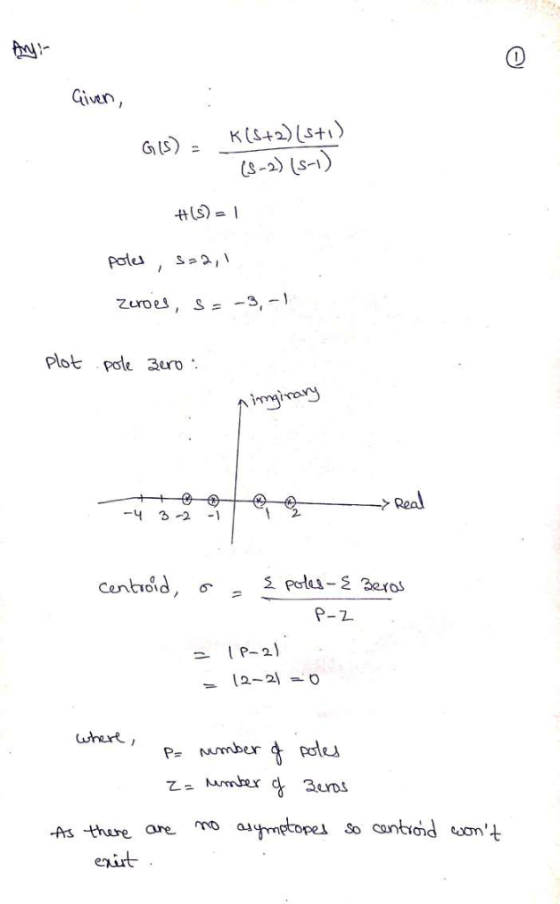
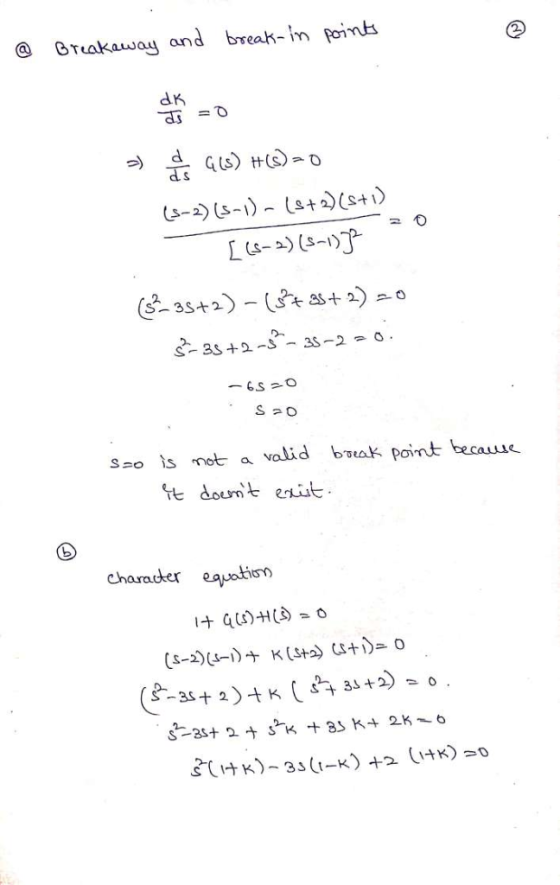
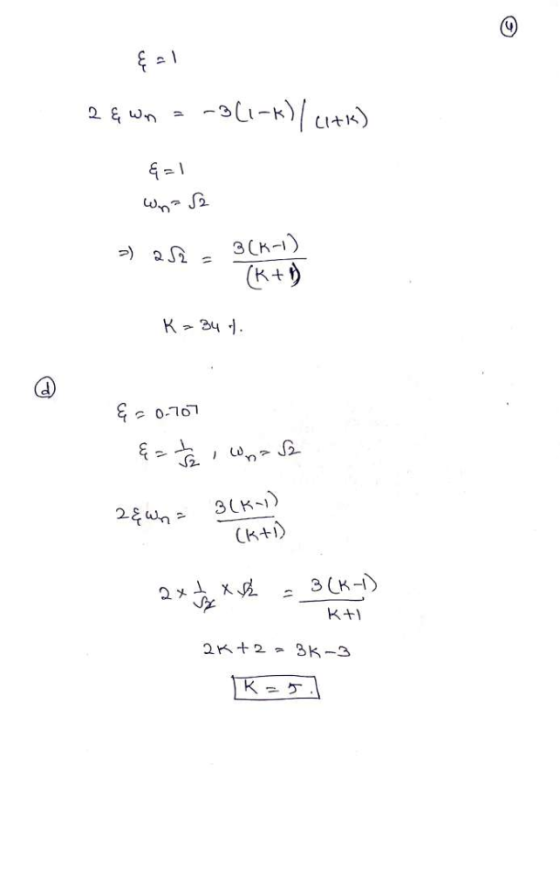
 For each system, make an accurate plot of the root locus and find the following: a) The breakaway and break-in points. b) The range of K to keep the system stable. c) The value of K that yields a stable system with critically damped second-order poles. d) The value of K that yields a stable system with a pair of second-order poles that have a damping ratio of 0.707. cally dempe secondes de protest 2) G(s) - K(s+2)(s+1) (s? –...
For the unity feedback system, where G(s) =-s-2)(s-1) make an accurate plot of the root locus...
 For the unity feedback system, where G(s) =-s-2)(s-1) make an accurate plot of the root locus and find the following: (a) The breakaway and break-in points (b) The range of K to keep the system stable (c) The value of K that yields a stable system with critically damped second-order poles (d) The value of K that yields a stable system with a pair of second-order poles that have a damping ratio of 0.707
Problem 6: For the system shown below, make an accurate plot of the root locus and find the follo...
 Problem 6: For the system shown below, make an accurate plot of the root locus and find the following a. The breakaway and break-in points, b. The range of K to keep the system stable, C. The value of K that yields a stable system with critically damped second-order poles C(s) K(s 2)(s 1) (s - 2)(s-1)
Problem 6: For the system shown below, make an accurate plot of the root locus and find the following a. The breakaway and...
Problem 6: For the system shown below, make an accurate plot of the root locus and find the following a. The breakaway and break-in points, b. The range of K to keep the system stable, C. The value of K that yields a stable system with critically damped second-order poles C(s) K(s 2)(s 1) (s - 2)(s-1)
Problem 6: For the system shown below, make an accurate plot of the root locus and find the following a. The breakaway and...
For the system shown below, find the followings; (a) Make an accurate plot of the root locus (b) The value of K that gives a stable system with critically damped second-order poles (c ) The value...
 For the system shown below, find the followings; (a) Make an accurate plot of the root locus (b) The value of K that gives a stable system with critically damped second-order poles (c ) The value of K that gives a marginally stable sytems Cs) (s-20s- I) 0.5 The characteristic equation (denominator of the closed-loop trans fer function set equal to zero) is given by
For the system shown below, find the followings; (a) Make an accurate plot of the...
For the system shown below, find the followings; (a) Make an accurate plot of the root locus (b) The value of K that gives a stable system with critically damped second-order poles (c ) The value of K that gives a marginally stable sytems Cs) (s-20s- I) 0.5 The characteristic equation (denominator of the closed-loop trans fer function set equal to zero) is given by
For the system shown below, find the followings; (a) Make an accurate plot of the...
1 GH(s) (s24s3s2 + 10s 24) sketch the root locus and find the following: [Section: 8.5...
 1 GH(s) (s24s3s2 + 10s 24) sketch the root locus and find the following: [Section: 8.5 a. The breakaway and break-in points b. The jo-axis crossing c. The range of gain to keep the system stable d. The value of K to yield a stable system with second-order complex poles, with a damping ratio of 0.5
1 GH(s) (s24s3s2 + 10s 24) sketch the root locus and find the following: [Section: 8.5 a. The breakaway and break-in points b. The...
1 GH(s) (s24s3s2 + 10s 24) sketch the root locus and find the following: [Section: 8.5 a. The breakaway and break-in points b. The jo-axis crossing c. The range of gain to keep the system stable d. The value of K to yield a stable system with second-order complex poles, with a damping ratio of 0.5
1 GH(s) (s24s3s2 + 10s 24) sketch the root locus and find the following: [Section: 8.5 a. The breakaway and break-in points b. The...
Question# 1 (25 points) For a unity feedback system with open loop transfer function K(s+10)(s+20) (s+30)(s2-20s+2...
 Question# 1 (25 points) For a unity feedback system with open loop transfer function K(s+10)(s+20) (s+30)(s2-20s+200) G(s) = Do the following using Matlab: a) Sketch the root locus. b) Find the range of gain, K that makes the system stable c) Find the value of K that yields a damping ratio of 0.707 for the system's closed-loop dominant poles. d) Obtain Ts, Tp, %OS for the closed loop system in part c). e) Find the value of K that yields...
Root Locus: Consider the following system
 Root Locus: Consider the following system (a) What are the poles of the open loop system (locations of the open loop poles)? What are zeros of the open loop system (locations of the zeros)? (b) What is the origin of the asymptotes? (c) What are the angles of asymptotes? (d) Find the break-away and break-in points. (e) Find the angles of departure for all the poles. (f) Draw the root locus plot of G(s). (g) For what values of K is the closed loop system stable?
Lectures 15-18: Root-locus method 5.1 Sketch the root locus for a unity feedback system with the ...
 help on #5.2
L(s) is loop transfer function
1+L(s) = 0
lecture notes:
Lectures 15-18: Root-locus method 5.1 Sketch the root locus for a unity feedback system with the loop transfer function (8+5(+10) .2 +10+20 where K, T, and a are nonnegative parameters. For each case summarize your results in a table similar to the one provided below. Root locus parameters Open loop poles Open loop zeros Number of zeros at infinity Number of branches Number of asymptotes Center of...
help on #5.2
L(s) is loop transfer function
1+L(s) = 0
lecture notes:
Lectures 15-18: Root-locus method 5.1 Sketch the root locus for a unity feedback system with the loop transfer function (8+5(+10) .2 +10+20 where K, T, and a are nonnegative parameters. For each case summarize your results in a table similar to the one provided below. Root locus parameters Open loop poles Open loop zeros Number of zeros at infinity Number of branches Number of asymptotes Center of...
Question 5 The root locus of a system is provided in the following figure. C(s) R(s) + (s-2%s -I)...
 Question 5 The root locus of a system is provided in the following figure. C(s) R(s) + (s-2%s -I) 2.00 1.50 1.00 . 50 -.50 -2.00 2.00 -2.00 1.00 1.00 Real (a) Find the location of closed-loop system poles (design poles) to provide S -0.707 (use the provided scaled graph to avoid numerical calculations). (b) Find the value of K corresponding to the design poles. (c) Find the value of settling time corresponding to the design poles. (d) It is...
3. Consider the system shown below. For this system. G(s) s(s+1)(s 2) H(s)1 We assume that the value of the gain K is nonnegative. Sketch the root locus plot and determine the K value such that the d...
 3. Consider the system shown below. For this system. G(s) s(s+1)(s 2) H(s)1 We assume that the value of the gain K is nonnegative. Sketch the root locus plot and determine the K value such that the damping ratio of a pair of dominant complex-conjugate closed-loop poles is 0.5. Ri)1 C(s)
3. Consider the system shown below. For this system. G(s) s(s+1)(s 2) H(s)1 We assume that the value of the gain K is nonnegative. Sketch the root locus plot...
3. Consider the system shown below. For this system. G(s) s(s+1)(s 2) H(s)1 We assume that the value of the gain K is nonnegative. Sketch the root locus plot and determine the K value such that the damping ratio of a pair of dominant complex-conjugate closed-loop poles is 0.5. Ri)1 C(s)
3. Consider the system shown below. For this system. G(s) s(s+1)(s 2) H(s)1 We assume that the value of the gain K is nonnegative. Sketch the root locus plot...
 For each system, make an accurate plot of the root locus and find the following: a) The breakaway and break-in points. b) The range of K to keep the system stable. c) The value of K that yields a stable system with critically damped second-order poles. d) The value of K that yields a stable system with a pair of second-order poles that have a damping ratio of 0.707. cally dempe secondes de protest 2) G(s) - K(s+2)(s+1) (s? –...
 For the unity feedback system, where G(s) =-s-2)(s-1) make an accurate plot of the root locus and find the following: (a) The breakaway and break-in points (b) The range of K to keep the system stable (c) The value of K that yields a stable system with critically damped second-order poles (d) The value of K that yields a stable system with a pair of second-order poles that have a damping ratio of 0.707
 Problem 6: For the system shown below, make an accurate plot of the root locus and find the following a. The breakaway and break-in points, b. The range of K to keep the system stable, C. The value of K that yields a stable system with critically damped second-order poles C(s) K(s 2)(s 1) (s - 2)(s-1)
Problem 6: For the system shown below, make an accurate plot of the root locus and find the following a. The breakaway and...
Problem 6: For the system shown below, make an accurate plot of the root locus and find the following a. The breakaway and break-in points, b. The range of K to keep the system stable, C. The value of K that yields a stable system with critically damped second-order poles C(s) K(s 2)(s 1) (s - 2)(s-1)
Problem 6: For the system shown below, make an accurate plot of the root locus and find the following a. The breakaway and...
 For the system shown below, find the followings; (a) Make an accurate plot of the root locus (b) The value of K that gives a stable system with critically damped second-order poles (c ) The value of K that gives a marginally stable sytems Cs) (s-20s- I) 0.5 The characteristic equation (denominator of the closed-loop trans fer function set equal to zero) is given by
For the system shown below, find the followings; (a) Make an accurate plot of the...
For the system shown below, find the followings; (a) Make an accurate plot of the root locus (b) The value of K that gives a stable system with critically damped second-order poles (c ) The value of K that gives a marginally stable sytems Cs) (s-20s- I) 0.5 The characteristic equation (denominator of the closed-loop trans fer function set equal to zero) is given by
For the system shown below, find the followings; (a) Make an accurate plot of the...
 1 GH(s) (s24s3s2 + 10s 24) sketch the root locus and find the following: [Section: 8.5 a. The breakaway and break-in points b. The jo-axis crossing c. The range of gain to keep the system stable d. The value of K to yield a stable system with second-order complex poles, with a damping ratio of 0.5
1 GH(s) (s24s3s2 + 10s 24) sketch the root locus and find the following: [Section: 8.5 a. The breakaway and break-in points b. The...
1 GH(s) (s24s3s2 + 10s 24) sketch the root locus and find the following: [Section: 8.5 a. The breakaway and break-in points b. The jo-axis crossing c. The range of gain to keep the system stable d. The value of K to yield a stable system with second-order complex poles, with a damping ratio of 0.5
1 GH(s) (s24s3s2 + 10s 24) sketch the root locus and find the following: [Section: 8.5 a. The breakaway and break-in points b. The...
 Question# 1 (25 points) For a unity feedback system with open loop transfer function K(s+10)(s+20) (s+30)(s2-20s+200) G(s) = Do the following using Matlab: a) Sketch the root locus. b) Find the range of gain, K that makes the system stable c) Find the value of K that yields a damping ratio of 0.707 for the system's closed-loop dominant poles. d) Obtain Ts, Tp, %OS for the closed loop system in part c). e) Find the value of K that yields...
 help on #5.2
L(s) is loop transfer function
1+L(s) = 0
lecture notes:
Lectures 15-18: Root-locus method 5.1 Sketch the root locus for a unity feedback system with the loop transfer function (8+5(+10) .2 +10+20 where K, T, and a are nonnegative parameters. For each case summarize your results in a table similar to the one provided below. Root locus parameters Open loop poles Open loop zeros Number of zeros at infinity Number of branches Number of asymptotes Center of...
help on #5.2
L(s) is loop transfer function
1+L(s) = 0
lecture notes:
Lectures 15-18: Root-locus method 5.1 Sketch the root locus for a unity feedback system with the loop transfer function (8+5(+10) .2 +10+20 where K, T, and a are nonnegative parameters. For each case summarize your results in a table similar to the one provided below. Root locus parameters Open loop poles Open loop zeros Number of zeros at infinity Number of branches Number of asymptotes Center of...
 Question 5 The root locus of a system is provided in the following figure. C(s) R(s) + (s-2%s -I) 2.00 1.50 1.00 . 50 -.50 -2.00 2.00 -2.00 1.00 1.00 Real (a) Find the location of closed-loop system poles (design poles) to provide S -0.707 (use the provided scaled graph to avoid numerical calculations). (b) Find the value of K corresponding to the design poles. (c) Find the value of settling time corresponding to the design poles. (d) It is...
 3. Consider the system shown below. For this system. G(s) s(s+1)(s 2) H(s)1 We assume that the value of the gain K is nonnegative. Sketch the root locus plot and determine the K value such that the damping ratio of a pair of dominant complex-conjugate closed-loop poles is 0.5. Ri)1 C(s)
3. Consider the system shown below. For this system. G(s) s(s+1)(s 2) H(s)1 We assume that the value of the gain K is nonnegative. Sketch the root locus plot...
3. Consider the system shown below. For this system. G(s) s(s+1)(s 2) H(s)1 We assume that the value of the gain K is nonnegative. Sketch the root locus plot and determine the K value such that the damping ratio of a pair of dominant complex-conjugate closed-loop poles is 0.5. Ri)1 C(s)
3. Consider the system shown below. For this system. G(s) s(s+1)(s 2) H(s)1 We assume that the value of the gain K is nonnegative. Sketch the root locus plot...
Most questions answered within 3 hours.
-
Where is the error in this code sequence?
String s1 = "Hello";
String s2 = "ello";...
asked 11 months ago -
Financial data for Joel de Paris, Inc., for last year
follow:
Joel de Paris, Inc.
Balance...
asked 11 months ago -
Consider this reaction:
Al2(SO4)3 (aq)+ BaCl3
(aq) Al2Cl6 (aq)- +
3BaSO4(s) . What is the...
asked 11 months ago -
Suppose that Savneet is considering increasing her
recent random sample from 20 car rentals to 40...
asked 11 months ago -
Trucks arrive at an unloading terminal at an average rate of 120
per hour.
Trucks arrive...
asked 11 months ago -
Why are methanol and ethanol completely soluble in water while
octanol is not very little soluble....
asked 11 months ago -
A facilities manager at a university reads in a research report
that the mean amount of...
asked 11 months ago -
When the CuSO4 is rehydrated by adding water to the anhydrous
compound, is this an endothermic...
asked 11 months ago -
A ray of sunlight is passing from diamond into crown glass; the
angle of incidence is...
asked 11 months ago -
A block of mass 0.249 kg is placed on top of a light, vertical
spring of...
asked 11 months ago -
how do the kidneys compensate in the presences of acidosis
a) trigger hyperventilate
b) reserve acid...
asked 11 months ago -
Question 501 pts
The rental rate of capital to the firm increases. Which of the
following...
asked 11 months ago