

44). 丁こ 5.ppu-m-Sec2 roe! rad
Homework Answers
Given:
For steel-
Modulus of rigidity: 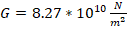
Density:
Fluid viscosity: 
Diameter of shaft:
Diameter of rotor: 
Length of shaft: 
Length of rotor: 
Thickness of oil layer: 
a). Torsional stiffness Ks of the shaft
Torsional stiffness of the shaft is given by the relation

J is the polar moment of inertia of the shaft given by the relation

From equation (2) and (1) torsional stiffness
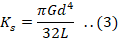
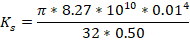
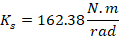
For shaft


On substituting values
b). Moment of inertia of the rotor
Mass Moment of inertia for a cylindrical object is given by the relation
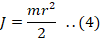
 is the radius of
rotor
is the radius of
rotor
 is mass rotor
Mass of the rotor can be evaluated by product of volume and density
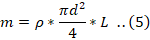
From equation (4) and (5)

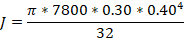
For rotor


On substituting values

c). Torsional damping constant B
The rotor is rotating in the surrounding environment of viscous oil, due to which damping effect(viscous force) will be generated., and this viscous force will cause resisting viscous torque.Viscous force is given by the following relation
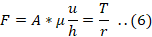
 , is the area between
rotor and stator
, is the area between
rotor and stator
 is the viscosity of
oil
is the viscosity of
oil
 is a relative
velocity between rotor and stator
is a relative
velocity between rotor and stator
 is the gap between
rotor and stator
is the gap between
rotor and stator
 is resisting torque
due to viscous effect
is resisting torque
due to viscous effect
 is rotor radius
 is rotor angular
velocity
is rotor angular
velocity
On substituting in equation (6)
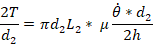
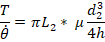
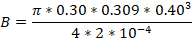
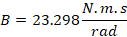
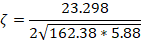
Torsional damping constant is given by
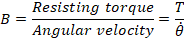
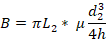
For rotor



On substituting values
d). Natural frequency and damping coefficient
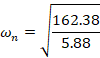
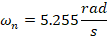
The natural frequency is given by the relation

 is
shaft stiffness
is
shaft stiffness
 mass moment inertia
of the rotor
mass moment inertia
of the rotor
On substituting values
Damping coefficient is given by the relation

 torsional
damping coefficient
torsional
damping coefficient
 is shaft
stiffness
is shaft
stiffness
 mass moment inertia
of rotor
mass moment inertia
of rotor

Add Answer to:
4. Consider the rotational system shown below. For steel, G- 8.27 x 101° Nt/m2 and p 7800 kg/m', ...
Most questions answered within 3 hours.
-
Where is the error in this code sequence?
String s1 = "Hello";
String s2 = "ello";...
asked 11 months ago -
Financial data for Joel de Paris, Inc., for last year
follow:
Joel de Paris, Inc.
Balance...
asked 11 months ago -
Consider this reaction:
Al2(SO4)3 (aq)+ BaCl3
(aq) Al2Cl6 (aq)- +
3BaSO4(s) . What is the...
asked 11 months ago -
Suppose that Savneet is considering increasing her
recent random sample from 20 car rentals to 40...
asked 11 months ago -
Trucks arrive at an unloading terminal at an average rate of 120
per hour.
Trucks arrive...
asked 11 months ago -
Why are methanol and ethanol completely soluble in water while
octanol is not very little soluble....
asked 11 months ago -
A facilities manager at a university reads in a research report
that the mean amount of...
asked 11 months ago -
When the CuSO4 is rehydrated by adding water to the anhydrous
compound, is this an endothermic...
asked 11 months ago -
A ray of sunlight is passing from diamond into crown glass; the
angle of incidence is...
asked 11 months ago -
A block of mass 0.249 kg is placed on top of a light, vertical
spring of...
asked 11 months ago -
how do the kidneys compensate in the presences of acidosis
a) trigger hyperventilate
b) reserve acid...
asked 11 months ago -
Question 501 pts
The rental rate of capital to the firm increases. Which of the
following...
asked 11 months ago