
Homework Answers
Add Answer to:
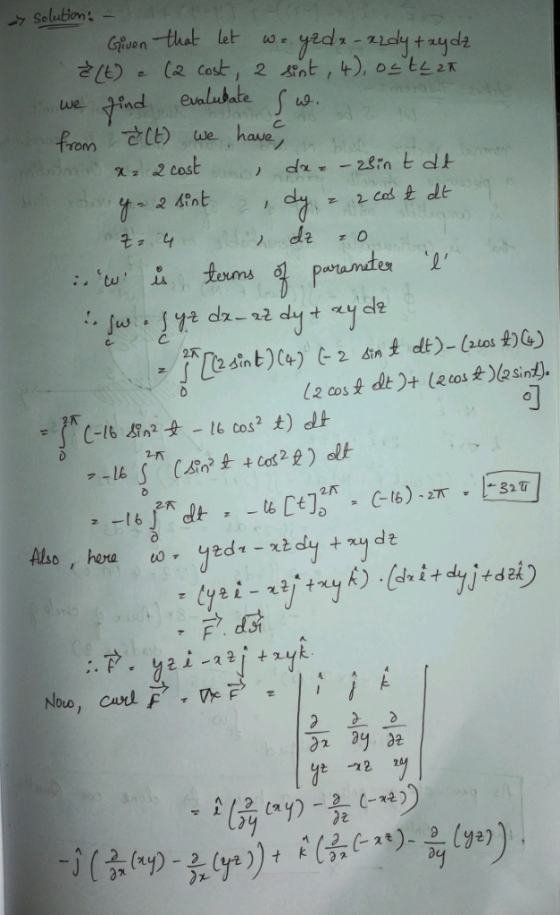
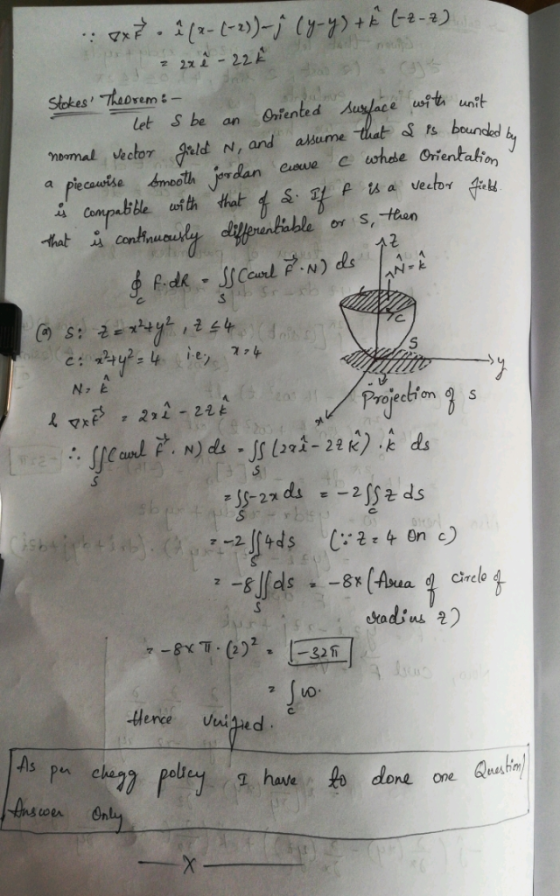
Given ω_yzdr-xzdv +.ndt and C(t)-(2cost2sint,4),0g1s2n a) Let S be the piece of the surface-x* +y...
10. Stokes' Theorem and Surface Integrals of Vector Fields a. Stokes' Theorem: F dr- b. Let S be the surface of the paraboloid z 4-x2-y2 and C is the trace of S in the xy-plane. Draw a sk...
 10. Stokes' Theorem and Surface Integrals of Vector Fields a. Stokes' Theorem: F dr- b. Let S be the surface of the paraboloid z 4-x2-y2 and C is the trace of S in the xy-plane. Draw a sketch of curve C in the xy-plane. Let F(x,y,z) = <2z, x, y?». Compute the curl (F) c. d. Find a parametrization of the surface S: G(u,v)- Compute N(u,v) e. Use Stokes' Theorem to computec F dr
10. Stokes' Theorem and Surface Integrals...
10. Stokes' Theorem and Surface Integrals of Vector Fields a. Stokes' Theorem: F dr- b. Let S be the surface of the paraboloid z 4-x2-y2 and C is the trace of S in the xy-plane. Draw a sketch of curve C in the xy-plane. Let F(x,y,z) = <2z, x, y?». Compute the curl (F) c. d. Find a parametrization of the surface S: G(u,v)- Compute N(u,v) e. Use Stokes' Theorem to computec F dr
10. Stokes' Theorem and Surface Integrals...
10. Stokes Theorem and Surface Integrals of Vector Fields a Stokes Theorem:J F dr- b. Let S be the surface of the paraboloid z 4-x2-y2 and C is the trace of S in the xy-plane. Draw a sketch of cu...
 10. Stokes Theorem and Surface Integrals of Vector Fields a Stokes Theorem:J F dr- b. Let S be the surface of the paraboloid z 4-x2-y2 and C is the trace of S in the xy-plane. Draw a sketch of curve C in the xy-plane. Let F(x,y,z) = <2z, x, y, Compute the curl (F) c. d. Find a parametrization of the surface S: G(u,v)ーーーーーーーーーーーーー Compute N(u,v) e. Use Stokes' Theorem to compute Jc F dr
10. Stokes Theorem and Surface...
10. Stokes Theorem and Surface Integrals of Vector Fields a Stokes Theorem:J F dr- b. Let S be the surface of the paraboloid z 4-x2-y2 and C is the trace of S in the xy-plane. Draw a sketch of curve C in the xy-plane. Let F(x,y,z) = <2z, x, y, Compute the curl (F) c. d. Find a parametrization of the surface S: G(u,v)ーーーーーーーーーーーーー Compute N(u,v) e. Use Stokes' Theorem to compute Jc F dr
10. Stokes Theorem and Surface...
1. Let F(x, y, z) = (-y + ,2-2,2-y), and let S be the surface of...
 1. Let F(x, y, z) = (-y + ,2-2,2-y), and let S be the surface of the paraboloid 2 = 9-32 - v2 for 2 > 0. oriented by an upward pointing normal vector. Note that the boundary of S is C, the circle of radius 3 in the xy-plane. Verify Stokes' Theorem by computing both sides of the equality: (a) (1 Credit) || (D x F). ds (b) (1 Credit) $F. dr
Verify that the line integral and the surface integral of Stokes Theorem are equal far the following vector field, surface S, and closed curve C. Assume that C has counterlockwise orientation and S h...
 Verify that the line integral and the surface integral of Stokes Theorem are equal far the following vector field, surface S, and closed curve C. Assume that C has counterlockwise orientation and S has a consistentorientation F = 〈y,-x, 11), s is the upper half of the sphere x2 + y2 +22-1 and C is the circle x2 + y2-1 in the xy-plane Construct the line integral of Stokes' Theorem using the parameterization r(t)= 〈cost, sint, O. for 0 sts2r...
10. Stokes' Theorem and Surfac e Integrals of Vector Fields a. Stokes' Theorem: F-dr= b. Let S be th ky-plane. Draw a sketch of curve C in the xy-plane. et be the surface of the paraboloi...
 10. Stokes' Theorem and Surfac e Integrals of Vector Fields a. Stokes' Theorem: F-dr= b. Let S be th ky-plane. Draw a sketch of curve C in the xy-plane. et be the surface of the paraboloid z 4-x-y and Cis the trace of S in the c Let Fox.y.z) <2z, x, y>, Compute the curl (F) d. Find a parametrization of the surface S: G(u,v)- Compute N(u,v) F-dr Use Stokes' Theorem to compute , e.
10. Stokes' Theorem and Surfac...
10. Stokes' Theorem and Surfac e Integrals of Vector Fields a. Stokes' Theorem: F-dr= b. Let S be th ky-plane. Draw a sketch of curve C in the xy-plane. et be the surface of the paraboloid z 4-x-y and Cis the trace of S in the c Let Fox.y.z) <2z, x, y>, Compute the curl (F) d. Find a parametrization of the surface S: G(u,v)- Compute N(u,v) F-dr Use Stokes' Theorem to compute , e.
10. Stokes' Theorem and Surfac...
(23 pts) Let F(x, y, z) = ?x + y, x + y, x2 + y2?,...
 (23 pts) Let F(x, y, z) = ?x + y, x + y, x2 + y2?, S be the top
hemisphere of the unit sphere oriented upward, and C the unit
circle in the xy-plane with positive orientation.
(a) Compute div(F) and curl(F).
(b) Is F conservative? Briefly explain.
(c) Use Stokes’ Theorem to compute ? F · dr by converting it to
a surface integral. (The integral is easy if C
you set it up correctly)
4. (23 pts)...
(23 pts) Let F(x, y, z) = ?x + y, x + y, x2 + y2?, S be the top
hemisphere of the unit sphere oriented upward, and C the unit
circle in the xy-plane with positive orientation.
(a) Compute div(F) and curl(F).
(b) Is F conservative? Briefly explain.
(c) Use Stokes’ Theorem to compute ? F · dr by converting it to
a surface integral. (The integral is easy if C
you set it up correctly)
4. (23 pts)...
2. Consider the conical surface S={(x,y,z)∈R3 : x2 + y2 = z2, 0 ≤ z ≤...
 2. Consider the conical surface
S={(x,y,z)∈R3 : x2 + y2 =
z2, 0 ≤ z ≤ 1},
and the vector field
(a) Carefully sketch S, and identify its boundary ∂S.
(b) By parametrising S appropriately, directly compute the flux
integral
S (∇ × f) · dS.
(c) By computing whatever other integral is necessary (and
please be careful about explaining any orien- tation/direction
choices you make), verify Stokes’ theorem for this case.
2. Consider the conical surface
S={(x,y,z)∈R3 : x2 + y2 =
z2, 0 ≤ z ≤ 1},
and the vector field
(a) Carefully sketch S, and identify its boundary ∂S.
(b) By parametrising S appropriately, directly compute the flux
integral
S (∇ × f) · dS.
(c) By computing whatever other integral is necessary (and
please be careful about explaining any orien- tation/direction
choices you make), verify Stokes’ theorem for this case.
Please show full working. Only answer if you know how. Regards (2) Let F-~itrj yk and consider the integral JTs ▽ x F·ń dS where s is the surface of the paraboloid z = 1-2.2-y2 corresponding to z >...
 Please show full working. Only answer if you know how.
Regards
(2) Let F-~itrj yk and consider the integral JTs ▽ x F·ń dS where s is the surface of the paraboloid z = 1-2.2-y2 corresponding to z > 0, and n is a unit normal vector to S in the positive z-direction. (a) Apply Stokes' theorem to evaluate the integral. (b) Evaluate the integral directly over the surface S (c) Evaluate the integral directly over the new surface S...
Please show full working. Only answer if you know how.
Regards
(2) Let F-~itrj yk and consider the integral JTs ▽ x F·ń dS where s is the surface of the paraboloid z = 1-2.2-y2 corresponding to z > 0, and n is a unit normal vector to S in the positive z-direction. (a) Apply Stokes' theorem to evaluate the integral. (b) Evaluate the integral directly over the surface S (c) Evaluate the integral directly over the new surface S...
(2) Let F zi + xj+yk and consider the integral vx Fi n dS where S is the surface of the paraboloid z = 1-x2-y2 corr...
 (2) Let F zi + xj+yk and consider the integral vx Fi n dS where S is the surface of the paraboloid z = 1-x2-y2 corresponding to 0, and n is a unit normal vector to S in the positive z-direction. (a) Apply Stokes' theorem to evaluate the integral. b) Evaluate the integral directly over the surface S. (c) Evaluate the integral directly over the new surface S which is given by the disk
(2) Let F zi + xj+yk...
(2) Let F zi + xj+yk and consider the integral vx Fi n dS where S is the surface of the paraboloid z = 1-x2-y2 corresponding to 0, and n is a unit normal vector to S in the positive z-direction. (a) Apply Stokes' theorem to evaluate the integral. b) Evaluate the integral directly over the surface S. (c) Evaluate the integral directly over the new surface S which is given by the disk
(2) Let F zi + xj+yk...
Consider the vector field F(x, y, z) -(z,2x, 3y) and the surface z- /9 - x2 -y2 (an upper hemisph...
 Consider the vector field F(x, y, z) -(z,2x, 3y) and the surface z- /9 - x2 -y2 (an upper hemisphere of radius 3). (a) Compute the flux of the curl of F across the surface (with upward pointing unit normal vector N). That is, compute actually do the surface integral here. V x F dS. Note: I want you to b) Use Stokes' theorem to compute the integral from part (a) as a circulation integral (c) Use Green's theorem (ie...
 10. Stokes' Theorem and Surface Integrals of Vector Fields a. Stokes' Theorem: F dr- b. Let S be the surface of the paraboloid z 4-x2-y2 and C is the trace of S in the xy-plane. Draw a sketch of curve C in the xy-plane. Let F(x,y,z) = <2z, x, y?». Compute the curl (F) c. d. Find a parametrization of the surface S: G(u,v)- Compute N(u,v) e. Use Stokes' Theorem to computec F dr
10. Stokes' Theorem and Surface Integrals...
10. Stokes' Theorem and Surface Integrals of Vector Fields a. Stokes' Theorem: F dr- b. Let S be the surface of the paraboloid z 4-x2-y2 and C is the trace of S in the xy-plane. Draw a sketch of curve C in the xy-plane. Let F(x,y,z) = <2z, x, y?». Compute the curl (F) c. d. Find a parametrization of the surface S: G(u,v)- Compute N(u,v) e. Use Stokes' Theorem to computec F dr
10. Stokes' Theorem and Surface Integrals...
 10. Stokes Theorem and Surface Integrals of Vector Fields a Stokes Theorem:J F dr- b. Let S be the surface of the paraboloid z 4-x2-y2 and C is the trace of S in the xy-plane. Draw a sketch of curve C in the xy-plane. Let F(x,y,z) = <2z, x, y, Compute the curl (F) c. d. Find a parametrization of the surface S: G(u,v)ーーーーーーーーーーーーー Compute N(u,v) e. Use Stokes' Theorem to compute Jc F dr
10. Stokes Theorem and Surface...
10. Stokes Theorem and Surface Integrals of Vector Fields a Stokes Theorem:J F dr- b. Let S be the surface of the paraboloid z 4-x2-y2 and C is the trace of S in the xy-plane. Draw a sketch of curve C in the xy-plane. Let F(x,y,z) = <2z, x, y, Compute the curl (F) c. d. Find a parametrization of the surface S: G(u,v)ーーーーーーーーーーーーー Compute N(u,v) e. Use Stokes' Theorem to compute Jc F dr
10. Stokes Theorem and Surface...
 1. Let F(x, y, z) = (-y + ,2-2,2-y), and let S be the surface of the paraboloid 2 = 9-32 - v2 for 2 > 0. oriented by an upward pointing normal vector. Note that the boundary of S is C, the circle of radius 3 in the xy-plane. Verify Stokes' Theorem by computing both sides of the equality: (a) (1 Credit) || (D x F). ds (b) (1 Credit) $F. dr
 Verify that the line integral and the surface integral of Stokes Theorem are equal far the following vector field, surface S, and closed curve C. Assume that C has counterlockwise orientation and S has a consistentorientation F = 〈y,-x, 11), s is the upper half of the sphere x2 + y2 +22-1 and C is the circle x2 + y2-1 in the xy-plane Construct the line integral of Stokes' Theorem using the parameterization r(t)= 〈cost, sint, O. for 0 sts2r...
 10. Stokes' Theorem and Surfac e Integrals of Vector Fields a. Stokes' Theorem: F-dr= b. Let S be th ky-plane. Draw a sketch of curve C in the xy-plane. et be the surface of the paraboloid z 4-x-y and Cis the trace of S in the c Let Fox.y.z) <2z, x, y>, Compute the curl (F) d. Find a parametrization of the surface S: G(u,v)- Compute N(u,v) F-dr Use Stokes' Theorem to compute , e.
10. Stokes' Theorem and Surfac...
10. Stokes' Theorem and Surfac e Integrals of Vector Fields a. Stokes' Theorem: F-dr= b. Let S be th ky-plane. Draw a sketch of curve C in the xy-plane. et be the surface of the paraboloid z 4-x-y and Cis the trace of S in the c Let Fox.y.z) <2z, x, y>, Compute the curl (F) d. Find a parametrization of the surface S: G(u,v)- Compute N(u,v) F-dr Use Stokes' Theorem to compute , e.
10. Stokes' Theorem and Surfac...
 (23 pts) Let F(x, y, z) = ?x + y, x + y, x2 + y2?, S be the top
hemisphere of the unit sphere oriented upward, and C the unit
circle in the xy-plane with positive orientation.
(a) Compute div(F) and curl(F).
(b) Is F conservative? Briefly explain.
(c) Use Stokes’ Theorem to compute ? F · dr by converting it to
a surface integral. (The integral is easy if C
you set it up correctly)
4. (23 pts)...
(23 pts) Let F(x, y, z) = ?x + y, x + y, x2 + y2?, S be the top
hemisphere of the unit sphere oriented upward, and C the unit
circle in the xy-plane with positive orientation.
(a) Compute div(F) and curl(F).
(b) Is F conservative? Briefly explain.
(c) Use Stokes’ Theorem to compute ? F · dr by converting it to
a surface integral. (The integral is easy if C
you set it up correctly)
4. (23 pts)...
 2. Consider the conical surface
S={(x,y,z)∈R3 : x2 + y2 =
z2, 0 ≤ z ≤ 1},
and the vector field
(a) Carefully sketch S, and identify its boundary ∂S.
(b) By parametrising S appropriately, directly compute the flux
integral
S (∇ × f) · dS.
(c) By computing whatever other integral is necessary (and
please be careful about explaining any orien- tation/direction
choices you make), verify Stokes’ theorem for this case.
2. Consider the conical surface
S={(x,y,z)∈R3 : x2 + y2 =
z2, 0 ≤ z ≤ 1},
and the vector field
(a) Carefully sketch S, and identify its boundary ∂S.
(b) By parametrising S appropriately, directly compute the flux
integral
S (∇ × f) · dS.
(c) By computing whatever other integral is necessary (and
please be careful about explaining any orien- tation/direction
choices you make), verify Stokes’ theorem for this case.
 Please show full working. Only answer if you know how.
Regards
(2) Let F-~itrj yk and consider the integral JTs ▽ x F·ń dS where s is the surface of the paraboloid z = 1-2.2-y2 corresponding to z > 0, and n is a unit normal vector to S in the positive z-direction. (a) Apply Stokes' theorem to evaluate the integral. (b) Evaluate the integral directly over the surface S (c) Evaluate the integral directly over the new surface S...
Please show full working. Only answer if you know how.
Regards
(2) Let F-~itrj yk and consider the integral JTs ▽ x F·ń dS where s is the surface of the paraboloid z = 1-2.2-y2 corresponding to z > 0, and n is a unit normal vector to S in the positive z-direction. (a) Apply Stokes' theorem to evaluate the integral. (b) Evaluate the integral directly over the surface S (c) Evaluate the integral directly over the new surface S...
 (2) Let F zi + xj+yk and consider the integral vx Fi n dS where S is the surface of the paraboloid z = 1-x2-y2 corresponding to 0, and n is a unit normal vector to S in the positive z-direction. (a) Apply Stokes' theorem to evaluate the integral. b) Evaluate the integral directly over the surface S. (c) Evaluate the integral directly over the new surface S which is given by the disk
(2) Let F zi + xj+yk...
(2) Let F zi + xj+yk and consider the integral vx Fi n dS where S is the surface of the paraboloid z = 1-x2-y2 corresponding to 0, and n is a unit normal vector to S in the positive z-direction. (a) Apply Stokes' theorem to evaluate the integral. b) Evaluate the integral directly over the surface S. (c) Evaluate the integral directly over the new surface S which is given by the disk
(2) Let F zi + xj+yk...
 Consider the vector field F(x, y, z) -(z,2x, 3y) and the surface z- /9 - x2 -y2 (an upper hemisphere of radius 3). (a) Compute the flux of the curl of F across the surface (with upward pointing unit normal vector N). That is, compute actually do the surface integral here. V x F dS. Note: I want you to b) Use Stokes' theorem to compute the integral from part (a) as a circulation integral (c) Use Green's theorem (ie...
Most questions answered within 3 hours.
-
Where is the error in this code sequence?
String s1 = "Hello";
String s2 = "ello";...
asked 11 months ago -
Financial data for Joel de Paris, Inc., for last year
follow:
Joel de Paris, Inc.
Balance...
asked 11 months ago -
Consider this reaction:
Al2(SO4)3 (aq)+ BaCl3
(aq) Al2Cl6 (aq)- +
3BaSO4(s) . What is the...
asked 11 months ago -
Suppose that Savneet is considering increasing her
recent random sample from 20 car rentals to 40...
asked 11 months ago -
Trucks arrive at an unloading terminal at an average rate of 120
per hour.
Trucks arrive...
asked 11 months ago -
Why are methanol and ethanol completely soluble in water while
octanol is not very little soluble....
asked 11 months ago -
A facilities manager at a university reads in a research report
that the mean amount of...
asked 11 months ago -
When the CuSO4 is rehydrated by adding water to the anhydrous
compound, is this an endothermic...
asked 11 months ago -
A ray of sunlight is passing from diamond into crown glass; the
angle of incidence is...
asked 11 months ago -
A block of mass 0.249 kg is placed on top of a light, vertical
spring of...
asked 11 months ago -
how do the kidneys compensate in the presences of acidosis
a) trigger hyperventilate
b) reserve acid...
asked 11 months ago -
Question 501 pts
The rental rate of capital to the firm increases. Which of the
following...
asked 11 months ago