
Homework Answers
Hope it helps you out.
In case any doubt please feel free to ask.
I will be happy to help you.
Thanks!!
Add Answer to:
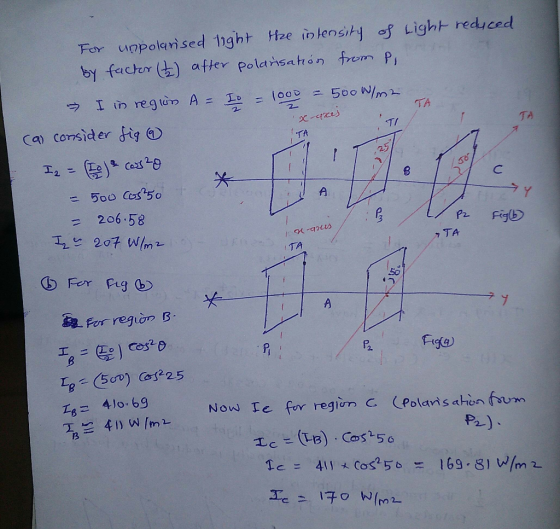
4) a) An unpolarized beam of light with intensity 1000 W/m2 is incident on polarizer P, an ideal ...
A beam of unpolarized sunlight with intensity of 14 W/m2 goes through a ideal polarizer that...
 A
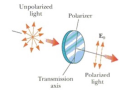
beam of unpolarized sunlight with intensity of 14 W/m2 goes through
a ideal polarizer that has a transmission axis rotated 30° to the
vertical. What is intensity of the beam after it goes through the
polarizer?
Unpolarized light Polarizer E Transmission axis Polarized light
A
beam of unpolarized sunlight with intensity of 14 W/m2 goes through
a ideal polarizer that has a transmission axis rotated 30° to the
vertical. What is intensity of the beam after it goes through the
polarizer?
Unpolarized light Polarizer E Transmission axis Polarized light
Unpolarized light of intensity 100 W/m2 is incident on polarizer #1. After passing through polarizer #1,...
Unpolarized light of intensity 100 W/m2 is incident on polarizer #1. After passing through polarizer #1, the light then passes through polarizer #2 whose transmission axis is at 20 degrees to that of polarizer #1. What is the intensity of the light transmitted through polarizer #2? (in units of W/m2)
Unpolarized light of intensity 60 W/m2 is incident on polarizer #1. After passing through polarizer #1,...
Unpolarized light of intensity 60 W/m2 is incident on polarizer #1. After passing through polarizer #1, the light then passes through polarizer #2 whose transmission axis is at 50 degrees to that of polarizer #1. What is the intensity of the light transmitted through polarizer #2? (in units of W/m2)
Unpolarized light with an intensity of 10.8 W/m2 is incident on a pair of polarizers. The...
Unpolarized light with an intensity of 10.8 W/m2 is incident on a pair of polarizers. The transmission axis of the first polarizer makes an angle 39.3° to the vertical, while the transmission axis of the second polarizer is vertical. (b) Suppose the second polarizer is rotated so that its transmission axis is horizontal. What is the intensity of the light after it passes through both polarizers?
In Experiment 1, unpolarized light of intensity 100 W/m2 is sent through a polarizer A and...
 In Experiment 1, unpolarized light of intensity 100 W/m2 is sent
through a polarizer A and is then incident on a polarizer B with
axis perpendicular to that of Polarizer A. In Experiment 2, a third
polarizer C is placed between A and B such that the polarization
axis of C is 45 degrees from that of A and B. Which of the
following is true?
a. The intensity of light transmitted through B will be 0W/m2 in
Experiment 1...
In Experiment 1, unpolarized light of intensity 100 W/m2 is sent
through a polarizer A and is then incident on a polarizer B with
axis perpendicular to that of Polarizer A. In Experiment 2, a third
polarizer C is placed between A and B such that the polarization
axis of C is 45 degrees from that of A and B. Which of the
following is true?
a. The intensity of light transmitted through B will be 0W/m2 in
Experiment 1...
An unpolarized light beam with intensity I0 is first passed through an ideal polarizer. At this...
An unpolarized light beam with intensity I0 is first passed through an ideal polarizer. At this instant, the light is polarized. We then pass that light through 3 more identical polarizers having parallel axes of transmission to each other. If the transmission axis of the final polarizer makes an angle of 35 ∘∘ with the electric field direction of the polarized light, what is the intensity of the emerging light? An unpolarized light beam with intensity I0 is first passed...
law: I = I0 cos²θ where I0 is the intensity of the polarized light beam just before entering the polarizer
law: I = I0 cos²θ where I0 is the intensity of the polarized light beam just before entering the polarizer, I is the intensity of the transmitted light beam immediately after passing through the polarizer, and is the angular difference between the polarization angle of the incident beam and the transmission axis of the polarizer. After passing through the polarizer, the transmitted light is polarized in the direction of the transmission axis of the polarizing filter. Part DOne way to produce a beam of polarized...
GOAL Understand how polarizing materials affect light intensity. Unpolarized light is incident upon three polarizers. The...
 GOAL Understand how polarizing materials affect light intensity. Unpolarized light is incident upon three polarizers. The first polarizer has a vertical transmission axis, the second has a transmission axis rotated 30.0 degree with respect to the first, and the third has a transmission axis rotated 75.0 degree relative to the first. If the initial light intensity of the beam is I_b, calculate the light intensity after the beam passes through the second polarizer and the third polarizer. After the beam...
Unpolarized light of intensity equal to 15.2 W/m2 is incident upon a polarizer oriented at 30°...
 Unpolarized light of intensity equal to 15.2 W/m2 is incident upon a polarizer oriented at 30° to vertical and a second polarizer (the analyzer) is oriented at 45° to vertical. Find the intensity of light that emerges from the analyzer. 2.
A beam of unpolarized light with intensity I 0 falls first upon a polarizer with transmission...
 A beam of unpolarized light with intensity I 0 falls first
upon a polarizer with transmission axis theta TA,1 then upon a
second polarizer with transmission axis theta TA.2 where theta TA,2
- theta TA,1 =90 degrees in other words the two axes are
perpendicular to one another) What is the intensity I 2 of the
light beam emerging from the second polarizer? ( Figure 4) Express
your answer as a decimal number times the symbol I 0 For example,...
A beam of unpolarized light with intensity I 0 falls first
upon a polarizer with transmission axis theta TA,1 then upon a
second polarizer with transmission axis theta TA.2 where theta TA,2
- theta TA,1 =90 degrees in other words the two axes are
perpendicular to one another) What is the intensity I 2 of the
light beam emerging from the second polarizer? ( Figure 4) Express
your answer as a decimal number times the symbol I 0 For example,...
 A
beam of unpolarized sunlight with intensity of 14 W/m2 goes through
a ideal polarizer that has a transmission axis rotated 30° to the
vertical. What is intensity of the beam after it goes through the
polarizer?
Unpolarized light Polarizer E Transmission axis Polarized light
A
beam of unpolarized sunlight with intensity of 14 W/m2 goes through
a ideal polarizer that has a transmission axis rotated 30° to the
vertical. What is intensity of the beam after it goes through the
polarizer?
Unpolarized light Polarizer E Transmission axis Polarized light
 In Experiment 1, unpolarized light of intensity 100 W/m2 is sent
through a polarizer A and is then incident on a polarizer B with
axis perpendicular to that of Polarizer A. In Experiment 2, a third
polarizer C is placed between A and B such that the polarization
axis of C is 45 degrees from that of A and B. Which of the
following is true?
a. The intensity of light transmitted through B will be 0W/m2 in
Experiment 1...
In Experiment 1, unpolarized light of intensity 100 W/m2 is sent
through a polarizer A and is then incident on a polarizer B with
axis perpendicular to that of Polarizer A. In Experiment 2, a third
polarizer C is placed between A and B such that the polarization
axis of C is 45 degrees from that of A and B. Which of the
following is true?
a. The intensity of light transmitted through B will be 0W/m2 in
Experiment 1...
 GOAL Understand how polarizing materials affect light intensity. Unpolarized light is incident upon three polarizers. The first polarizer has a vertical transmission axis, the second has a transmission axis rotated 30.0 degree with respect to the first, and the third has a transmission axis rotated 75.0 degree relative to the first. If the initial light intensity of the beam is I_b, calculate the light intensity after the beam passes through the second polarizer and the third polarizer. After the beam...
 Unpolarized light of intensity equal to 15.2 W/m2 is incident upon a polarizer oriented at 30° to vertical and a second polarizer (the analyzer) is oriented at 45° to vertical. Find the intensity of light that emerges from the analyzer. 2.
 A beam of unpolarized light with intensity I 0 falls first
upon a polarizer with transmission axis theta TA,1 then upon a
second polarizer with transmission axis theta TA.2 where theta TA,2
- theta TA,1 =90 degrees in other words the two axes are
perpendicular to one another) What is the intensity I 2 of the
light beam emerging from the second polarizer? ( Figure 4) Express
your answer as a decimal number times the symbol I 0 For example,...
A beam of unpolarized light with intensity I 0 falls first
upon a polarizer with transmission axis theta TA,1 then upon a
second polarizer with transmission axis theta TA.2 where theta TA,2
- theta TA,1 =90 degrees in other words the two axes are
perpendicular to one another) What is the intensity I 2 of the
light beam emerging from the second polarizer? ( Figure 4) Express
your answer as a decimal number times the symbol I 0 For example,...
Most questions answered within 3 hours.
-
Where is the error in this code sequence?
String s1 = "Hello";
String s2 = "ello";...
asked 11 months ago -
Financial data for Joel de Paris, Inc., for last year
follow:
Joel de Paris, Inc.
Balance...
asked 11 months ago -
Consider this reaction:
Al2(SO4)3 (aq)+ BaCl3
(aq) Al2Cl6 (aq)- +
3BaSO4(s) . What is the...
asked 11 months ago -
Suppose that Savneet is considering increasing her
recent random sample from 20 car rentals to 40...
asked 11 months ago -
Trucks arrive at an unloading terminal at an average rate of 120
per hour.
Trucks arrive...
asked 11 months ago -
Why are methanol and ethanol completely soluble in water while
octanol is not very little soluble....
asked 11 months ago -
A facilities manager at a university reads in a research report
that the mean amount of...
asked 11 months ago -
When the CuSO4 is rehydrated by adding water to the anhydrous
compound, is this an endothermic...
asked 11 months ago -
A ray of sunlight is passing from diamond into crown glass; the
angle of incidence is...
asked 11 months ago -
A block of mass 0.249 kg is placed on top of a light, vertical
spring of...
asked 11 months ago -
how do the kidneys compensate in the presences of acidosis
a) trigger hyperventilate
b) reserve acid...
asked 11 months ago -
Question 501 pts
The rental rate of capital to the firm increases. Which of the
following...
asked 11 months ago