
Homework Answers
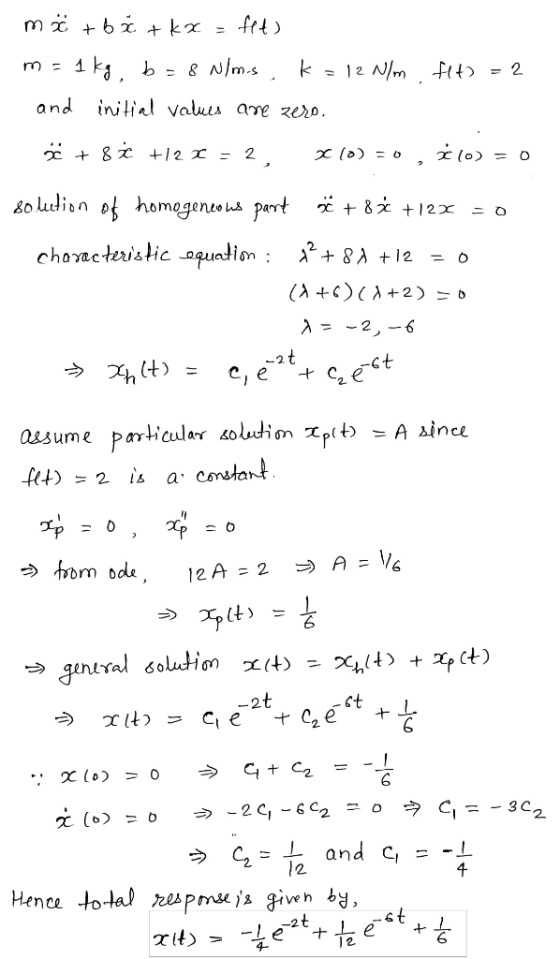

MATLAB code for plot :
t = t = 0:0.01:5;
x = -0.25*exp(-2*t)+(1/12)*exp(-6*t)+(1/6);
plot(t,x);
xlabel('Time t'), ylabel('x(t)');
Add Answer to:
1. There is a mass-spring-damper system as shown in Fig. 1 (a) Find the total response(x(t)). In ...
. (40pts) Consider a spring-mass-damper system shown below, where the input u() is displacement input at...
 . (40pts) Consider a spring-mass-damper system shown below, where the input u() is displacement input at the right end of the spring k3 and x() is the displacement of mass ml. (Note that the input is displacement, NOT force) k3 k1 m2 (a) (10pts) Draw necessary free-body diagrams, and the governing equations of motion of the system. (b) (10pts) Find the transfer function from the input u() to the output x(t). (c) (10pts) Given the system parameter values of m1-m2-1,...
Given the the mass-spring-damper system in Figure 3.10, assume that the contact forces are viscous friction....
 Given the the mass-spring-damper system in Figure 3.10, assume
that the contact forces are viscous friction. 1. State the number
of degrees of freedom in the system.
2. Derive the equations of motion and state them in matrix
notation. 3. If f(t) = a (a constant), what is the long term state
of the system? 4. If the forcing is f(t) = A sin(ωt), and the
system parameters are given in Table 3.1, simulate the response
from rest. Plot all...
Given the the mass-spring-damper system in Figure 3.10, assume
that the contact forces are viscous friction. 1. State the number
of degrees of freedom in the system.
2. Derive the equations of motion and state them in matrix
notation. 3. If f(t) = a (a constant), what is the long term state
of the system? 4. If the forcing is f(t) = A sin(ωt), and the
system parameters are given in Table 3.1, simulate the response
from rest. Plot all...
mmHg 10-26. The displacement y(t) of a spring-mass system shown in Fig. P10.26 is given by 0.25 y(t)+ 10 y()0 (a) Find the transient solution, yrun() (b) Find the steady-state solution of the disp...
 mmHg 10-26. The displacement y(t) of a spring-mass system shown in Fig. P10.26 is given by 0.25 y(t)+ 10 y()0 (a) Find the transient solution, yrun() (b) Find the steady-state solution of the displacement ys (c) Determine the total displacement y(t) if the initial displacement y(0) 0.2 m and the initial veloc- ity y(0)-0 m/s (d) Sketch the total displacement y(t). k 10 N/m 0.25 kg y0)
mmHg 10-26. The displacement y(t) of a spring-mass system shown in Fig. P10.26...
mmHg 10-26. The displacement y(t) of a spring-mass system shown in Fig. P10.26 is given by 0.25 y(t)+ 10 y()0 (a) Find the transient solution, yrun() (b) Find the steady-state solution of the displacement ys (c) Determine the total displacement y(t) if the initial displacement y(0) 0.2 m and the initial veloc- ity y(0)-0 m/s (d) Sketch the total displacement y(t). k 10 N/m 0.25 kg y0)
mmHg 10-26. The displacement y(t) of a spring-mass system shown in Fig. P10.26...
3 dismo plesis The spring mass damper system shown is subjected to a force f(t), which...
 3
dismo plesis
The spring mass damper system shown is subjected to a force f(t), which is a step function. b m f(t) At time t=0, with zero initial conditions, the system is subjected to the force. The magnitude of the force is 4 newton, while the spring rate is 8.2 newton/meter, and the damping coefficient is 10 newton-sec/meter. Calculate the energy stored in the spring, in Joules, in steady state.
3
dismo plesis
The spring mass damper system shown is subjected to a force f(t), which is a step function. b m f(t) At time t=0, with zero initial conditions, the system is subjected to the force. The magnitude of the force is 4 newton, while the spring rate is 8.2 newton/meter, and the damping coefficient is 10 newton-sec/meter. Calculate the energy stored in the spring, in Joules, in steady state.
A mass-spring-damper system is shown below. If a periodic external forceAssume: r acts on the mass...
 A mass-spring-damper system is shown below. If a periodic external forceAssume: r acts on the mass as graphed below, what is the steady state response of the system? D= Spring Mass m External force r(t) Dashpot Vibrating system under considerati r(t) ?/2
Problem 1. Consider the following mass, spring, and damper system. Let the force F be the...
 Problem 1. Consider the following mass, spring, and damper system. Let the force F be the input and the position x be the output. M-1 kg b- 10 N s/m k 20 N/nm F = 1 N when t>=0 PART UNIT FEEDBACK CONTROL SYSTEM 5) Construct a unit feedback control for the mass-spring-damper system 6) Draw the block diagram of the unit feedback control system 7) Find the Transfer Function of the closed-loop (CL) system 8) Find and plot the...
Consider the following second-order ODE representing a spring-mass-damper system for zero initial...
 Consider the following second-order ODE representing a spring-mass-damper system for zero initial conditions (forced response): where u is the Unit Step Function (of magnitude 1 a. Use MATLAB to obtain an analytical solution x() for the differential equation, using the Laplace Transforms approach (do not use DSOLVE). Obtain the analytical expression for ao. Also obtain a plot of x() (for a simulation of 14 seconds) b. Obtain the Transfer Function representation for the system. c. Use MATLAB to obtain the...
A. 1st Order Systems Consider the spring-damper system shown in Figure 1. Figure 1: spring-damper system...
 A. 1st Order Systems Consider the spring-damper system shown in Figure 1. Figure 1: spring-damper system (1)Draw FBD and deduce EOM. Clearly state your assumptions. (2)Cast EOM as an ODE in standard form; write the time constant T and the forcing function f(t) in terms of k,c, f*(1) (3) Write the solution x(t) as the sum x(t) = x (1)+x,() and do the following: a) give the name of x (1) b) write the equation that x(!) must satisfy and...
Problem 2 - A modified mass-spring-damper system: Model the modified mass-spring-damper system shown below. The mass...
 Problem 2 - A modified mass-spring-damper system: Model the modified mass-spring-damper system shown below. The mass of the handle is negligi- ble (only 1 FBD is necessary). Consider the displacement (t) to be the input to the system and the cart displacement az(t) to be the output. You may assume negligible drag. MwSpring-Damper System M0 Problem 3 Repeat problem 2, but with the following differences: • Assume the mass of the handle m, is not equal to zero. You may...
For the single DOF spring-mass-damper system shown, the displacement of the mass is x. Assume m-...
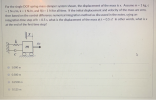 For the single DOF spring-mass-damper system shown, the displacement of the mass is x. Assume m- 1 kg, c 1 N-s/m, k = 1 N/m, and f(t)-1 N for all time. If the initial displacement and velocity of the mass are zero, then based on the central difference numerical integration method as discussed in the notes, using an integration time step of h 0.5 s, what is the displacement of the mass at t 0.5 s? In other words, what...
 . (40pts) Consider a spring-mass-damper system shown below, where the input u() is displacement input at the right end of the spring k3 and x() is the displacement of mass ml. (Note that the input is displacement, NOT force) k3 k1 m2 (a) (10pts) Draw necessary free-body diagrams, and the governing equations of motion of the system. (b) (10pts) Find the transfer function from the input u() to the output x(t). (c) (10pts) Given the system parameter values of m1-m2-1,...
 Given the the mass-spring-damper system in Figure 3.10, assume
that the contact forces are viscous friction. 1. State the number
of degrees of freedom in the system.
2. Derive the equations of motion and state them in matrix
notation. 3. If f(t) = a (a constant), what is the long term state
of the system? 4. If the forcing is f(t) = A sin(ωt), and the
system parameters are given in Table 3.1, simulate the response
from rest. Plot all...
Given the the mass-spring-damper system in Figure 3.10, assume
that the contact forces are viscous friction. 1. State the number
of degrees of freedom in the system.
2. Derive the equations of motion and state them in matrix
notation. 3. If f(t) = a (a constant), what is the long term state
of the system? 4. If the forcing is f(t) = A sin(ωt), and the
system parameters are given in Table 3.1, simulate the response
from rest. Plot all...
 mmHg 10-26. The displacement y(t) of a spring-mass system shown in Fig. P10.26 is given by 0.25 y(t)+ 10 y()0 (a) Find the transient solution, yrun() (b) Find the steady-state solution of the displacement ys (c) Determine the total displacement y(t) if the initial displacement y(0) 0.2 m and the initial veloc- ity y(0)-0 m/s (d) Sketch the total displacement y(t). k 10 N/m 0.25 kg y0)
mmHg 10-26. The displacement y(t) of a spring-mass system shown in Fig. P10.26...
mmHg 10-26. The displacement y(t) of a spring-mass system shown in Fig. P10.26 is given by 0.25 y(t)+ 10 y()0 (a) Find the transient solution, yrun() (b) Find the steady-state solution of the displacement ys (c) Determine the total displacement y(t) if the initial displacement y(0) 0.2 m and the initial veloc- ity y(0)-0 m/s (d) Sketch the total displacement y(t). k 10 N/m 0.25 kg y0)
mmHg 10-26. The displacement y(t) of a spring-mass system shown in Fig. P10.26...
 3
dismo plesis
The spring mass damper system shown is subjected to a force f(t), which is a step function. b m f(t) At time t=0, with zero initial conditions, the system is subjected to the force. The magnitude of the force is 4 newton, while the spring rate is 8.2 newton/meter, and the damping coefficient is 10 newton-sec/meter. Calculate the energy stored in the spring, in Joules, in steady state.
3
dismo plesis
The spring mass damper system shown is subjected to a force f(t), which is a step function. b m f(t) At time t=0, with zero initial conditions, the system is subjected to the force. The magnitude of the force is 4 newton, while the spring rate is 8.2 newton/meter, and the damping coefficient is 10 newton-sec/meter. Calculate the energy stored in the spring, in Joules, in steady state.
 A mass-spring-damper system is shown below. If a periodic external forceAssume: r acts on the mass as graphed below, what is the steady state response of the system? D= Spring Mass m External force r(t) Dashpot Vibrating system under considerati r(t) ?/2
 Problem 1. Consider the following mass, spring, and damper system. Let the force F be the input and the position x be the output. M-1 kg b- 10 N s/m k 20 N/nm F = 1 N when t>=0 PART UNIT FEEDBACK CONTROL SYSTEM 5) Construct a unit feedback control for the mass-spring-damper system 6) Draw the block diagram of the unit feedback control system 7) Find the Transfer Function of the closed-loop (CL) system 8) Find and plot the...
 Consider the following second-order ODE representing a spring-mass-damper system for zero initial conditions (forced response): where u is the Unit Step Function (of magnitude 1 a. Use MATLAB to obtain an analytical solution x() for the differential equation, using the Laplace Transforms approach (do not use DSOLVE). Obtain the analytical expression for ao. Also obtain a plot of x() (for a simulation of 14 seconds) b. Obtain the Transfer Function representation for the system. c. Use MATLAB to obtain the...
 A. 1st Order Systems Consider the spring-damper system shown in Figure 1. Figure 1: spring-damper system (1)Draw FBD and deduce EOM. Clearly state your assumptions. (2)Cast EOM as an ODE in standard form; write the time constant T and the forcing function f(t) in terms of k,c, f*(1) (3) Write the solution x(t) as the sum x(t) = x (1)+x,() and do the following: a) give the name of x (1) b) write the equation that x(!) must satisfy and...
 Problem 2 - A modified mass-spring-damper system: Model the modified mass-spring-damper system shown below. The mass of the handle is negligi- ble (only 1 FBD is necessary). Consider the displacement (t) to be the input to the system and the cart displacement az(t) to be the output. You may assume negligible drag. MwSpring-Damper System M0 Problem 3 Repeat problem 2, but with the following differences: • Assume the mass of the handle m, is not equal to zero. You may...
 For the single DOF spring-mass-damper system shown, the displacement of the mass is x. Assume m- 1 kg, c 1 N-s/m, k = 1 N/m, and f(t)-1 N for all time. If the initial displacement and velocity of the mass are zero, then based on the central difference numerical integration method as discussed in the notes, using an integration time step of h 0.5 s, what is the displacement of the mass at t 0.5 s? In other words, what...
Most questions answered within 3 hours.
-
Where is the error in this code sequence?
String s1 = "Hello";
String s2 = "ello";...
asked 11 months ago -
Financial data for Joel de Paris, Inc., for last year
follow:
Joel de Paris, Inc.
Balance...
asked 11 months ago -
Consider this reaction:
Al2(SO4)3 (aq)+ BaCl3
(aq) Al2Cl6 (aq)- +
3BaSO4(s) . What is the...
asked 11 months ago -
Suppose that Savneet is considering increasing her
recent random sample from 20 car rentals to 40...
asked 11 months ago -
Trucks arrive at an unloading terminal at an average rate of 120
per hour.
Trucks arrive...
asked 11 months ago -
Why are methanol and ethanol completely soluble in water while
octanol is not very little soluble....
asked 11 months ago -
A facilities manager at a university reads in a research report
that the mean amount of...
asked 11 months ago -
When the CuSO4 is rehydrated by adding water to the anhydrous
compound, is this an endothermic...
asked 11 months ago -
A ray of sunlight is passing from diamond into crown glass; the
angle of incidence is...
asked 11 months ago -
A block of mass 0.249 kg is placed on top of a light, vertical
spring of...
asked 11 months ago -
how do the kidneys compensate in the presences of acidosis
a) trigger hyperventilate
b) reserve acid...
asked 11 months ago -
Question 501 pts
The rental rate of capital to the firm increases. Which of the
following...
asked 11 months ago