
Homework Answers
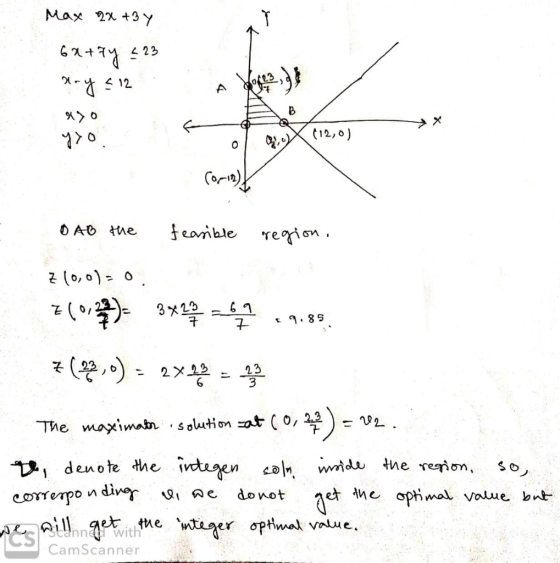
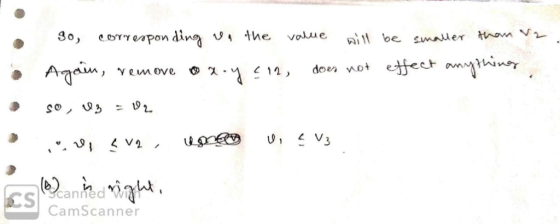
plz feel free to comment in case of doubts as i am happy to help you. Plz upvote the solution if u r satisfied. It means a lot to me , thanks
Find the complete optimal solution to this linear programming problem. Max 5x + 3y s.t. 2x...
Find the complete optimal solution to this linear programming problem. Max 5x + 3y s.t. 2x + 3y £ 30 2x + 5y £ 40 6x - 5y £ 0 x , y ³ 0
Consider the following linear program: Max 2X + 3Y s.t. 5X +5Y ≤ 400 -1X+ 1Y...
Consider the following linear program: Max 2X + 3Y s.t. 5X +5Y ≤ 400 -1X+ 1Y ≥ 10 1X + 3Y ≥ 90 X, Y ≥ 0 a. Use the graphical solution procedure to find the optimal solution. b. Conduct a sensitivity analysis to determine the range of optimality for the objective function coefficients X & Y. c. What are the binding constraints? d. If the right-hand-side of the binding constraints are marginally increased, what will be the Dual Value?
Let (IP) be the following integer program: max (0, -1). s.t. 1-1 -107 -10 10 -11</-0.5...
 Let (IP) be the following integer program: max (0, -1). s.t. 1-1 -107 -10 10 -11</-0.5 1-10 / 0 z integer Let (LP) be the LP relaxation of (IP). We draw the feasible region of (LP) here. 2. . . . . . . to (LP), and prove that it is optimal by providing a (a) Determine an optimal solution certificate of optimality.
Question 1. (30 points) You are provided with the following integer program: max := 3x +...
 Question 1. (30 points) You are provided with the following integer program: max := 3x + y 8.t. x + 1.6y S8 - 5 + 6x = 15 35.5 x,y20 and integer (a) On the graph provided on the following page, use the graphical solution method to identify the feasible points on your graph. (Use the scale 1 by 1 for each small square so that you can visually detect the feasible integer solutions.) (b) Enumerate the feasible extreme points...
Consider the following linear program Max 3xl +2x2 S.t 1x1 + 1x2 〈 10 3x1 1x2...
 Consider the following linear program Max 3xl +2x2 S.t 1x1 + 1x2 〈 10 3x1 1x2 〈 24 1xl t 2x2< 16 And xl, x2> 0. a) Use Excel Solver to find the optimal solution to this problem. State the optimal values of xl, x2, and Z. b) Assume that the objective function coefficient for xl changes from 3 to 5. Does the optimal solution change? c) Assume that the objective function coefficient for x1 remains 3, but the objective...
Solve the following using Optimization 1) Using substitution: U = 2 ln(x) + ln(y) s.t. 2x...
Solve the following using Optimization 1) Using substitution: U = 2 ln(x) + ln(y) s.t. 2x + y = 20 2) Using LaGrangian: U = √x + ln(y) s.t. x+y=10 3) Using both: U = 5 ln(x) + 3 ln(y) s.t. 4x + 3y = 100
Question 3 Solve the following linear program: Max 3x+2y s.t. 2x+2y <8 A 3x+2y < 12...
 Question 3 Solve the following linear program: Max 3x+2y s.t. 2x+2y <8 A 3x+2y < 12 B 1x+0.5y < 3C x,y> 0 w How much slack is in constraint B? 2 units of slack O 10 units of slack O 2 units of surplus 10 units of surplus
Consider the following constraints and the corresponding graph below: Constraint 1 Constraint 2:x+2ys8 Constraint 3 x-3y...
 Consider the following constraints and the corresponding graph below: Constraint 1 Constraint 2:x+2ys8 Constraint 3 x-3y 2-2 2x-v21 2r-y-1 4 4 6 b. (3 points) The objective function is Minimize 2x-3y. Mark the optimal solution(s) n the above graph. Do not calculate the x and y coordinates at optimal solution(s). Draw the optimal objective function line through the optimal solution(s)
a)Consider the following nonlinear programming problem. max−4x^2 + |3x − 9| + 3 − x s.t....
a)Consider the following nonlinear programming problem. max−4x^2 + |3x − 9| + 3 − x s.t. x belongs to [−5, 5] Which of the following is the solution to the nonlinear programming problem? (Explanation Please) A. x = −5. B. x = 5. C. x = −1/2. D. x = 3. b)Consider the following nonlinear programming problem. max x^2 + |2x − 4| + 2 − 3x s.t. x belongs to [−5, 5] Which of the following is the set...
M 4. Consider the utility maximization problem max U(x,y) = x +y s.t. x + 4y...
 M 4. Consider the utility maximization problem max U(x,y) = x +y s.t. x + 4y = 100. (a) Using the Lagrange method, find the quantities demanded of the two goods. (b) Suppose income increases from 100 to 101. What is the exact increase in the optimal value of U(x, y)? Compare with the value found in (a) for the Lagrange multiplier. (C) Suppose we change the budget constraint to px + y = m, but keep the same utility...
 Let (IP) be the following integer program: max (0, -1). s.t. 1-1 -107 -10 10 -11</-0.5 1-10 / 0 z integer Let (LP) be the LP relaxation of (IP). We draw the feasible region of (LP) here. 2. . . . . . . to (LP), and prove that it is optimal by providing a (a) Determine an optimal solution certificate of optimality.
 Question 1. (30 points) You are provided with the following integer program: max := 3x + y 8.t. x + 1.6y S8 - 5 + 6x = 15 35.5 x,y20 and integer (a) On the graph provided on the following page, use the graphical solution method to identify the feasible points on your graph. (Use the scale 1 by 1 for each small square so that you can visually detect the feasible integer solutions.) (b) Enumerate the feasible extreme points...
 Consider the following linear program Max 3xl +2x2 S.t 1x1 + 1x2 〈 10 3x1 1x2 〈 24 1xl t 2x2< 16 And xl, x2> 0. a) Use Excel Solver to find the optimal solution to this problem. State the optimal values of xl, x2, and Z. b) Assume that the objective function coefficient for xl changes from 3 to 5. Does the optimal solution change? c) Assume that the objective function coefficient for x1 remains 3, but the objective...
 Question 3 Solve the following linear program: Max 3x+2y s.t. 2x+2y <8 A 3x+2y < 12 B 1x+0.5y < 3C x,y> 0 w How much slack is in constraint B? 2 units of slack O 10 units of slack O 2 units of surplus 10 units of surplus
 Consider the following constraints and the corresponding graph below: Constraint 1 Constraint 2:x+2ys8 Constraint 3 x-3y 2-2 2x-v21 2r-y-1 4 4 6 b. (3 points) The objective function is Minimize 2x-3y. Mark the optimal solution(s) n the above graph. Do not calculate the x and y coordinates at optimal solution(s). Draw the optimal objective function line through the optimal solution(s)
 M 4. Consider the utility maximization problem max U(x,y) = x +y s.t. x + 4y = 100. (a) Using the Lagrange method, find the quantities demanded of the two goods. (b) Suppose income increases from 100 to 101. What is the exact increase in the optimal value of U(x, y)? Compare with the value found in (a) for the Lagrange multiplier. (C) Suppose we change the budget constraint to px + y = m, but keep the same utility...
Most questions answered within 3 hours.
-
Where is the error in this code sequence?
String s1 = "Hello";
String s2 = "ello";...
asked 11 months ago -
Financial data for Joel de Paris, Inc., for last year
follow:
Joel de Paris, Inc.
Balance...
asked 11 months ago -
Consider this reaction:
Al2(SO4)3 (aq)+ BaCl3
(aq) Al2Cl6 (aq)- +
3BaSO4(s) . What is the...
asked 11 months ago -
Suppose that Savneet is considering increasing her
recent random sample from 20 car rentals to 40...
asked 11 months ago -
Trucks arrive at an unloading terminal at an average rate of 120
per hour.
Trucks arrive...
asked 11 months ago -
Why are methanol and ethanol completely soluble in water while
octanol is not very little soluble....
asked 11 months ago -
A facilities manager at a university reads in a research report
that the mean amount of...
asked 11 months ago -
When the CuSO4 is rehydrated by adding water to the anhydrous
compound, is this an endothermic...
asked 11 months ago -
A ray of sunlight is passing from diamond into crown glass; the
angle of incidence is...
asked 11 months ago -
A block of mass 0.249 kg is placed on top of a light, vertical
spring of...
asked 11 months ago -
how do the kidneys compensate in the presences of acidosis
a) trigger hyperventilate
b) reserve acid...
asked 11 months ago -
Question 501 pts
The rental rate of capital to the firm increases. Which of the
following...
asked 11 months ago